

Engineered For Studio Durability — reinforced steel frames and sealed carriage bearings deliver consistent glide through thousands of high-frequency Pilates sessions without wobble or spring fatigue.
Technical Specifications
| Parameter | Value |
|---|---|
| Product Type | Pilates Cadillac Reformer |
| Model NO. | SRY-01A |
| Specification | 2400 × 770 × 2160 mm |
| Net Weight | 150 kgs |
| Resistance Type | Commercial-grade spring and pulley system |
| Included Accessories | Long Box / Jump Board / Platform |
| Color Options | Solid Color (customizable) |
| Logo | Customized Is Allowed |
| Target User | Adult / Unisex |
| Warranty | 3 Years |
| Production Capacity | 80 Pieces/Month |
Application Suitability
| Deployment Scenario | Typical Use |
|---|---|
| Boutique Pilates studio | Daily group reformer classes with high-throughput carriage cycles |
| Five-star hotel wellness center | Private and semi-private Pilates suites for guest programming |
| Rehabilitation and physiotherapy clinic | Low-impact resistance training with precise spring tension control |
| Yoga and mind-body fitness studio | Cross-discipline equipment supporting flexibility and core work |
| Private high-end home gym | Dedicated Pilates practice with full accessory configuration |
Why Carriage Wobble Ends Client Retention Before Management Notices
A misaligned carriage turns a premium studio class into a liability within the first hundred sessions.
Boutique studios and hotel wellness floors that deploy Pilates equipment at commercial frequency often discover carriage instability and spring fatigue before the quarterly maintenance window arrives. Members notice the uneven glide during footwork sequences and mention it at the front desk — or simply stop booking [NEED_CITE: carriage bearing wear patterns under group class duty cycles]. When the reformer cannot hold a straight line under lateral load, instructors spend class time compensating instead of cueing. This is the failure mode that erodes membership renewal rates long before any frame or spring visibly degrades.
Positioning Within a Commercial Pilates Zone
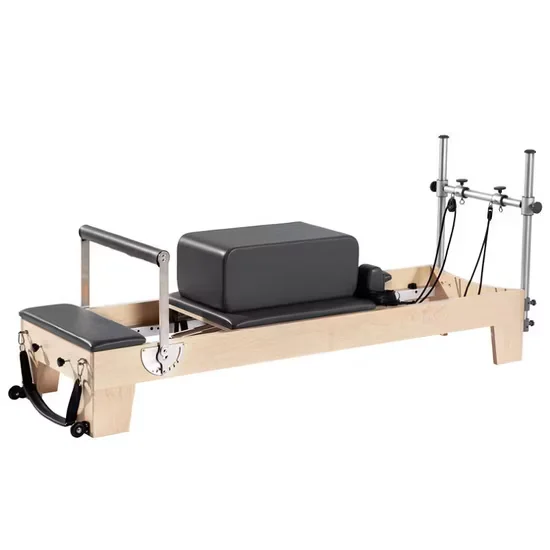
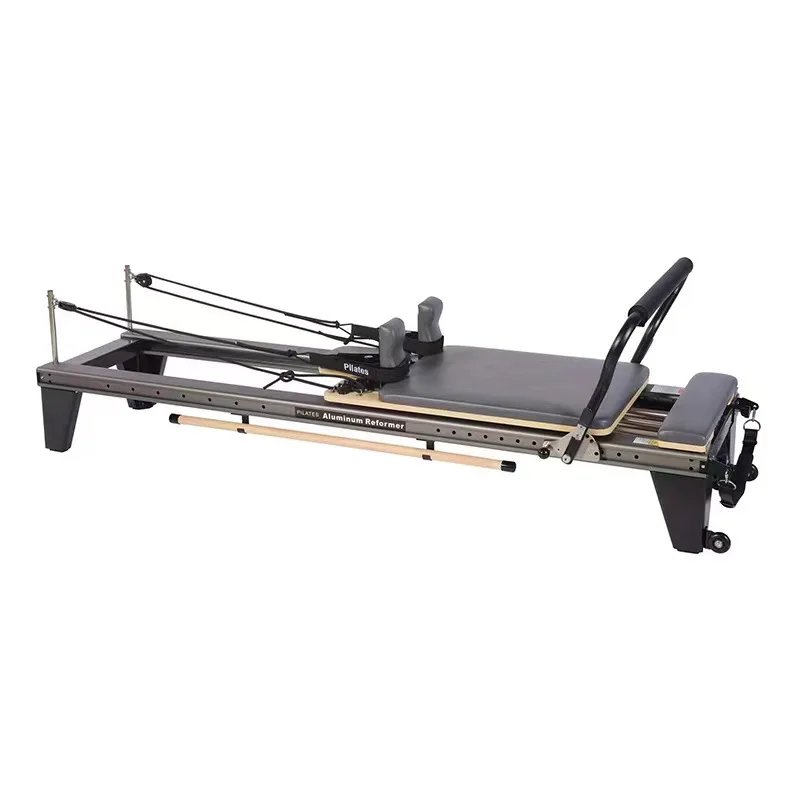
This commercial Pilates Cadillac reformer machine covers the full spectrum of mat-to-apparatus programming, from supine footwork on the carriage to overhead trapeze work on the Cadillac tower. In a studio layout, it pairs with mat stations for warm-up flow and sits as the primary apparatus for semi-private sessions where clients move between spring-loaded resistance and bodyweight suspension. The 2400 × 770 mm footprint suits facilities allocating dedicated apparatus bays, and the 2160 mm tower height accommodates overhead reach work for users across a broad range of statures. Spring resistance adjusts incrementally, allowing instructors to progress clients from rehabilitation-level tension through advanced athletic loading without swapping hardware.
Continuous Studio Throughput and Facility Requirements
A reformer scheduled for four to six group classes daily accumulates thousands of carriage cycles per week, placing sustained demand on bearing surfaces and spring anchors [NEED_CITE: commercial Pilates apparatus duty cycle standards]. The sealed bearing carriage system on this unit is built to maintain smooth travel under that repetition volume without requiring weekly lubrication interventions. Deployment on upper floors of hotel properties demands attention to vibration transmission through the steel frame into the subfloor — a level installation surface with appropriate isolation padding prevents structure-borne noise from reaching occupied rooms below. Adequate ceiling clearance must exceed the 2160 mm tower height plus full overhead arm reach, and surrounding clearance on all sides allows safe accessory transitions during class flow.
Spring, Pulley, and Carriage Mechanics Explained
The spring and pulley system on this commercial Pilates Cadillac reformer machine provides progressive resistance that increases proportionally with carriage displacement — a mechanical behavior fundamentally different from the fixed-step increments of magnetic or pin-selected weight stacks. Commercial-grade springs maintain their rate consistency across high-repetition duty cycles, whereas light-duty springs lose tension and develop permanent set under daily studio loading. The sealed bearing carriage eliminates the metal-on-metal friction that causes audible scraping and uneven travel as open bushings wear. A reinforced steel frame resists the lateral and torsional loads generated during single-leg work and jump board sequences, preventing the frame flex that gradually misaligns the carriage track [NEED_CITE: reinforced frame requirements for commercial Pilates equipment]. The included long box, jump board, and platform attach to standardized mounting points, allowing full-discipline programming without aftermarket adapters.
The Hidden Cost of Specifying Below Commercial Grade
Studios that purchase light-duty reformers for commercial class schedules typically encounter spring fatigue and carriage play within the first year of operation. The springs lose their calibrated rate, forcing instructors to verbally compensate for uneven resistance between left and right sides — a problem members feel before they can articulate. Carriage wobble under jump board use becomes a safety concern that pulls equipment out of rotation mid-semester. When multiple units across a studio floor degrade at different rates, the inconsistency between stations undermines the synchronized class format that boutique Pilates depends on [NEED_CITE: apparatus consistency requirements for group Pilates instruction]. The resulting equipment swap cycle costs more than specifying commercial-grade components from the start.
Why This Product Line Fits Facility Deployment
The reinforced steel frame and sealed carriage bearings on this unit are validated for the high-frequency use patterns typical of studio class schedules rather than light personal practice. The full accessory package — long box, jump board, and platform — arrives as a matched set, eliminating the compatibility gaps that appear when accessories are sourced separately. OEM customization covers logo application and color finish, allowing the equipment to align with studio branding without aftermarket vinyl or paint. When planning a multi-unit Cadillac zone, our team provides a 3D layout covering unit spacing, instructor sightlines, and member circulation paths so the deployment functions operationally from day one. Technical support remains available around the clock for spring replacement guidance and carriage adjustment queries.
Documentation & Test Records
- Frame load-bearing test report for reinforced steel construction
- Carriage glide durability record under high-repetition cycling
- Spring resistance specification and replacement cycle documentation
- Accessory mounting compatibility confirmation for long box, jump board, platform
- OEM customization scope and branding application guide
- Installation and commissioning reference for studio deployment
Installation, Commissioning & Maintenance
- Allocate minimum clearance on all four sides of the 2400 × 770 mm footprint for safe accessory transitions
- Verify ceiling height exceeds 2160 mm tower plus full overhead arm extension before anchoring
- Level the steel frame on a flat surface with isolation padding to prevent vibration transmission
- Inspect carriage bearing travel and spring anchor tension during initial commissioning before client use
- Schedule periodic spring rate verification and carriage track cleaning based on weekly class volume
- Apply sweat-resistant wipe-down protocols to the steel frame and upholstery after each session
Planning Your Pilates Apparatus Deployment
Provide your studio floor plan and target class schedule so we can generate a 3D layout covering unit spacing, member flow, and instructor sightlines specific to this commercial Pilates Cadillac reformer machine. Confirm ceiling height and subfloor type to verify safe tower clearance and vibration isolation requirements. Specify your target market so accessory packaging and documentation align with local compliance expectations. Indicate whether logo customization, color matching, or console branding is required for your facility identity so we scope the OEM package accurately.
Frequently Asked Questions
Q: What accessories are included and can they be upgraded or swapped?
A: This unit ships with a long box, jump board, and platform as standard accessories, each attaching to standardized mounting points on the frame. Additional or alternative accessories may be available depending on production scheduling and accessory catalog availability. Confirm your specific accessory requirements during the inquiry stage so we can verify compatibility and include them in the production scope before the order enters the manufacturing queue.
Q: How does the carriage bearing system maintain smooth glide over high-repetition use?
A: The carriage runs on sealed bearings rather than open bushings, which prevents dust and debris from entering the contact surfaces during daily studio operation. This sealed design maintains consistent glide without requiring frequent lubrication. Periodic visual inspection of the carriage track and bearing housing is recommended to confirm alignment, particularly in facilities running multiple group classes per day on the same unit.
Q: What is the expected spring replacement cycle under daily studio-class conditions?
A: Spring lifespan depends directly on weekly class volume and the resistance levels most frequently used during programming. Commercial-grade springs on this unit are specified for the repetition counts typical of group reformer classes, but studios running high-intensity jump board sequences daily may reach replacement intervals sooner. Request the spring resistance specification and replacement cycle documentation during the inquiry process to plan your maintenance schedule accordingly.
Q: Can the frame and finish be customized to match studio branding?
A: Yes. The frame color is available in solid color options, and logo customization is permitted on applicable surfaces. During the OEM scoping stage we confirm logo placement, color codes, and any additional branding elements you require. Provide your brand guidelines early in the inquiry so customization details are locked before the proforma invoice is issued and production begins.
Q: What floor space and ceiling height are required for safe Cadillac deployment?
A: The unit measures 2400 × 770 mm in footprint with a 2160 mm tower height. Ceiling clearance must exceed the tower height plus the tallest user’s full overhead arm reach. Surrounding clearance on all sides should allow safe mounting and dismounting of the long box, jump board, and platform during class transitions. Provide your room dimensions so we can confirm fit within your planned apparatus zone layout.
![Yoga Training Pilates Equipment Maple Wood Pilates Reformer BedStudio Grade Pilates Reformer for Commercial Gym Use with OEM Support[WARN] draft identifier mismatch](https://bicksport.com/wp-content/uploads/2026/08/yoga-training-pilates-equipment-maple-wood-pilates-reformer-bedstudio-grade-pilates-reformer-for-commercial-gym-use-with-oem-supportwarn-draft-identifier-mismatch-7be1dc.webp)