
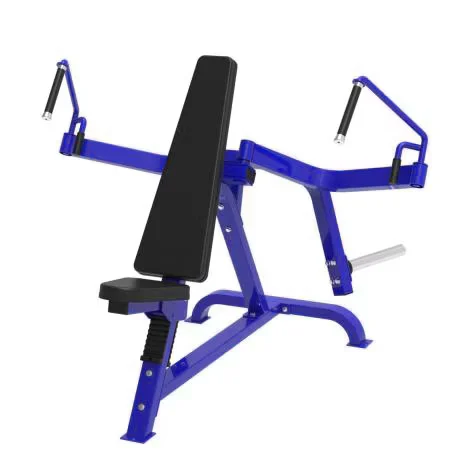
![Hip and Glute 5076 Commercial Strength Trainer for Gym & Club [WARN] draft identifier mismatch](https://bicksport.com/wp-content/uploads/2026/08/hip-and-glute-5076-commercial-strength-trainer-for-gym-club-warn-draft-identifier-mismatch-3b7f47.webp)
Steel-Frame Rigidity — Every 5076 Hip and Glute Trainer undergoes continuous high-load cycling in our testing lab to verify weld integrity and resonance suppression before it leaves the factory floor.
Technical Specifications
| Parameter | Value |
|---|---|
| Designation | 5076 |
| Power Source | Manual |
| Resistance Type | Manual / friction-based |
| Material | Steel |
| Exercise Part | Hip and Glute |
| Product Dimensions | 1250 × 1750 × 1090 mm |
| Net Weight | 65 kg |
| Foldable | Unfolded |
| Certification | ISO 9001, CE |
| OEM/ODM | Available |
| Fit Area | Professional Gym and Club |
Application Suitability
| Deployment Scenario | Typical Use |
|---|---|
| Chain gym strength zone | High-frequency hip thrust and glute isolation circuits during peak member traffic |
| Community fitness center | Supervised lower-body strength sessions for general membership across experience levels |
| Professional gym and club | Targeted glute and posterior chain work integrated into personal trainer programming |
| Sports performance training center | Athlete-specific hip drive and glute activation under controlled manual resistance |
| Hotel fitness center strength corner | Compact footprint deployment alongside free-weight racks for guest self-service use |
Why Strength Frame Resonance Reaches the Cardio Zone Before Anyone Files a Report
Structural engineering determines whether your equipment stays quiet or becomes a noise complaint.
I spent years on the assembly line before moving into the noise lab, and one lesson stuck: when a strength frame lacks rigidity, every heavy rep sends vibration through the floor slab. In multi-use facilities where the free-weight area sits beside the cardio zone or above guest rooms, that low-frequency resonance travels further than any airborne sound. Facility operators often chase acoustic treatments on walls and ceilings when the real problem is the equipment frame itself transmitting structure-borne vibration [NEED_CITE: structural vibration transmission in multi-floor fitness facilities]. The commercial hip and glute trainer strength equipment segment has historically borrowed frame designs from lighter-duty home equipment, and the result is predictable — high-load hip thrust cycles generate enough oscillation to rattle weight plate storage racks across the room.
How the 5076 Fits Within a Commercial Strength Zone Layout
This commercial hip and glute trainer strength equipment targets hip extension and glute isolation movements in the moderate-to-high intensity range, complementing squat racks and leg press machines already present in most strength zones. The 1250 × 1750 mm footprint allows placement along perimeter walls or between cable stations without disrupting primary traffic lanes. It suits deployment positions where user turnover is high but floor space remains constrained — such as functional training areas in boutique studios or secondary strength corners in full-service health clubs. The steel frame accommodates users across a wide body-size spectrum, and the manual friction-based resistance system allows quick load adjustments between sets without requiring console interaction or power supply access.
Continuous Load Cycles and Deployment Environment Considerations
A manual resistance system eliminates motor duty-cycle concerns entirely — there is no motor to overheat during back-to-back personal training sessions or circuit rotations. This makes the unit suitable for facilities operating from early morning through late evening without scheduling cool-down intervals between users. Noise transmission is limited to mechanical contact points: pad surfaces, pivot bearings, and the friction mechanism itself, all of which remain well below the threshold that triggers complaints in adjacent spaces [NEED_CITE: acceptable noise thresholds for fitness equipment near occupied rooms]. The 65 kg net weight provides stability during*ng facility reconfiguration. Floor leveling and a rubber isolation mat beneath the base frame further reduce structure-borne transmission to floors below.
Reading the Drive and Resistance Specifications
The friction-based manual resistance system operates without electrical components, which removes an entire category of maintenance concerns — no motor brushes to replace, no drive boards to troubleshoot, no power surges to protect against. Manual resistance delivers a linear load curve that users modulate directly through the adjustment mechanism, providing tactile feedback that experienced lifters often prefer over motorized alternatives. The steel frame construction addresses the primary failure point in hip and glute isolation machines: the pivot assembly and main structural tube junction, which bear concentrated bending moments during peak hip extension. Reinforced welding at these junctions prevents the gradual loosening that causes rattling and uneven resistance feel over thousands of cycles. Sealed bearings at rotational points keep friction consistent and prevent contamination from chalk dust and sweat that accumulates in high-traffic strength zones.
What Happens When Frame Specifications Get Compromised
Facilities that procure strength equipment based on price-point comparisons often discover the cost difference within the first year. Lightweight frames that flex under loaded hip thrusts develop fatigue cracking at weld joints, leading to units being pulled from the floor for repair while members wait for replacements [NEED_CITE: fatigue failure patterns in commercial strength equipment frames]. Friction mechanisms built with undersized components lose adjustment granularity over time, leaving users with either too little resistance or a jarring jump between settings. When pad mounting points shift due to frame flex, contact alignment drifts and users report discomfort that personal trainers cannot solve through cueing alone. These issues compound across a fleet: one problematic unit generates member complaints, but five problematic units generate membership cancellations.
Why This Product Line Addresses Those Gaps
Our noise lab testing protocols extend beyond cardio equipment — the same continuous high-load cycling methodology that validates treadmill motors also stress-tests strength frame welds through thousands of loaded repetitions. Every 5076 unit runs through endurance verification before shipping, confirming that the manual resistance mechanism maintains smooth adjustment and that frame deflection stays within tolerance under maximum expected loading. OEM and ODM customization covers frame color, pad material, and brand identification so that chain operators can maintain visual consistency across locations while deploying commercial hip and glute trainer strength equipment rated for continuous facility use. Our 3D layout planning service incorporates this unit’s 1250 × 1750 mm footprint alongside adjacent equipment to confirm safe spacing and traffic flow before any order is finalized. Full technical documentation accompanies every shipment, and 24/7 support coverage addresses field questions without waiting for regional business hours.
Documentation & Test Records
- CE declaration of conformity for the 5076 Hip and Glute Trainer
- EN 957 test report covering structural integrity and safety requirements
- ISO 9001 certificate for manufacturing quality management
- Frame weld inspection and load test record per unit
- Manual resistance mechanism durability test documentation
- Installation guide with floor anchoring and leveling specifications
Installation, Commissioning & Maintenance
- Confirm 1250 × 1750 mm clearance with minimum 600 mm user access on loading side
- Place rubber isolation mat beneath steel base frame to dampen structure-borne vibration
- Level all four base contact points to prevent uneven load distribution during hip thrusts
- Inspect friction mechanism adjustment smoothness after first 500 cycles of use
- Wipe pad surfaces and pivot areas daily to prevent sweat corrosion and chalk buildup
- Verify sealed bearing condition at pivot points quarterly and replace if gritty rotation is detected
Scoping Your Strength Zone Equipment Requirements
Provide your strength zone floor plan and planned equipment list so we can generate a 3D layout showing how the 5076 integrates with your existing rack and cable positions. Specify expected daily user volume per unit to confirm that the manual resistance system matches your traffic pattern. Indicate whether the deployment floor sits above occupied spaces so we can advise on isolation matting and anchoring. State your target market for OEM branding and color requirements so that customization scoping begins with the quotation.
Frequently Asked Questions
Q: How does manual friction resistance compare to plate-loaded or cable-driven systems for hip and glute training?
A: Manual friction resistance provides a self-contained unit with no loose plates to manage and no cable stack to maintain, reducing daily setup time between users. The load adjustment is immediate and tactile, suited to circuit environments where members rotate through stations quickly. Plate-loaded systems offer finer incremental loading for advanced lifters, while cable systems provide variable resistance curves — each has a distinct role in a comprehensive strength zone.
Q: Does the steel frame rigidity affect noise levels in a multi-floor facility?
A: Frame rigidity directly determines how much vibration transfers through the floor slab during loaded repetitions. A frame that flexes under hip thrust loads generates low-frequency oscillation that travels further than airborne noise, often reaching spaces below or beside the strength zone. The 5076’s steel construction and reinforced pivot junctions minimize this structure-borne transmission, keeping the unit compatible with upper-floor hotel and commercial deployments.
Q: What OEM and ODM customization is available for the 5076?
A: Customization covers frame color, pad material and color, brand logo placement, and minor specification adjustments to match chain facility standards. Console UI customization does not apply since this is a manual resistance unit with no electronic interface. Minimum order quantities and lead times vary depending on the scope of visual and specification changes requested — provide your brand guidelines during the inquiry stage for accurate scoping.
Q: What maintenance does the manual friction mechanism require over time?
A: The friction mechanism requires periodic inspection of contact surfaces and adjustment hardware to maintain smooth resistance transitions. Sealed bearings at pivot points should be checked quarterly for contamination from chalk dust and sweat. Unlike motorized systems, there are no electrical components to service, which reduces both scheduled maintenance visits and unplanned downtime. Replacement friction components are included in the spare parts list provided with every unit.


![Commercial Gym ISO-Lateral Incline Bench Fitness Equipment [WARN] draft identifier mismatch](https://bicksport.com/wp-content/uploads/2026/08/commercial-gym-iso-lateral-incline-bench-fitness-equipment-warn-draft-identifier-mismatch-a488ee.webp)