
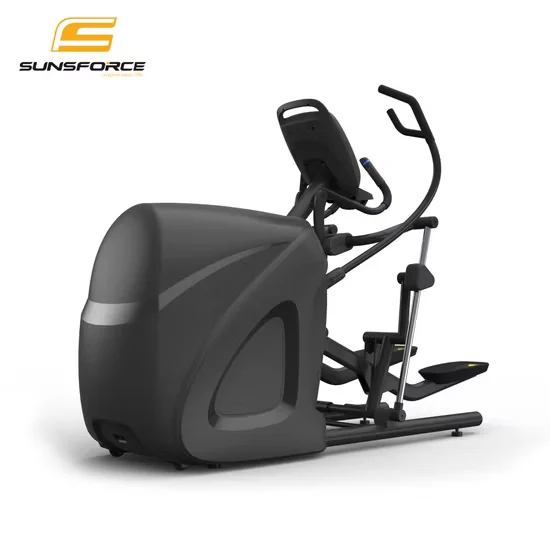
Whisper-Quiet Magnetic Operation — Magnetic resistance with no physical contact eliminates friction noise, achieving sub-35dB output suitable for guest room floor deployment.
Technical Specifications
| Parameter | Value |
|---|---|
| Designation | CTC60 |
| Product Type | Elliptical Trainer |
| Resistance Type | Magnetic |
| Resistance Levels | 1–25 |
| Stride Grade | 1–10 |
| Step Depth Grade | 1–15 |
| Pedal Center Distance | 230 mm |
| Max User Weight | 180 kg |
| Console Type | LED |
| Connectivity | Available (OEM/ODM customization) |
| Net Weight | 240 kg |
| Product Dimensions | 2120 × 790 × 1680 mm |
| Foldable | Unfolded |
| Certification | CE, EN 957, ISO 9001, RoHS |
Application Suitability
| Deployment Scenario | Typical Use |
|---|---|
| Hotel fitness center on guest room floors | 24-hour low-noise cardio access without disturbing adjacent rooms |
| International gym chain cardio zone | High-frequency elliptical training across varied fitness levels |
| Corporate wellness room | Employee mid-day sessions with minimal acoustic footprint |
| High-end residential home gym | Shared building cardio option meeting strict noise bylaws |
| Sports performance training center | Stride grade and resistance programming for athletic conditioning |
Why Low-Frequency Vibration Travels Farther Than You Expect
Magnetic resistance eliminates mechanical contact, removing the primary source of structure-borne vibration.
Traditional belt-driven ellipticals generate continuous low-frequency hum that propagates through floor slabs into occupied rooms below. In hotel deployments, front desk complaints arrive before maintenance teams even notice the problem. A commercial elliptical trainer with magnetic resistance avoids this failure mode entirely by generating resistance through proximity magnets rather than physical friction surfaces [NEED_CITE: acoustic transmission paths in commercial building cardio deployments]. The 240 kg net weight and reinforced steel frame further dampen residual vibration, preventing the harmonic resonance that lighter machines transmit into structural floors during sustained use.
Positioning Within the Cardio Zone Mix
This commercial elliptical trainer covers the full intensity spectrum from rehabilitation-grade low-resistance stepping to high-output interval work across 25 magnetic resistance levels. The 1–10 stride grade and 1–15 step depth grade allow programming that ranges from flat steady-state to aggressive climb simulation. In a cardio zone layout, it complements treadmills and rowing machines by offering zero-impact sustained cardio without the landing forces associated with running. The 230 mm pedal center distance and 180 kg maximum user weight accommodate a broad range of body types, making it viable for general-access facilities where user demographics vary widely. Deploy it in interior zones away from direct HVAC discharge to keep console electronics within operating temperature.
Continuous Operation and Facility Infrastructure Requirements
Facilities running 18-hour or 24-hour schedules demand equipment rated for sustained duty cycles rather than intermittent home use. The magnetic resistance system on this unit carries no friction wear components, meaning the resistance mechanism itself does not degrade across extended daily operation [NEED_CITE: magnetic resistance duty cycle standards for commercial fitness equipment]. Sub-35dB acoustic output makes floor-level deployment viable above occupied spaces — a critical factor for hotels placing cardio rooms directly below guest corridors. The 240 kg frame mass requires a level, load-rated floor with vibration isolation pads beneath the feet to prevent long-term creep on timber or raised-access surfaces. Confirm that the target facility’s voltage and plug standard matches the machine’s power supply configuration before container loading, as post-arrival rewiring introduces avoidable commissioning delays.
Magnetic Drive and Resistance Architecture Explained
The resistance mechanism operates through electromagnetic proximity — magnets positioned near a metal flywheel create eddy current braking without physical contact. This design fundamentally differs from friction-pad and fan-based systems where resistance surfaces physically wear over time. With 25 discrete resistance levels, the magnetic gap adjustment provides smooth progression between steps without the jump or hesitation common in poorly calibrated mechanical systems. The LED console provides real-time workout telemetry and supports OEM data interface customization, allowing integration with facility management platforms where usage tracking is required. The 230 mm pedal center distance keeps the stride path aligned with natural hip mechanics, reducing the lateral sway that narrower pedal spacing introduces during extended sessions. Frame rigidity under the 180 kg user load ensures that the magnetic gap remains constant regardless of user weight, preventing the resistance drift that occurs when lighter frames flex under load.
The Hidden Cost of Underspecified Components
Gym operators who source equipment rated for light commercial use routinely face motor and bearing replacements within the first year of continuous public operation. Noise complaints compound the problem — a single machine generating structure-borne vibration in a hotel deployment can trigger a full-zone replacement order rather than a targeted repair [NEED_CITE: equipment replacement cost drivers in hospitality fitness centers]. Machines without IoT-capable consoles create data blind spots where usage patterns remain invisible to facility managers, leaving underutilized units occupying premium floor space. Voltage mismatches discovered after delivery force either transformer installation or complete unit return, both of which delay facility opening and erode project margins.
Why This Product Line Fits Commercial Deployments
Sub-35dB operation has been validated in live hotel environments where guest room proximity demanded verified acoustic performance. The magnetic resistance system and frame structure undergo 10,000-hour continuous operation testing before production approval. Console interfaces support full OEM customization including UI language, branding, and data output protocol matching your facility management software. As part of a six-series cardio family, this elliptical allows single-source procurement across treadmills, bikes, rowers, stair climbers, and spin bikes — simplifying spare parts inventory and maintenance training. The 3D cardio zone layout service accounts for this unit’s 2120 × 790 mm footprint along with required clearance intervals and airflow corridors to prevent dead zones where equipment sits unused. Technical support operates on a 24/7 response cycle, and spare parts documentation is provided at the time of shipment rather than upon request.
Documentation & Test Records
- CE declaration of conformity covering the complete elliptical trainer assembly
- EN 957 test report verifying structural and safety compliance
- ISO 9001 certificate for the manufacturing quality management system
- Noise level test report documenting sub-35dB measured output
- 10,000-hour durability test record for magnetic drive and frame components
- Console technical documentation with data interface specification
Installation, Commissioning & Maintenance
- Allow minimum clearance around the 2120 × 790 mm footprint for safe user ingress and egress
- Install vibration isolation pads beneath feet on all floor types to prevent structural transmission
- Confirm voltage and plug configuration match facility supply before energizing the LED console
- Calibrate magnetic resistance gap during initial commissioning to verify smooth 1–25 level transitions
- Inspect pedal bearings and crank bolts on scheduled intervals per the maintenance guide
- Wipe console and frame contact points daily to prevent sweat corrosion on steel surfaces
Sourcing the Right Configuration for Your Facility
Provide your cardio zone square footage and planned unit count to receive a 3D layout with airflow and sightline analysis for this elliptical and complementary cardio units. Specify daily operating hours so the duty cycle rating aligns with your actual usage pattern. Identify the deployment floor and adjacent room types to confirm whether the sub-35dB acoustic profile meets your building’s transmission requirements. State your target market voltage and plug standard along with any console data interface needs to finalize the configuration before quotation.
Frequently Asked Questions
Q: How does magnetic resistance noise performance compare to fan-based systems?
A: Fan resistance relies on air displacement, which generates audible turbulence that scales with pedal cadence. Magnetic resistance operates through eddy current braking with no moving contact surfaces, producing acoustic output limited to bearing rotation and pedal mechanics. In environments where ambient noise must remain low — such as hotel guest floors or shared residential buildings — the magnetic system delivers measurably quieter operation across the full resistance range without the white noise signature of fan units.
Q: Can the console data integrate with our existing gym management platform?
A: The LED console supports OEM and ODM data interface customization. During the specification phase, we scope the required communication protocol and data fields so the console outputs usage metrics compatible with your facility management software or member application. Interface configuration is finalized before production, ensuring the units arrive with data connectivity ready for commissioning rather than requiring field firmware modifications.
Q: What distinguishes commercial-grade elliptical construction from home-use models?
A: Commercial units are built around continuous-duty bearing systems, reinforced steel frames tested for sustained load cycles, and magnetic resistance mechanisms rated for thousands of daily transitions. Home models typically use lighter frames and friction-based resistance that degrade under the sustained multi-user throughput of a gym or hotel fitness center. The 180 kg user weight rating and 240 kg net mass reflect structural margins designed for uninterrupted public access rather than intermittent personal use.
Q: How should cardio zone layout account for equipment spacing and airflow?
A: Elliptical trainers require lateral clearance for arm swing paths and rear clearance for user mounting. In a multi-unit cardio zone, equipment placement should align with HVAC supply registers to prevent heat buildup around console electronics during continuous operation. Sightline planning from the entrance and from treadmill positions influences which machines receive the highest usage — units placed in visual dead zones consistently show lower utilization regardless of their technical capability.
![Commercial Cross Trainer Elliptical Trainer Exercise Gym Equipment CTC60-T [WARN] draft identifier mismatch](https://bicksport.com/wp-content/uploads/2026/08/commercial-cross-trainer-elliptical-trainer-exercise-gym-equipment-ctc60-t-warn-draft-identifier-mismatch-db8f96.webp)
![New Design Professional Elliptical Trainers Machine for Commercial Gym Use [WARN] draft identifier mismatch](https://bicksport.com/wp-content/uploads/2026/08/new-design-professional-elliptical-trainers-machine-for-commercial-gym-use-warn-draft-identifier-mismatch-184f82.webp)
![Elliptical Gym Commercial Fitness Equipment Cross Trainer 10.1" Touch Screen [WARN] draft identifier mismatch](https://bicksport.com/wp-content/uploads/2026/08/elliptical-gym-commercial-fitness-equipment-cross-trainer-10-1-touch-screen-warn-draft-identifier-mismatch-7ec675.webp)