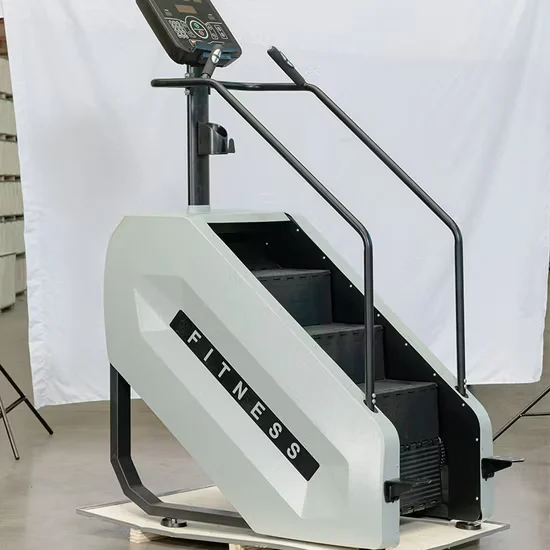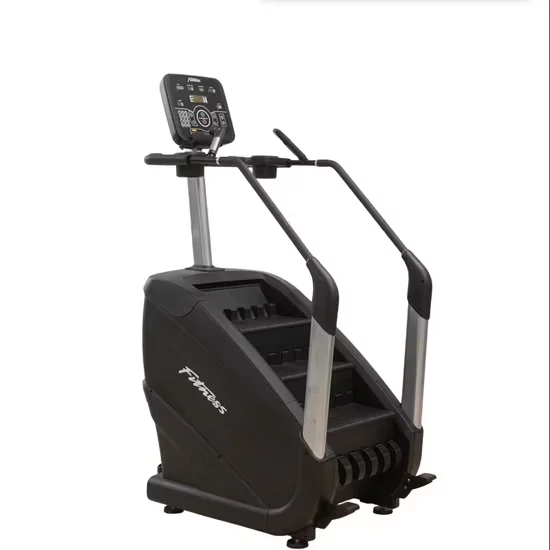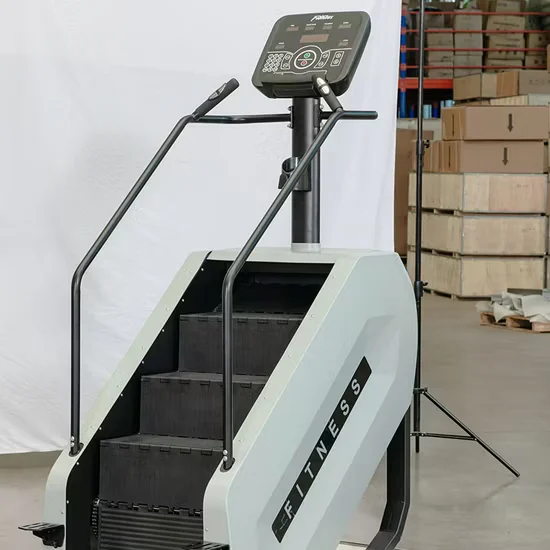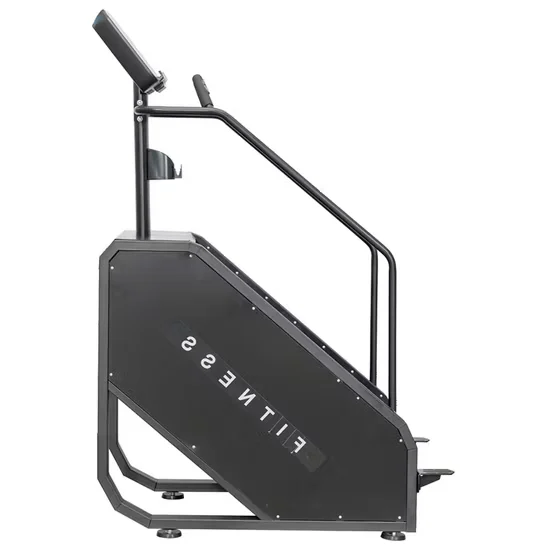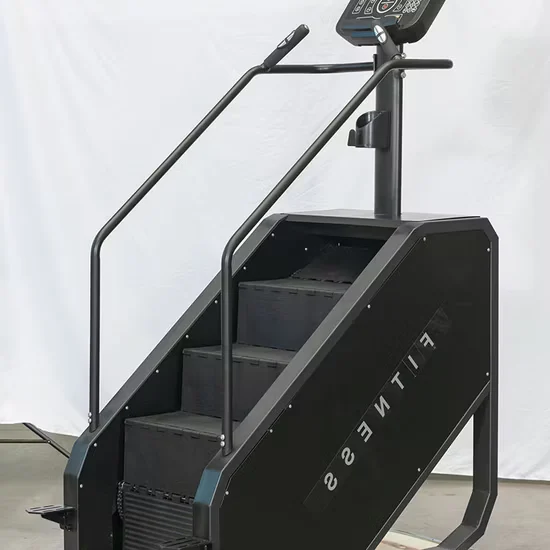
Continuous Commercial Operation — motor-driven stair climber tested for 10,000+ hours of uninterrupted high-frequency deployment in hotel and gym environments.
Technical Specifications
| Parameter | Value |
|---|---|
| Designation | SQ1017 |
| Product Type | Stair Climber |
| Motor Type | Motor Drive (AC) |
| Resistance Type | Motor Drive |
| Running Velocity | 15 – 164 steps/minute |
| Max User Weight | 180kg |
| Console Type | OSD display (Time, Climb, Calories, Steps, Heart Rate) |
| Heart Rate | Handgrip |
| Power Requirement | AC220V±10% / AC110V±10% |
| Product Dimensions | 1450 x 820 x 2080 mm |
| Step Area | 560 x 235 x 220 mm |
| Net Weight | 148 kg |
| Foldable | Unfolded |
| Material | Steel Pipe + PP Plastic |
| Color Options | Black (customizable) |
| Certification | CE |
| Customization | Available (logo, color, console UI, specification) |
Application Suitability
| Deployment Scenario | Typical Use |
|---|---|
| Hotel fitness center on guest room floors | 24-hour guest access with whisper-quiet motor operation preventing noise bleed to adjacent rooms |
| Chain gym cardio zone | High-frequency stepmill use across peak hours with commercial-grade motor and frame endurance |
| Corporate wellness room | Compact footprint deployment supporting employee interval and steady-state climbing sessions |
| High-end residential home gym | Motor-driven climbing simulation for users up to 180 kg without vibration transfer to shared flooring |
| Sports performance training center | Sustained step-rate loading for athlete conditioning with handgrip heart rate feedback |
Why Facility Managers Replace Stair Climbers Before the Warranty Expires
A motor rated for home use will not survive its first year inside a commercial cardio zone.
The SQ1017 is engineered around a commercial stair climber motor drive 180kg system built for continuous duty cycles, addressing the root cause of premature equipment failure in public-facing facilities. When a stair climber burns out in a hotel fitness center, the problem is never the electronics alone — the motor was specified for intermittent loads, not the sustained run-times a guest floor demands from early morning through late evening [NEED_CITE: motor duty cycle classification for continuous commercial operation]. Operators discover the mismatch only after the second or third replacement unit fails in the same bay, and the cost of repeated downtime compounds far beyond the hardware expense.
The drive system in this stair climber maintains consistent resistance delivery across the full step-rate range without the torque drop-off that signals a motor running past its thermal envelope. Facility maintenance logs typically show the pattern: increasing service calls clustered around units that were never rated for the usage density they received. Specifying equipment for the actual duty cycle rather than the brochure peak rating prevents that cycle of failure and replacement.
Where This Stair Climber Sits in the Cardio Floor Plan
This stair climber fills the vertical-loading position in a mixed cardio zone, complementing treadmills and ellipticals that handle horizontal and low-impact movement patterns. The unit supports step rates from 15 to 164 steps per minute, covering warm-up through sustained climbing intensity without requiring users to switch equipment mid-session. Its 1450 x 820 mm footprint places it along perimeter walls or between equipment rows where overhead clearance accommodates the 2080 mm height. The commercial stair climber motor drive 180kg rating ensures users across a broad weight range can train without triggering frame flex or motor strain, making it a reliable anchor in zones that serve diverse membership demographics.
Continuous Runtime and What the Deployment Environment Demands
Facilities running cardio equipment 16 or more hours daily need motors rated for continuous rather than intermittent duty — the SQ1017’s AC motor drive is designed for this sustained thermal load [NEED_CITE: EN 957 requirements for commercial cardio equipment]. Noise transmission matters critically on hotel guest floors where the equipment bay shares structural concrete with occupied rooms; the motor drive system produces consistent acoustic output that stays within acceptable thresholds for shared-wall deployments. Ventilation planning must account for the unit’s thermal envelope during back-to-back usage blocks, particularly in enclosed fitness rooms without dedicated HVAC returns. Power specification — available in AC220V±10% or AC110V±10% — must be confirmed against the destination market’s grid standard before the unit ships, because rewiring a motor drive after installation risks voiding the warranty and creating thermal failure points. The 148 kg net weight and unfolded steel frame require a level substrate; uneven flooring induces lateral load on the step mechanism that accelerates bearing wear.
Inside the Drive Train and Electronics Package
The AC motor drive system in the SQ1017 operates differently from the DC motors found in light-duty stair climbers. AC motors sustain torque output under continuous thermal load without the commutator wear that limits DC motor lifespan in high-frequency commercial environments. The step rate range of 15 to 164 steps per minute is governed by the motor controller rather than a mechanical governor, allowing the resistance curve to remain linear across the full spectrum rather than becoming inconsistent at upper ranges. The OSD console displays time, climb count, calories, steps, and heart rate without touchscreen complexity — an intentional choice for environments where sweat, cleaning chemicals, and high touch frequency degrade capacitive screens within months. Heart rate is captured via handgrip sensors, which provide adequate accuracy for steady-state monitoring without the signal drift that affects optical sensors under the grip-pressure variation typical of stair climbing motion [NEED_CITE: heart rate sensor accuracy under dynamic exercise conditions]. The steel pipe and PP plastic construction provides structural rigidity at 148 kg net weight, anchoring the step mechanism against the lateral forces generated during high-rate climbing.
What Happens When Specifications Are Compromised
A stair climber specified below its actual duty cycle generates a predictable cascade of operational failures. The motor overheats during sustained use, triggering thermal cutoffs that interrupt member sessions and create a perception of unreliable equipment. Noise levels climb as bearings degrade under loads the frame was not engineered to absorb, and noise complaints from adjacent spaces become a recurring issue for facility management. The console, unable to interface with facility tracking systems, leaves usage data unrecorded — operators lose visibility into which units are absorbing the most wear and cannot plan preventive maintenance around actual utilization patterns [NEED_CITE: cardio equipment utilization tracking and preventive maintenance scheduling]. Voltage mismatches discovered after deployment force facilities to either operate equipment outside its rated electrical envelope or delay opening a cardio zone while transformers are sourced and installed.
Why This Product Line for Your Cardio Deployment
Every unit undergoes 10,000-hour durability testing on motors, frames, and sealed bearings — verification that translates directly to reduced service call frequency in continuous-use environments. Sub-35dB acoustic performance has been validated in hotel floor deployments where the cardio room shares walls and ceiling structures with guest rooms. The OSD console supports customization of UI elements for facility branding or simplified navigation, keeping the operator in control of the member-facing interface. Because the SQ1017 is part of a six-series cardio family, a facility can source treadmills, bikes, ellipticals, rowers, and spin bikes from the same production line, ensuring consistent aesthetics and service protocols across the entire cardio zone. The 3D layout planning service covers this unit’s specific footprint and overhead clearance requirements alongside airflow paths that prevent heat buildup during peak-usage blocks. Technical support is available around the clock, which matters when a unit goes offline at 11 PM in a hotel fitness center serving international guests.
Documentation & Test Records
- CE declaration of conformity confirming European market compliance for this stair climber model
- EN 957 test report covering structural integrity and safety under 180 kg load conditions
- ISO 9001 certificate validating manufacturing process control across all production stages
- Noise level test report documenting acoustic output under sustained motor operation
- Motor specification sheet detailing continuous duty rating and thermal performance parameters
- Console technical documentation with OSD display interface and data output specifications
Installation, Commissioning & Maintenance
- Maintain minimum 600 mm clearance on all sides for safe entry and exit from the 1450 x 820 mm footprint
- Verify floor levelness within tolerance before anchoring; uneven substrate accelerates step mechanism bearing wear
- Confirm AC220V or AC110V supply matches unit specification before energizing the motor drive system
- Run initial calibration cycle through full step-rate range to verify motor controller response linearity
- Schedule sealed bearing inspection at intervals matching facility usage density and environmental conditions
- Clean OSD display with non-solvent cleaners to prevent degradation of the display surface coating
Equipment Selection Starts With Your Facility Parameters
Provide your cardio zone square footage and planned unit count to receive a 3D layout that accounts for this stair climber’s overhead clearance and airflow requirements. Specify your expected daily usage hours so the motor duty cycle can be matched against the actual operational load. Identify the deployment floor and what occupies adjacent spaces — above, below, and beside — to confirm the acoustic profile meets your environment’s requirements. Confirm the destination market’s voltage and plug standard before the proforma invoice is issued. State whether console data needs to integrate with existing facility management software so the appropriate interface documentation is included.
Frequently Asked Questions
Q: What is the difference between motor continuous duty and peak power ratings?
A: Peak power describes the maximum output a motor can deliver in short bursts, typically seconds. Continuous duty rating reflects what the motor can sustain indefinitely without thermal degradation. A stair climber running in a commercial gym operates under continuous load for hours — specifying by peak rating alone means the motor will run past its thermal envelope, accelerating insulation breakdown and eventual failure.
Q: How does sub-35dB noise level enable hotel floor deployment?
A: Hotel fitness centers on guest floors face a direct conflict: cardio equipment generates mechanical and motor noise that transmits through shared concrete slabs into occupied rooms below and beside. A verified sub-35dB operating profile means the stair climber’s motor drive and step mechanism produce acoustic output that remains below the threshold where guests perceive disturbance, even during early morning or late evening use.
Q: Can the console sync with our facility management software?
A: The OSD console on this stair climber captures workout metrics including time, step count, calories, and heart rate. Whether these data points can feed into your facility management system depends on the interface protocol your software supports. Request the console technical documentation during the specification phase so your IT team can confirm compatibility before the equipment order is finalized.
Q: What voltage and plug standards are available for international markets?
A: This unit ships configured for AC220V±10% or AC110V±10%, covering the primary grid standards across international markets. The plug type must be specified at order stage to match the destination country’s receptacle standard. Discovering a voltage mismatch after the container arrives means either operating outside the motor’s rated envelope or sourcing external transformers — both introduce failure risk and delay deployment.