
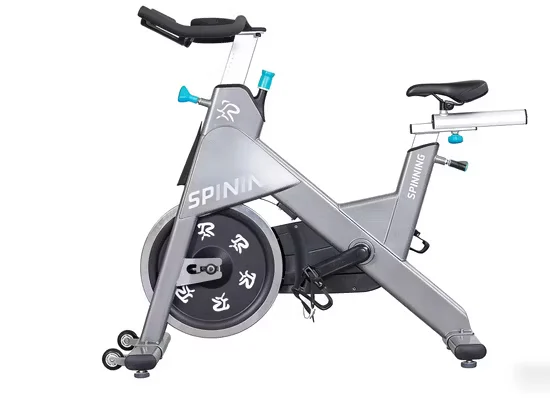
Whisper-Quiet Friction Resistance — Leather belt drive paired with precision-tuned friction pads delivers smooth, low-noise cycling suitable for noise-sensitive commercial floors.
Technical Specifications
| Parameter | Value |
|---|---|
| Product Type | Spin Bike |
| Resistance Type | Friction |
| Resistance Adjustment | Power-Style Resistance Adjustment |
| Flywheel Weight | 10-20 kg |
| Drive Type | Leather Belt |
| Max User Weight | 150 kg |
| Product Dimensions | 1473 × 520 × 1270 mm |
| Net Weight | 60 kg |
| Power Source | Manual (Man-powered) |
| Foldable | Unfolded |
| Certification | CE, GS, RoHS, FCC |
Application Suitability
| Deployment Scenario | Typical Use |
|---|---|
| Hotel fitness center on guest room floors | 24-hour self-service cardio for guests seeking quiet, low-impact cycling |
| Chain gym cardio zone | High-frequency group cycling classes and individual steady-state sessions |
| Boutique spin studio | Instructor-led interval classes with friction-based tactile resistance control |
| Corporate wellness room | Mid-day and after-work cycling sessions for employee health programs |
| High-end residential home gym | Daily personal training with smooth belt-driven pedal stroke |
Why Friction Pads Wear Out Before the Belt Does in Commercial Cycling Zones
The pad-to-flywheel contact point bears every watt of resistance your riders demand.
When a commercial indoor spinning bike friction resistance belt drive system enters a high-traffic studio, the friction pad takes the full thermal and mechanical load of every sprint interval. Over hundreds of classes, the pad material compresses and its surface glazes, causing the resistance curve to drift. Riders notice the knob feels different week over week. Meanwhile, the leather belt sits in a separate plane, transferring rotational energy without the same abrasive wear. Maintenance teams often replace belts on schedule but neglect pad inspection until a member complains about inconsistent load. [NEED_CITE: friction pad wear rate under continuous commercial cycling duty cycles]
Where This Spin Bike Fits in a Mixed Cardio Floor
This commercial indoor spinning bike friction resistance belt drive unit occupies a compact footprint, making it suitable for dense studio layouts where group class capacity matters. The friction resistance mechanism gives riders direct, infinite adjustment between zero load and maximum braking force, covering everything from recovery spins to standing climbs. In a mixed cardio zone, it pairs naturally with ellipticals and rowers to give members non-impact alternatives to treadmill running. The 150 kg max user weight accommodates a broad commercial demographic, and the manual power requirement means no dedicated electrical circuit is needed per station.
Continuous Deployment and Floor-Level Noise Considerations
Even without a motor, a spin bike transmits pedal-stroke vibration through its frame into the floor structure. The leather belt drive eliminates the metallic rattle associated with chain-driven alternatives, but the flywheel’s rotational mass still generates low-frequency oscillation during standing efforts. When deploying on upper hotel floors or above occupied office space, anti-vibration pads beneath the leveling feet help isolate structure-borne transmission. The 1473 × 520 mm footprint leaves adequate lateral spacing for rider mounting in group configurations. Ambient room ventilation matters for rider comfort rather than equipment cooling, since no motor generates thermal load. [NEED_CITE: structure-borne vibration thresholds for cardio equipment on suspended floor slabs]
Belt Tension, Pad Composition, and Flywheel Inertia Explained
The leather belt in this drive system transfers pedal force to the flywheel without the lubrication and stretch issues inherent to chains. Proper belt tension prevents slip under high-resistance standing efforts while avoiding excessive bearing load. The friction resistance pad presses directly against the flywheel rim, and its material composition determines both the feel of the resistance curve and the inspection interval — softer compounds provide smoother engagement but wear faster under group-class abuse. The 10-20 kg flywheel range stores rotational energy that carries the pedal stroke through the dead spots at top and bottom of each revolution, producing a fluid ride feel across different rider weights.
The Cost of Ignoring Pad Inspection in High-Traffic Studios
When friction pads go unchecked, the resistance knob requires progressively more turns to achieve the same perceived load. Instructors calling out resistance targets lose control of class intensity. Members who cannot hit their expected effort levels quietly stop booking. The complaint reaches management not as a maintenance ticket but as declining class attendance. By that point, the pad may have worn unevenly enough to score the flywheel surface, turning a consumable replacement into a component rebuild. [NEED_CITE: member attrition patterns linked to perceived equipment degradation in group fitness]
Why This Product Line Earns Its Place in the Studio
Every unit undergoes noise level verification that confirms sub-35 dB operation during sustained pedaling, critical for hotel deployments where the cycling studio shares a wall with guest corridors. The 10,000-hour durability protocol tests the frame welds, bearing seals, and belt-track alignment under continuous loading far beyond typical studio class schedules. Full OEM and ODM customization extends to frame color and console mounting options, letting boutique studios match their interior branding. Our 3D cardio-zone layout service calculates the exact unit spacing and sightline clearance this bike requires, ensuring every rider has unobstructed instructor visibility. Technical support runs 24/7, covering friction pad replacement guidance and belt tension recalibration whenever your maintenance team needs it.
Documentation & Test Records
- CE declaration of conformity for commercial indoor cycling equipment
- EN 957 test report validating structural integrity under 150 kg static and dynamic loading
- Noise level test report documenting operational sound during continuous pedaling
- Durability test record covering 10,000-hour frame and bearing validation
- Friction pad material specification and recommended inspection interval sheet
- Leather belt tension calibration guide and replacement parts list
Installation, Commissioning & Maintenance
- Position each unit with minimum 600 mm lateral clearance to accommodate rider mounting within the 1473 × 520 mm footprint
- Install anti-vibration pads under all four leveling feet before first use on upper-floor deployments
- Verify belt tension using the deflection test specified in the commissioning guide before releasing to members
- Inspect friction pad surface for glazing and measure remaining thickness monthly under group-class schedules
- Wipe down the leather belt and flywheel contact surfaces weekly to remove sweat residue and prevent corrosion
- Check frame bolt torque at all weld joints quarterly per the maintenance schedule in the installation guide
Planning Your Cycling Studio Deployment
Provide your cycling zone square footage and target unit count so we can generate a 3D layout covering rider sightlines, instructor positioning, and airflow paths around each bike. Specify the deployment floor and adjacent room types so we can confirm the noise isolation approach matches your building’s acoustic requirements. Indicate whether you need console mounting points for future heart-rate display integration. Confirm your target market so we can align any electrical accessories with local voltage standards.
Frequently Asked Questions
Q: How does friction resistance compare to magnetic resistance for noise and maintenance in a commercial studio?
A: Friction resistance delivers direct tactile feedback through physical pad contact, giving riders a familiar road-bike feel. Magnetic systems operate without contact and need less routine maintenance, but friction pads are a straightforward consumable. In a studio running daily classes, plan for periodic pad inspection and replacement to keep the resistance curve consistent across every bike in the room.
Q: What is the practical difference between a leather belt drive and a chain drive on a commercial spin bike?
A: A leather belt drive operates noticeably quieter than a chain and does not require lubrication, making it better suited for noise-sensitive environments like hotel fitness floors. Chains tolerate higher torque peaks but transmit more mechanical sound and need regular cleaning. For group cycling studios prioritizing a quiet class atmosphere, belt drive is the standard choice.
Q: How does the 10-20 kg flywheel weight range affect ride smoothness for different users?
A: A heavier flywheel within this range stores more rotational energy, carrying the pedal stroke smoothly through the top and bottom dead points. Lighter riders may find a heavier flywheel requires more effort to accelerate but rewards with a fluid cadence once up to speed. The range allows facilities to select a weight that matches their typical user profile and class intensity.
Q: What maintenance schedule should a high-traffic studio follow for friction pads and belt tension?
A: Inspect friction pad thickness and surface condition monthly, replacing when glazing or uneven wear appears. Check belt tension quarterly using the deflection method in the commissioning guide, adjusting if slip occurs under high resistance. Weekly wipe-downs of the belt and flywheel surfaces prevent sweat corrosion. Document every inspection to track wear rates specific to your class volume.
Q: How is the 150 kg max user weight validated for commercial spin bike structural safety?
A: The frame undergoes EN 957 static and dynamic load testing, confirming weld integrity and component stability under repeated high-force pedal strokes at maximum rated weight. This testing covers both seated and standing cycling positions. Facilities serving populations with higher average body weights should verify the rating matches their member profile before procurement.

![Professional Flywheel Spinning Bike for Gym Fitness Aerobic Exercise Belt Drive [WARN] draft identifier mismatch](https://bicksport.com/wp-content/uploads/2026/08/professional-flywheel-spinning-bike-for-gym-fitness-aerobic-exercise-belt-drive-warn-draft-identifier-mismatch-e87eac.webp)