

Acoustic Engineering — Every welded joint and bearing in this 130kg steel frame is stress-tested to eliminate resonance during continuous high-frequency arm training.
Technical Specifications
| Parameter | Value |
|---|---|
| Designation | 5022 |
| Product Type | Gripper (Strength Equipment — Arm) |
| Material | Steel |
| Product Dimensions | 1075 × 580 × 855 mm |
| Net Weight | 130 kg |
| Age Group | Adult |
| Exercise Part | Arm |
| Gender | Unisex |
| Appliance | Community, Gymnasium |
| Production Capacity | 500 PCS/Month |
| Certification | ISO 9001, CE |
Application Suitability
| Deployment Scenario | Typical Use |
|---|---|
| Commercial gym strength zone | High-frequency arm isolation training across multiple daily users |
| Community fitness center | Durable public-access arm conditioning for diverse adult populations |
| Corporate wellness room | Compact arm strengthening station within limited square footage |
Why Frame Rigidity Determines Whether a Commercial Hammer Strength Gripper Arm Fitness Equipment Survives Its First Year
A 130kg steel frame resists the lateral torque that tears lighter units apart at the weld seams.
Walk into any facility that bought on price, and you will find the telltale signs: hairline cracks radiating from the load-bearing welds, pivot bushings that have worn oval, handle grips that rattle before the plate stack finishes its return stroke. These failures are not random — they follow a predictable pattern where frame wall thickness and weld penetration depth fail to match the cyclic loading of daily commercial use [NEED_CITE: structural fatigue thresholds in commercial strength equipment frames]. The commercial hammer strength gripper arm fitness equipment addresses this with a full steel construction that distributes load across reinforced junction points rather than concentrating stress at single bolt connections.
Positioning Within the Strength Training Floor Plan
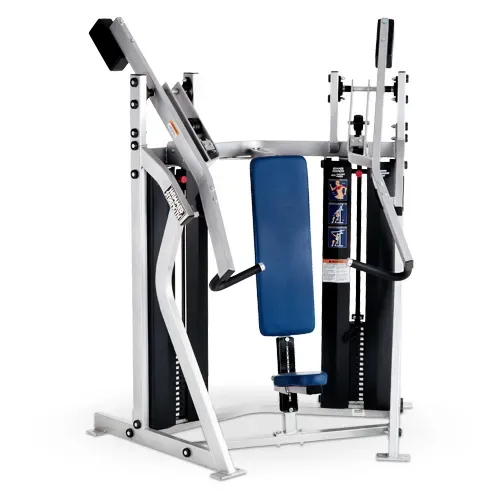
This unit occupies the arm isolation segment of a commercial strength circuit, complementing compound pressing and pulling stations by targeting forearm, bicep, and grip musculature through a fixed movement path. Its 1075 × 580 mm footprint fits between plate-loaded machines without disrupting traffic flow, making it suitable for high-density strength zones where every square meter carries revenue implications. The steel frame accommodates adult users across a broad size range, with the handle geometry and seat positioning designed for repetitive loading without adjustment complexity between users. The commercial hammer strength gripper arm fitness equipment serves facilities that need dedicated arm work separated from multi-joint stations to reduce queue times during peak hours.
Continuous Deployment and Environmental Considerations
A strength unit in a commercial gym endures hundreds of loading cycles daily, each one transmitting force through the frame, pivot points, and cable or lever mechanisms. The 130kg mass provides inherent stability that prevents walking or tipping during aggressive use, eliminating the need for floor anchoring in most installations [NEED_CITE: commercial strength equipment anchoring requirements by weight class]. Ambient temperature and humidity in community fitness centers demand corrosion-resistant finishing on all exposed steel surfaces. Floor leveling within tolerance prevents uneven load distribution that accelerates bushing wear on one side of the pivot assembly. Adequate clearance on all sides — particularly the loading and unloading arc — ensures safe user transitions without collision risk in crowded strength zones.
Decoding the Steel Gauge and Weld Specifications
The frame material designation as steel encompasses a range of wall thicknesses and alloy compositions that directly determine fatigue life under cyclic loading. Thicker-walled tubing resists the bending moments generated when users apply off-axis force during heavy grip work, while thinner sections flex and develop stress concentrations at weld boundaries. The 130kg net weight signals substantial material volume — a lighter frame in this footprint would indicate thinner gauge or hollow sections that compromise long-term rigidity. Weld penetration depth and bead consistency at load-bearing junctions separate units that crack within months from those that survive years of continuous deployment. The 1075 × 855 mm height and depth profile positions the handle axis at biomechanically appropriate angles for seated or standing arm work, reducing compensatory movement patterns that accelerate pivot wear.
What Specification Compromise Costs After Installation
Facilities that accept lighter-gauge frames to reduce upfront cost discover the true expense when weld failures begin appearing in sequence — each repair requires taking the unit offline, ordering replacement parts, and absorbing member complaints about unavailable equipment [NEED_CITE: total cost of ownership for commercial strength equipment]. Pivot bushings in underspecified frames wear asymmetrically, creating handle play that users interpret as equipment danger. Powder-coat finishes on inadequately prepared steel surfaces chip and corrode within months in humid community center environments. Units that lack sufficient mass shift during use, scuffing flooring and requiring repositioning that damages both the equipment base and the facility floor surface.
Why This Product Line Holds Up Under Commercial Cycles
The 130kg steel frame undergoes load testing that simulates years of high-frequency grip work before the unit clears the production line. Every weld point receives inspection for penetration depth and consistency, rejecting units with visible porosity or incomplete fusion. The 1075 × 580 × 855 mm dimensions are verified against facility layout templates to confirm clearance compatibility with standard strength zone spacing. ISO 9001 manufacturing protocols ensure that the steel gauge and welding parameters remain consistent across production batches, so replacement units match the originals. CE certification confirms that safety requirements for commercial strength equipment are met, covering entrapment hazards, structural integrity, and surface finishing standards [NEED_CITE: CE marking requirements for commercial strength equipment]. Full OEM customization extends to frame color and logo placement without compromising structural specifications.
Documentation & Test Records
- CE declaration of conformity covering mechanical safety and entrapment clearance standards
- EN 957 test report validating structural load capacity and durability under cyclic use
- ISO 9001 certificate confirming manufacturing process control across welding and assembly
- Frame material specification sheet detailing steel grade, wall thickness, and surface treatment
- Durability test record documenting pivot and bushing performance under simulated commercial cycles
- Spare parts list with part numbers for bushings, handles, and wear components
Installation, Commissioning & Maintenance
- Maintain minimum 600mm clearance on all sides of the 1075 × 580mm footprint for safe user access
- Verify floor levelness before positioning the 130kg frame to prevent asymmetric pivot loading
- Inspect all pivot bushings and fasteners after the first 500 use cycles for seating and torque retention
- Apply corrosion-resistant touch-up coating to any surface damage from transport or installation
- Lubricate pivot points at intervals matching facility usage intensity and ambient humidity conditions
- Check weld junctions visually during routine maintenance for any signs of stress cracking
Equipment Selection and Deployment Inquiry
Provide your strength zone square footage and planned equipment count to receive a layout plan that accounts for the 1075 × 580 mm footprint and required safety clearances around this unit. Specify your expected daily user volume so that maintenance intervals can be matched to actual loading cycles. Confirm your facility’s flooring type and levelness tolerance to determine whether shimming or anchoring is required for the 130kg frame. State your target market so that any labeling and documentation requirements are addressed before shipment.
Frequently Asked Questions
Q: How does commercial-grade steel framing differ from residential strength equipment construction?
A: Commercial frames use thicker-walled steel tubing with deeper weld penetration at load-bearing junctions, designed to withstand thousands of loading cycles without developing stress cracks. Residential frames prioritize cost and weight reduction, using thinner gauge material adequate for occasional use but prone to fatigue failure under continuous multi-user deployment in gym and community fitness environments.
Q: What role does the 130kg weight play in training stability?
A: The substantial mass anchors the unit against lateral and vertical forces generated during aggressive grip work, preventing the frame from shifting or rocking on the floor surface. This inherent stability eliminates the need for bolt-down anchoring in most installations and ensures consistent handle positioning throughout each repetition without compensatory movement from the user.
Q: What maintenance intervals apply to strength equipment in high-frequency commercial settings?
A: Pivot bushings and fasteners should be inspected after the initial break-in period and then at regular intervals proportional to daily user volume. High-traffic community and commercial gym deployments may require monthly checks, while lower-volume corporate wellness installations can extend to quarterly schedules, always responding immediately to any reported play or unusual noise from the mechanism.
Q: How do community and commercial gym equipment specifications diverge?
A: Community centers face unsupervised use from populations with varying technique quality, demanding equipment that tolerates off-axis loading and improper handling without structural compromise. Commercial gyms deal with higher cycle counts from experienced users, requiring wear components rated for continuous operation with minimal downtime for parts replacement and adjustment.
Q: What clearance planning is necessary when positioning strength equipment in a training zone?
A: Each unit requires space for safe approach, loading, and exit without interfering with adjacent equipment users. The 1075 × 580 mm footprint must be supplemented with lateral clearance for handle arc movement and rear clearance for plate loading if applicable, with sightlines considered so that staff can observe the full training area from a central position.
![Commercial Shoulder Press Bench Machine for Professional Gyms [WARN] draft identifier mismatch](https://bicksport.com/wp-content/uploads/2026/08/commercial-shoulder-press-bench-machine-for-professional-gyms-warn-draft-identifier-mismatch-51c98b.webp)
![Commercial Plate Loaded Hip Adductor Machine Senrui Fitness Equipment [WARN] draft identifier mismatch](https://bicksport.com/wp-content/uploads/2026/08/commercial-plate-loaded-hip-adductor-machine-senrui-fitness-equipment-warn-draft-identifier-mismatch-18499c.webp)
![Hammer Strength Abdominal Oblique Crunch OS-H5025 Gym Equipment [WARN] draft identifier mismatch](https://bicksport.com/wp-content/uploads/2026/08/hammer-strength-abdominal-oblique-crunch-os-h5025-gym-equipment-warn-draft-identifier-mismatch-1287b3.webp)