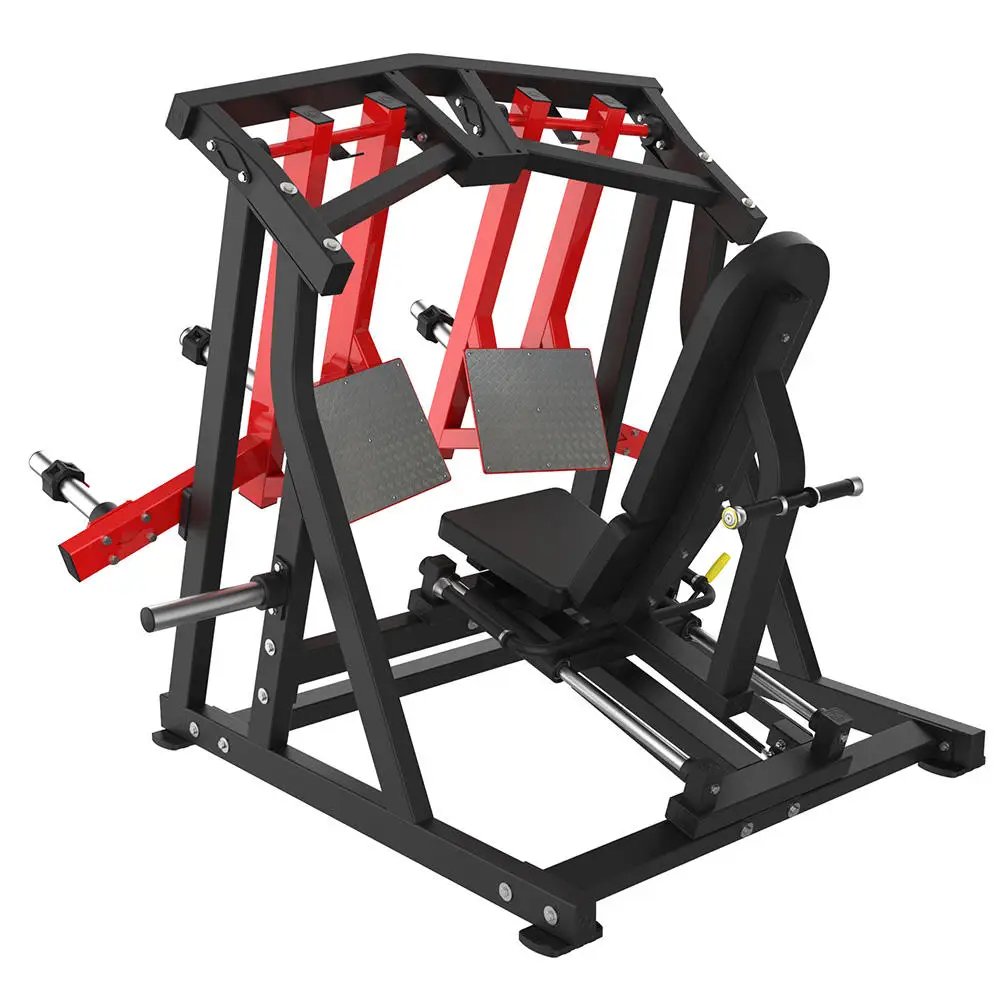
10,000-Hour Endurance Verified — Reinforced steel frame and sealed bearing assemblies tested for continuous high-frequency operation across professional leg training zones.
Technical Specifications
| Parameter | Value |
|---|---|
| Product Type | Linear Hack Press (Strength Equipment) |
| Model NO. | OS-H5038 |
| Designation | OS-H5038 |
| Frame Material | Steel |
| Exercise Target | Leg |
| Product Dimensions | 2375 × 1500 × 1475 mm |
| Net Weight | 250 kg |
| Max User Weight | 180 kg |
| Main Frame Color | Available per customer requirements |
| Cushion Color | Available per customer requirements |
| Certification | ISO 9001, CE |
| Application | Professional Gym and Club, Community, Gymnasium |
| Transport Package | Plywood Box |
| HS Code | 9506911900 |
| Origin | China |
Application Suitability
| Deployment Scenario | Typical Use |
|---|---|
| International gym chain leg training zone | High-frequency lower body compound movements during peak membership hours |
| Professional sports training center | Athlete-grade linear pressing mechanics for periodized leg development |
| Corporate wellness facility | Multi-user leg press stations accommodating varied fitness levels |
| Community fitness center | Durable lower body equipment rated for continuous daily access |
| High-end residential gym | Heavy-duty leg training in shared amenity spaces with strict noise floors |
Why Light-Commercial Leg Presses Fail Before the First Membership Renewal
Commercial duty cycles demand engineered endurance, not adapted consumer hardware.
Gym operators rarely notice a problem until a member files a complaint or a machine locks up mid-session. Light-commercial leg presses pulled into high-traffic facilities often show premature wear on guide rails and bushings within the first heavy quarter, leaving maintenance teams scrambling for replacements while floor availability drops [NEED_CITE: commercial strength equipment duty cycle classification for continuous public facility operation]. I have walked into facilities where the linear guide assemblies on competitor units developed visible play after months of constant loading, producing metal-on-metal vibration that transmits through concrete floors to adjacent rooms. The commercial linear hack press leg press machine OS-H5038 addresses this through reinforced steel construction and sealed bearing interfaces that maintain alignment under sustained loading cycles.
Positioning Within the Strength and Conditioning Floor Layout
This equipment anchors the lower body compound movement station, covering linear hip, knee, and ankle extension through a fixed mechanical path that isolates quadriceps and gluteal engagement. It complements free-weight squat racks and plate-loaded leg sleds by offering a guided alternative for users who require controlled movement patterns or are working through rehabilitation protocols. The commercial linear hack press leg press machine fits high-density deployment in professional gym leg training zones where floor space must accommodate multiple users rotating through stations, and its 180 kg user weight capacity covers the full spectrum of general membership and athletic populations. The fixed linear path allows operators to position the unit against walls or in rows without requiring lateral clearance for free barbell movement.
Continuous Operation Demands and Environmental Placement
A leg training station in a busy gym chain typically sees sustained loading across eight to twelve active hours daily, and each repetition transmits significant force through the frame into the floor structure. The 250 kg frame mass of the OS-H5038 provides the inertial stability needed to absorb these loads without resonant vibration traveling to occupied spaces below. Deployment on suspended floor slabs requires confirmation of load-bearing capacity and the use of vibration-damping mats beneath the contact feet [NEED_CITE: structural load requirements for heavy commercial strength equipment on suspended floors]. Adequate ventilation around the unit ensures that sweat and humidity do not accelerate corrosion on the steel frame, and operators should confirm that the surrounding clearance allows safe loading and unloading of weight plates without blocking pedestrian flow through the training zone.
Engineering Behind the Steel Frame and Linear Guide Mechanics
The main frame uses steel construction to resist the cyclical deformation that occurs when users push maximum loads through the linear press path. Unlike stamped or tubular light-commercial assemblies, the reinforced steel profile maintains structural geometry across thousands of loaded repetitions, preventing the guide rail misalignment that causes uneven wear and binding. The linear guide system constrains movement to a single plane, removing the balance component from the exercise and directing force output purely into the target muscle groups. Sealed bearing interfaces reduce maintenance intervals by preventing chalk dust, sweat residue, and ambient humidity from penetrating the moving contact surfaces. The cushion contact points are specified by color per customer requirements, allowing facility operators to coordinate upholstery with brand identity and existing equipment palettes. Frame color is also available per customer requirements, supporting full OEM/ODM visual integration across multi-site rollouts.
The Hidden Cost of Specification Shortcuts
Operators who select light-commercial leg presses for busy facilities regularly encounter cascading costs that far exceed the initial savings. Guide rail play develops under sustained loading, creating noise and uneven movement that drives users toward alternative stations and accelerates component failure. When bushings and bearings are not sealed against gym-floor contaminants, maintenance teams face weekly service calls instead of monthly inspections [NEED_CITE: maintenance frequency comparison between sealed and open bearing systems in commercial strength equipment]. Units that shift under load due to insufficient frame mass create safety concerns that expose facilities to liability, and the downtime required to source replacement parts for discontinued light-commercial models leaves floor space generating no revenue for extended periods. Voltage and plug standard mismatches discovered after delivery add further delays when electrical adapters are needed before equipment can be commissioned.
What This Product Line Delivers to Facility Operators
Every unit in the Biketon Sport commercial range undergoes 10,000-hour durability testing on structural components and moving assemblies, validating endurance before the equipment reaches the training floor. The six-series cardio and strength family allows a facility to source every discipline from one manufacturing line, simplifying procurement and spare parts management. OEM/ODM customization extends to frame color, cushion color, and specification adjustments, ensuring the commercial linear hack press leg press machine integrates with facility branding without requiring secondary finishing. The free 3D layout and airflow planning service covers square footage, sightlines, and member flow, positioning this 2375 × 1500 × 1475 mm unit with correct clearance for safe plate loading and user rotation. ISO 9001 and CE certifications back every shipment, and 24/7 technical support response ensures operators are never waiting for resolution during peak operating hours.
Documentation & Test Records
- CE declaration of conformity for commercial strength equipment compliance
- EN 957 test report covering structural integrity and safety requirements
- ISO 9001 certificate verifying quality management across manufacturing
- Noise level test record documenting operational sound under load
- Durability test record confirming 10,000-hour component endurance validation
- Spare parts list with ordering codes for frame and guide components
Installation, Commissioning & Maintenance
- Allocate minimum clearance around the 2375 × 1500 × 1475 mm footprint for safe plate loading and user egress
- Install vibration-damping pads beneath contact feet to isolate floor-transmitted resonance in multi-level facilities
- Confirm level installation using adjustable feet to prevent lateral drift during loaded repetitions
- Inspect sealed bearing interfaces quarterly and wipe guide rails to remove chalk and sweat residue buildup
- Tighten frame fasteners to specified torque values after the first month of loaded operation
- Check cushion upholstery condition monthly and replace worn contact pads per OEM color specification
Equipment Selection and Deployment Planning
Share your strength training zone dimensions and equipment count to receive a 3D layout and airflow plan that positions this unit with correct user flow and safety margins. Specify the expected daily usage hours so that deployment recommendations match the continuous loading demands of your membership volume. Identify the deployment floor level and adjacent occupied spaces to confirm that vibration transmission and structural loading remain within acceptable limits. State your target market voltage and plug standards to ensure electrical compatibility before the container ships, and indicate whether console-integrated usage tracking is required for your facility management system.
Frequently Asked Questions
Q: What OEM/ODM customization options are available for this unit?
A: Frame color and cushion color are fully customizable to match your facility branding and interior design standards. Specification adjustments including upholstery density and grip configuration can be scoped during the OEM consultation phase, and minimum order quantities remain flexible for multi-site rollouts across gym chain networks.
Q: How does the steel frame construction differ from light-commercial alternatives?
A: The reinforced steel profile resists cyclical deformation under repeated maximum loading, maintaining linear guide alignment across extended service intervals. Light-commercial tubular assemblies develop play at the bearing interfaces far earlier, producing noise, uneven movement, and accelerated component wear under continuous public facility usage.
Q: What maintenance schedule is recommended for high-frequency environments?
A: Quarterly inspection of sealed bearing interfaces and guide rail surfaces is recommended for facilities operating eight or more hours daily. Monthly fastener torque checks and cushion condition assessments prevent minor wear from developing into safety concerns, and the sealed bearing design significantly reduces the frequency of lubrication service calls.
Q: Can the equipment be specified for different user weight requirements?
A: The unit is rated for a maximum user weight of 180 kg, covering the full range of general membership and athletic populations. Specification adjustments can be discussed during the OEM scoping phase if your facility serves specialized user groups requiring modified capacity thresholds or altered cushion geometry.
Q: What documentation supports CE compliance and facility integration?
A: Each shipment includes the CE declaration of conformity, EN 957 test report, ISO 9001 certificate, durability test record, and noise level test documentation. Installation guides, commissioning checklists, and spare parts lists with ordering codes are provided to support immediate deployment and ongoing maintenance scheduling.


![H016 Plate-Loaded Seated Biceps Curl Machine for Commercial Gyms [WARN] draft identifier mismatch](https://bicksport.com/wp-content/uploads/2026/08/h016-plate-loaded-seated-biceps-curl-machine-for-commercial-gyms-warn-draft-identifier-mismatch-5fb5d1.webp)