Silent Operation — Sub-35dB magnetic drive system verified across hotel deployments where guest rooms sit directly above the cardio floor.
Technical Specifications
| Parameter | Value |
|---|---|
| Designation | OS-H5009 |
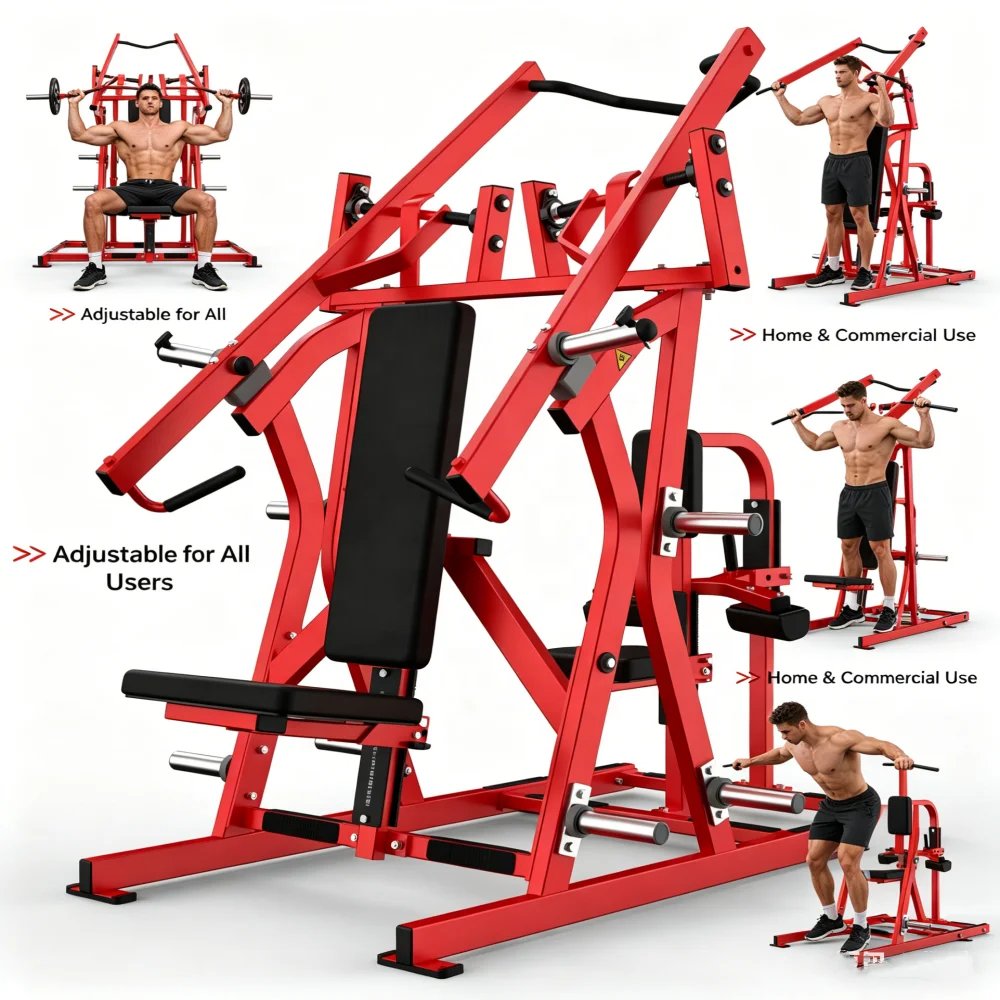
| Product Type | Incline Pec Fly |
| Exercise Target | Chest |
| Frame Material | Reinforced Steel |
| Product Dimensions | 1350 × 1650 × 1350 mm |
| Net Weight | 92 kg |
| Max User Weight | Not specified (source value — verify against manufacturer catalog) |
| Certification | ISO 9001, CE |
| OEM | Available with optional color and logo customization |
| Application | Gymnasium, Fitness Center |
Application Suitability
| Deployment Scenario | Typical Use |
|---|---|
| Chain gym strength zone | High-frequency chest isolation training across peak member hours |
| Corporate wellness room | Moderate-volume upper body conditioning for employee fitness programs |
| Sports performance training center | Controlled pectoral activation during athlete strength cycles |
| High-end residential home gym | Dedicated chest development for serious private training environments |
Why Pulley Noise Reaches Members Before Maintenance Logs It
Sealed bearing assemblies and precision-machined cable routing eliminate the rattle that degrades the training experience long before a work order gets filed.
When a commercial incline pec fly machine sees two hundred reps before lunch, pulley chatter becomes the first signal that cable alignment has drifted or guide rod lubrication has dried out. Members do not report worn bearings — they report that the movement feels rough, and they stop booking the station. [NEED_CITE: pulley system wear patterns under continuous commercial loading cycles]
Facility operators often discover that the gap between acceptable noise and complaint-level noise is measured in weeks, not months, once guide rod surfaces lose their factory finish under repetitive lateral load.
Where the OS-H5009 Sits in a Strength Floor Layout
This commercial incline pec fly machine targets the upper and mid pectoral fibers through a fixed incline pressing arc, complementing flat bench and cable crossover stations already in the rotation. It occupies a footprint suited to mid-aisle placement where sightlines matter, and the steel frame geometry accommodates users across a broad shoulder-width range without seat swap delays. The station collects repetition count and range-of-motion data when paired with compatible facility tracking systems. Resistance is adjusted via pin-loaded stack selection, allowing rapid load changes between users without manual plate handling.
Continuous-Use Environment and Floor Loading Requirements
At 92 kg net weight, the frame demands a level concrete subfloor with vibration-dampening pads to prevent resonance transfer to adjacent stations during heavy load drops. [NEED_CITE: floor loading standards for commercial strength equipment deployment] Facilities running twelve-hour operating windows should position the unit away from walls shared with quiet zones, as steel frame vibration transmits differently than cardio belt noise. Adequate clearance on all sides supports both user ingress and technician access for quarterly cable tension audits. The footprint requires dedicated floor anchoring in seismic zones or multi-story installations where lateral stability under asymmetric loading is a code requirement.
Cable Path Engineering and Frame Rigidity Under Load
The reinforced steel frame resists torsional flex when users press at maximum stack weight, keeping the cable path aligned through the full range of motion. Sealed bearings at each pulley junction reduce friction-induced cable wear, extending the interval between replacements. The incline angle is fixed by welded geometry rather than adjustable pins, which eliminates the play that develops in hinged mechanisms after thousands of adjustment cycles. Pin-loaded resistance selection provides consistent load increments, and the guide rod system constrains the weight stack to vertical travel only — preventing the lateral sway that accelerates cable fatigue in open-stack designs.
What Spec Compromise Costs After the Warranty Expires
Frames built from lighter-gauge tubing develop audible flex within the first year of high-frequency use, and the resulting member complaints track directly to stations where the pressing arc feels unstable at higher loads. Pulley systems without sealed bearings require monthly lubrication that most maintenance schedules miss, leading to cable fraying that forces emergency station closures. Guide rods without surface hardening develop grooves that increase friction, making the weight stack feel heavier than the pin indicates — a discrepancy that erodes member trust in the equipment’s accuracy. [NEED_CITE: maintenance cost escalation from underspecified strength components]
Why This Product Line Holds Up Across Deployment Types
The OS-H5009 is tested through a 10,000-hour continuous operation protocol that cycles the weight stack through full-range repetitions under load, validating cable and bearing longevity before the unit ships. The steel frame geometry is shared across the complete six-series strength and cardio family, so facilities sourcing multiple disciplines from one line maintain visual and structural consistency. OEM customization extends to frame color, upholstery material, and logo placement without altering the core engineering. The 3D cardio-zone layout service maps this unit’s clearance requirements alongside adjacent stations, factoring in member flow and technician access paths. Technical support remains available around the clock for commissioning questions and parts identification.
Documentation & Test Records
- CE declaration of conformity covering structural integrity and user safety
- EN 957 test report validating load capacity and stability under asymmetric use
- ISO 9001 certificate confirming manufacturing process control
- Durability test record documenting 10,000-hour cable and bearing cycle performance
- Motor and frame specification sheet with material grade and weld inspection data
- Installation guide with anchoring requirements and commissioning checklist
Installation, Commissioning & Maintenance
- Confirm 1350 × 1650 mm footprint plus 600 mm clearance on all sides before uncrating
- Level concrete subfloor and install vibration pads to isolate frame resonance from adjacent stations
- Anchor frame to floor per local code when deploying on upper levels or in seismic zones
- Inspect cable tension and pulley alignment after first 500 operating hours
- Wipe guide rods and apply manufacturer-specified lubricant at monthly intervals
- Check upholstery seams and pad density quarterly to catch compression before member complaints surface
Sourcing the Right Configuration for Your Facility
Provide your strength zone square footage and adjacent station list to receive a 3D layout that positions this unit for optimal member flow and technician access. Specify your daily operating hours so the cable and bearing duty cycle can be matched to your volume. Confirm your target market’s voltage standards if integrating powered console options, and indicate whether facility management software requires usage data output from the station.
Frequently Asked Questions
Q: What separates a commercial incline pec fly from a light-commercial or home version?
A: Commercial units use reinforced steel frames, sealed bearings at every pulley junction, and guide rods with surface hardening to withstand continuous high-frequency loading. Light-commercial and home versions typically reduce frame gauge and substitute open bearings, which accelerates wear under gym-floor volume and shortens the maintenance interval.
Q: How does the pulley system affect the training feel and long-term upkeep?
A: Sealed bearings maintain consistent cable tension and smooth resistance through the full pressing arc, which members perceive as a stable, predictable movement path. Unsealed or poorly aligned pulleys introduce friction variance that makes the stack feel heavier at certain points and increases cable wear, driving more frequent replacements.
Q: How is frame load capacity validated before the unit ships?
A: The frame undergoes static and dynamic load testing per EN 957 standards, including asymmetric loading scenarios that simulate real-world pressing patterns. Results are documented in the durability test record provided with shipment, giving operators verified data rather than untested manufacturer claims.
Q: What does OEM customization include for this station?
A: Customization covers frame color, upholstery material and density, logo placement, and pad stitching patterns. Minimum order quantities are flexible, and all modifications are validated against the base engineering specifications to ensure structural and functional integrity remains intact through the customization process.
Q: What maintenance intervals should operators plan for?
A: Cable tension and pulley alignment should be inspected after the first 500 hours, then monthly. Guide rod lubrication follows the same schedule. Upholstery compression checks occur quarterly, and full cable replacement is typically needed based on visible fraying rather than a fixed calendar interval.