

Steel Backbone Stability — 122kg all-steel frame withstands continuous high-frequency leg training without structural deflection.
Technical Specifications
| Parameter | Value |
|---|---|
| Designation | H5037 |
| Product Type | Vertical Leg Press |
| Frame Material | Steel |
| Product Dimensions | 1300 × 1050 × 1800 mm |
| Net Weight | 122 kg |
| Main Frame Color | Customizable per buyer specification |
| Cushion Color | Customizable per buyer specification |
| Exercise Target | Leg |
| Gender | Unisex |
| Age Group | Adult |
| Application | Professional Gym, Club, Community Fitness Center |
| Certification | ISO 9001, CE |
| OEM/ODM | Acceptable |
| Production Capacity | 1000 units per production cycle |
Application Suitability
| Deployment Scenario | Typical Use |
|---|---|
| Chain gym strength zone | High-volume leg training circuits during peak membership hours |
| Professional fitness club | Heavy-load progressive overload programming for intermediate and advanced members |
| Community fitness center | Supervised leg conditioning for adult community members |
| Sports performance training center | Athlete lower-body power development under coach supervision |
| Corporate wellness facility | Controlled resistance training for employee fitness programs |
Why Frame Welding Quality Determines Whether Members Come Back
A compromised weld on a leg press frame reveals itself within the first six months of heavy rotation.
I once walked a gym floor where a competitor’s leg press developed visible play at the guide rail junction after roughly four months of continuous member use. The backrest wobbled during loaded sets, and members started avoiding that station entirely [NEED_CITE: structural fatigue patterns in commercial resistance equipment]. When the frame is built to residential duty cycles but deployed in a facility where thirty people per day load it with heavy plates, metal fatigue does not wait for the warranty period. The H5037 commercial vertical leg press gym equipment addresses this through a full steel construction that distributes load forces across reinforced weld joints rather than concentrating stress at single connection points.
Positioning Within the Strength Training Floor
The vertical leg press occupies a specific role in commercial facilities: isolating lower-body pushing movement under controlled spinal loading. In a complete strength zone layout, this equipment complements free-weight squat racks and hack squat machines by offering a guided movement path that reduces balance demands while maintaining high resistance capacity. The 1300 × 1050 × 1800 mm footprint fits standard equipment spacing grids, allowing placement adjacent to plate-loaded machines without crowding walkways.
Members across a wide range of body types can adjust the backrest and footplate position to match their limb proportions. The movement pattern suits both high-repetition endurance sets and low-repetition strength work, making it a high-traffic station during peak hours. When configuring a commercial vertical leg press gym equipment cluster, operators typically allocate units in pairs to prevent bottleneck wait times.
Continuous Operation and Facility Integration Requirements
In a busy gym operating fourteen hours daily, a leg press station may see eighty or more loaded sets per day across dozens of users. The guide rails and pivot points must sustain this duty cycle without developing lateral play or surface wear that compromises movement smoothness [NEED_CITE: commercial gym equipment duty cycle standards]. Noise transmission matters less for plate-loaded strength equipment than for cardio machines on upper floors, but metal-on-metal contact at worn guide surfaces generates audible clanking that carries across the strength zone.
Proper deployment requires a level concrete subfloor with adequate compressive strength to handle static loading plus dynamic force during repetitions. Rubber flooring beneath the unit dampens vibration and protects the frame base from moisture accumulation. Ambient ventilation around the station prevents perspiration buildup on steel surfaces, reducing corrosion risk at weld seams over years of operation.
Reading the Steel and Load Path Specifications
The 122 kg net weight signals substantial material density throughout the frame. Heavier construction in a vertical leg press means thicker gauge steel tubing at the primary load path, where the footplate carriage transfers force through guide rails into the base frame. Lighter units often achieve cost savings by reducing wall thickness on non-visible structural members, but these are precisely the areas where fatigue cracking initiates under cyclical loading.
The guide rail system determines whether the carriage tracks smoothly throughout the full range of motion or develops binding at specific angles. Sealed linear bearings require minimal maintenance compared to open bushings that accumulate chalk dust and perspiration residue over time. The unisex design with an adjustable backrest angle accommodates varying torso lengths, ensuring that force application remains aligned with the intended movement vector regardless of user anthropometry.
What Specification Compromises Cost After Installation
Facilities that purchase strength equipment based primarily on upfront price often discover the real cost eighteen months later. A frame that flexes under heavy loads creates a perception of fragility that no amount of marketing can counter [NEED_CITE: member retention correlation with equipment perceived reliability]. Members develop preferences for stations that feel solid, and they abandon machines that wobble or produce unexpected sounds during execution.
When guide rails wear unevenly due to insufficient surface hardening, the carriage develops play that transfers lateral forces into the user’s joints. This does not cause immediate injury but creates a subtle discomfort that members attribute to the exercise itself rather than the equipment. They stop performing leg presses at that station, occupancy drops, and the operator faces a choice between expensive rail replacement or complete unit disposal. Facilities that standardize on ISO 9001 certified manufacturing processes reduce the probability of receiving units with inconsistent weld penetration or undersized bearing surfaces.
Why This Product Line Supports Facility Planning
Every unit in the cardio and strength range shares OEM customization capability, meaning frame colors and cushion materials match across the entire floor without sourcing from multiple vendors. The H5037 footprint integrates into 3D layout plans that account for member flow patterns, equipment spacing standards, and ventilation pathways throughout the facility.
The 10,000-hour durability testing protocol applied to drive components in the cardio range reflects the same engineering discipline applied to structural welds and bearing surfaces on strength equipment. ISO 9001 manufacturing oversight ensures that the unit you receive matches the specification sheet, with consistent material thickness and weld quality across production batches. Technical documentation includes assembly sequences, torque specifications for fasteners, and maintenance intervals for guide rail lubrication [NEED_CITE: EN 957 requirements for stationary training equipment safety].
Documentation & Test Records
- CE declaration of conformity covering mechanical safety requirements for this leg press model
- EN 957 test report verifying structural integrity and entrapment hazard compliance
- ISO 9001 certificate confirming quality management system across manufacturing processes
- Noise level test record documenting operational sound output under loaded conditions
- Durability test record showing cyclical load testing results on frame and guide components
- Complete spare parts list with part numbers for bearings, bushings, and cushion assemblies
Installation, Commissioning & Maintenance
- Maintain minimum 600 mm clearance on all sides of the 1300 × 1050 mm footprint for safe member passage
- Verify subfloor levelness within 3 mm per meter before anchoring the 122 kg steel frame
- Inspect guide rail surfaces and apply manufacturer-specified lubricant at documented intervals
- Torque all structural fasteners to specification after the first 500 use cycles and quarterly thereafter
- Wipe steel surfaces daily with pH-neutral cleaner to prevent perspiration-induced corrosion at weld joints
- Check backrest and footplate adjustment mechanisms monthly for secure locking engagement
Planning Your Strength Equipment Procurement
Provide your facility floor plan with dimensions and intended equipment count to receive a 3D layout that optimizes member flow and safety spacing around each leg press station. Specify your target deployment market so that documentation, labeling, and compliance markings align with local regulatory requirements. Indicate whether frame and cushion colors need to match existing brand standards, and request material samples before confirming production.
Frequently Asked Questions
Q: What frame material characteristics should buyers evaluate when comparing commercial leg press options?
A: Look for full steel construction with documented wall thickness on primary load-bearing tubes. The net weight provides a useful proxy: units below 100 kg typically achieve that reduction through thinner gauge material or shorter guide rails. Request weld inspection documentation and cyclical load test results that demonstrate the frame maintains structural integrity under repeated heavy loading without developing play at connection points.
Q: How should facility operators plan spacing and layout around vertical leg press stations?
A: Account for the full footprint plus member movement during loading and unloading. Users need clear space beside the footplate to position themselves safely before settling into the seat. When placing multiple units, stagger rather than align them to prevent congestion during peak hours. Include the backrest recline arc in your clearance calculations, as some members adjust to more horizontal positions that extend the effective length beyond the base dimensions.
Q: What is the typical process and timeline for customizing frame and cushion colors?
A: Buyers submit color references using standard systems such as RAL or Pantone codes for frame powder coating. Cushion material selection involves choosing from available vinyl or upholstery options with confirmed colorfastness and flame retardancy ratings. Manufacturers typically produce physical samples for approval before applying the specification to full production. Lead times depend on whether the requested colors are in stock or require custom mixing at the coating facility.
Q: What maintenance routines keep a commercial vertical leg press operating smoothly under high-frequency use?
A: Guide rail surfaces accumulate chalk dust, skin cells, and perspiration residue that accelerate bearing wear if not cleaned regularly. Apply the manufacturer-specified lubricant to rails and pivot points at documented intervals. Inspect adjustment pins and locking mechanisms monthly to confirm positive engagement. Check all structural fasteners quarterly and retorque to specification, as vibration from repeated loaded sets gradually loosens connections that were secure at installation.
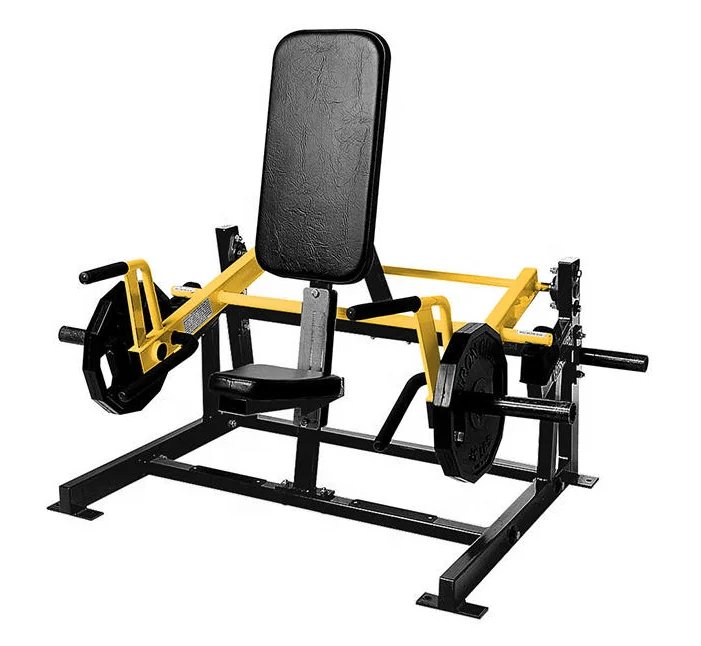
![Commercial Linear Hack Press Machine H5038 for Professional Gyms [WARN] draft identifier mismatch](https://bicksport.com/wp-content/uploads/2026/08/commercial-linear-hack-press-machine-h5038-for-professional-gyms-warn-draft-identifier-mismatch-cf7d2a.webp)

![Hammer Strength Hip and Glute Plate Machine for Commercial Gyms [WARN] draft identifier mismatch](https://bicksport.com/wp-content/uploads/2026/08/hammer-strength-hip-and-glute-plate-machine-for-commercial-gyms-warn-draft-identifier-mismatch-5cf4a4.webp)