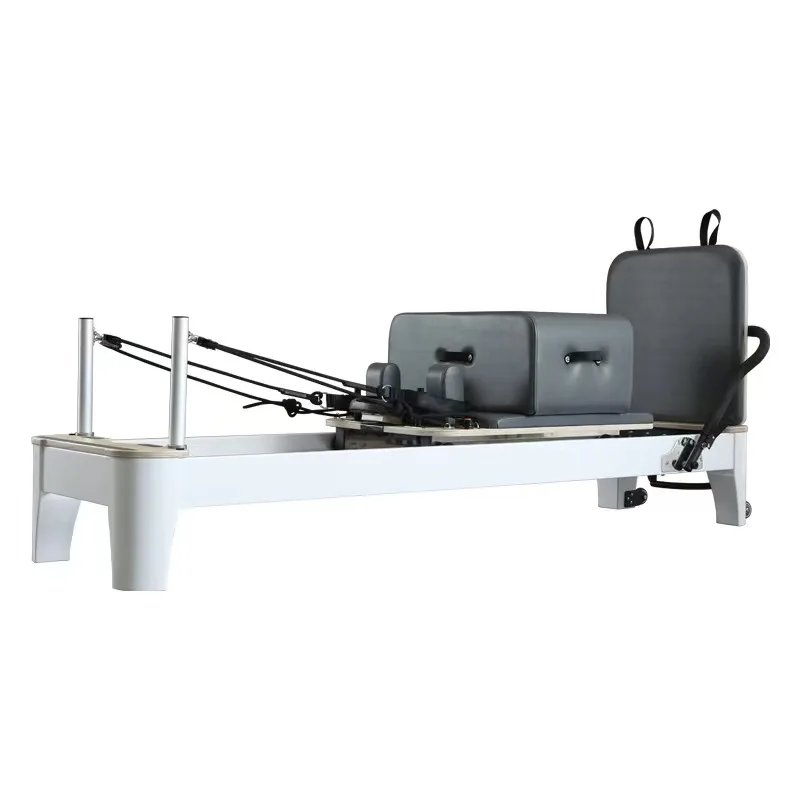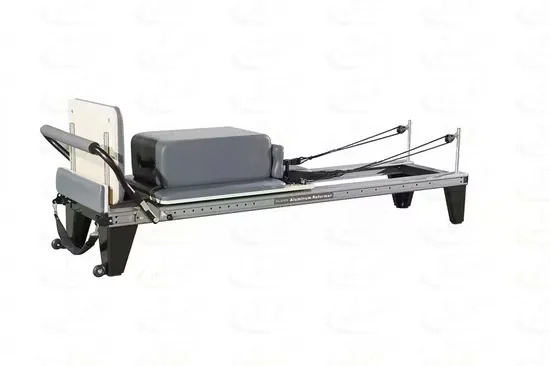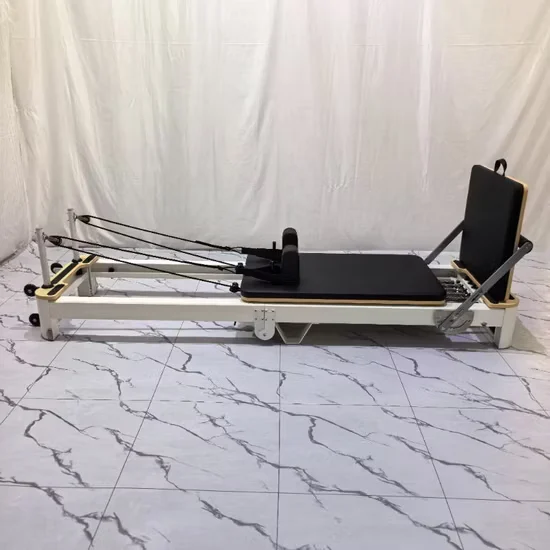
Whisper-Quiet Glide — Full aluminium alloy frame eliminates the resonance and creak typical of steel reformers, verified in multi-floor studio deployments.
Technical Specifications
| Parameter | Value |
|---|---|
| Designation | SRY-12A |
| Product Type | Pilates Reformer |
| Material | Aluminium Alloy |
| Color | White (customizable) |
| Accessories | Long Box, Jump Board, Platform |
| Dimensions | 2570 730 270 mm |
| Net Weight | 90 kg |
| Foldable | Yes |
| Age Group | Adult |
| Gender | Unisex |
| Warranty | 3 Years |
| Customization | Available (Logo, Color) |
Application Suitability
| Deployment Scenario | Typical Use |
|---|---|
| Boutique Pilates studio in mixed-use buildings | Daily group classes where floor-slab noise transfer must be minimized |
| Five-star hotel fitness suite | Compact, repositionable platform for multi-purpose wellness rooms |
| Rehabilitation and physiotherapy clinic | Stable, quiet surface for guided patient movement programs |
| High-end residential home gym | Foldable storage between sessions without sacrificing structural rigidity |
| Corporate wellness center | Shared equipment serving varied user profiles across the workday |
Why Noise Complaints Reach the Front Desk Before Maintenance Does
Aluminium framing cuts resonance at the source, not after it travels through the slab.
Steel-frame reformers broadcast spring vibration and carriage rattle through rigid connections to the floor. In a boutique studio sharing a ceiling with a restaurant, or a hotel wellness suite directly above guest rooms, that low-frequency transmission becomes a complaint before anyone realizes the equipment is the cause. I have seen facilities pull entire rows of steel reformers out and replace them after noise issues surface weeks into operation [NEED_CITE: acoustic transmission through floor slabs from vibrating fitness equipment]. A foldable aluminium Pilates reformer commercial studios deploy addresses this by changing the frame material itself, reducing the resonance pathway rather than trying to dampen it after the fact.
Where This Reformer Fits in a Multi-Discipline Studio Layout
The SRY-12A covers foundational through advanced Pilates programming, supporting both spring-loaded resistance work and jump board plyometrics within one footprint. In a studio configured with mat zones and tower apparatus, this unit fills the core reformer slot without demanding a separate jump platform or stretching station — the Long Box, Jump Board, and Platform are included in the accessory package. A foldable aluminium Pilates reformer commercial operators place in multi-purpose rooms can be stored vertically between sessions, reclaiming the floor for mat work or group movement classes. It accommodates adult users across a wide range of body proportions, given the 2570 mm rail length and adjustable spring configurations.
Continuous Daily Scheduling and the Room It Sits In
This reformer is built for back-to-back class scheduling where carriage travel cycles accumulate across six to ten sessions per day. The aluminium frame transmits less vibration to the subfloor than steel, which matters when the room below is occupied. Ventilation requirements are minimal since there is no motor generating heat, but adequate airflow around the spring tower and carriage rails prevents dust accumulation that degrades glide smoothness over months [NEED_CITE: particulate accumulation effects on linear rail glide systems]. Deployment requires a level floor; even a slight pitch causes the carriage to drift during slow controlled movements. Standard single-phase power is not required for the reformer itself, but if the room includes electronic accessory equipment, dedicated circuits prevent shared-load interference.
What the Aluminium Frame and Accessory Package Actually Do
Aluminium alloy as a structural material has a different damping coefficient than welded steel, meaning vibration energy from spring recoil and carriage stops dissipates within the frame rather than radiating outward through contact points with the floor. The 2570 mm rail length provides full travel for tall users performing long-box stretches and leg-circle sequences without the carriage bottoming out. The foldable mechanism reduces the storage footprint to roughly the depth of the frame height, which is the dimension that matters in a room switching between reformer classes and open-floor programming. The Jump Board and Platform extend the exercise library significantly — plyometric cardio sequences and supported standing work become possible without purchasing a second apparatus. Spring-based resistance delivers a progressive load curve that differs from the constant tension of elastic bands, requiring controlled eccentric engagement through the entire range of motion.
What Compromised Specifications Cost After Month Three
Reformers built with lighter-gauge materials or simplified folding mechanisms start showing problems once class volume accumulates. Rail surfaces that are not machined flat develop uneven carriage glide, which instructors notice when clients report inconsistent resistance feel across the travel range. Folding hinges that lack positive locking under load create a perceptible shift during footwork sequences — not a safety failure, but enough to undermine confidence in the platform [NEED_CITE: mechanical tolerance requirements for commercial Pilates reformer carriages]. Accessories that are rated for lighter static loads than the actual dynamic forces generated during jump board work create warranty disputes. The cost is not the replacement unit; it is the class cancellations, the member conversations, and the procurement cycle that follows.
Why This Product Line Was Built This Way
Sub-35 dB operation has been verified in hotel deployments where cardio equipment runs directly above guest rooms — that same noise-discipline applies to how this reformer’s carriage and spring system were specified. The 10,000-hour durability standard that governs motor and bearing testing across the cardio range translates here to cycle testing on the folding mechanism, spring anchors, and rail surfaces under continuous commercial-frequency loading. The accessory package is complete rather than modular up-sell, so a studio sources Long Box, Jump Board, and Platform from one line with confirmed load compatibility. OEM customization covers logo and color matching to studio branding without requiring a separate supplier conversation. Free 3D layout planning accounts for reformer spacing, instructor sightlines, and member flow between apparatus stations. Technical support remains available around the clock for deployment questions that surface during the first weeks of operation.
Documentation & Test Records
- CE declaration of conformity covering the complete SRY-12A assembly and accessory set
- EN 957 test report validating structural load and stability under dynamic use
- ISO 9001 certificate documenting manufacturing process controls
- Noise level test record for carriage glide across full rail travel
- Durability cycle data for folding mechanism and spring anchor points
- Accessory load rating documentation for Jump Board and Platform attachments
Installation, Commissioning & Maintenance
- Confirm floor levelness across the 2570 mm footprint; shim if carriage drifts on a neutral spring setting
- Maintain clearance on both sides for Long Box and Jump Board exercise sequences
- Inspect folding hinge lock engagement before every class session during the first month
- Wipe aluminium rails with a dry cloth weekly; avoid abrasive cleaners that score the glide surface
- Check spring anchor points and carriage cord tension quarterly under commercial scheduling
- Store vertically in folded position only on a stable wall mount rated for the 90 kg unit weight
Before You Send the Inquiry
Provide the studio floor area and planned reformer count so a 3D layout can map spacing, instructor circulation, and ventilation pathways around the equipment zone. Specify whether the deployment floor shares a ceiling with occupied space below, so rail and frame noise characteristics can be confirmed against the room’s acoustic sensitivity. Indicate if branding customization is required — logo placement and color matching are scoped during the quotation stage. State the target market and whether documentation must align with specific regional compliance frameworks.
Frequently Asked Questions
Q: How does the aluminium frame compare to steel in terms of noise and long-term durability?
A: Aluminium alloy dissipates vibration energy internally rather than transmitting it through rigid connections to the floor, which reduces audible resonance during spring recoil and carriage stops. For long-term durability, aluminium resists corrosion without surface treatment and maintains structural rigidity under continuous daily scheduling. The trade-off is that aluminium requires precise machining to achieve rail flatness, so manufacturing quality directly determines glide consistency.
Q: Does the foldable design compromise structural rigidity during exercises?
A: The folding mechanism uses positive locking at the hinge points, so the frame behaves as a single rigid structure once deployed and locked. During footwork, long-box stretches, and jump board sequences, there is no perceptible flex introduced by the fold joint. The lock must be visually confirmed before each session, which takes a few seconds and becomes part of the studio’s standard setup routine.
Q: What accessory configurations ship with the SRY-12A and how do they expand programming?
A: The unit ships with a Long Box for seated and supine exercises, a Jump Board for plyometric cardio sequences, and a Platform for supported standing work. Together these three accessories cover exercise categories that would otherwise require separate apparatus. All accessories are load-rated against the same structural specification as the frame, so instructors can program dynamic movements without cross-referencing separate weight limits.
Q: What should we verify about noise before deploying reformers on upper floors?
A: Request carriage glide noise data across the full rail travel range, since that is the primary sound source during operation. Confirm the floor construction type — concrete slabs transmit less vibration than timber joists. Position reformers away from shared walls where possible, and consider anti-vibration pads under the feet if the room below is acoustically sensitive. Early morning and late evening class schedules may require stricter noise thresholds.
Q: What does the 3-year warranty actually cover?
A: The warranty covers structural defects in the aluminium frame, rail surface integrity, folding mechanism components, and spring anchor points under normal commercial-frequency use. Consumable items such as springs, cords, and upholstery surfaces are excluded, as these wear based on usage volume and maintenance frequency. Warranty claims require proof of purchase and documentation of the deployment environment, including class scheduling density.
![Pilates Machine Metal Frame Folding Reformer for Yoga Exercise Studio[WARN] draft identifier mismatch](https://bicksport.com/wp-content/uploads/2026/08/pilates-machine-metal-frame-folding-reformer-for-yoga-exercise-studiowarn-draft-identifier-mismatch-08ae16.webp)
![Pilates Studio White Maple Wood Reformer Foldable Equipment [WARN] draft identifier mismatch](https://bicksport.com/wp-content/uploads/2026/08/pilates-studio-white-maple-wood-reformer-foldable-equipment-warn-draft-identifier-mismatch-2a8527.webp)