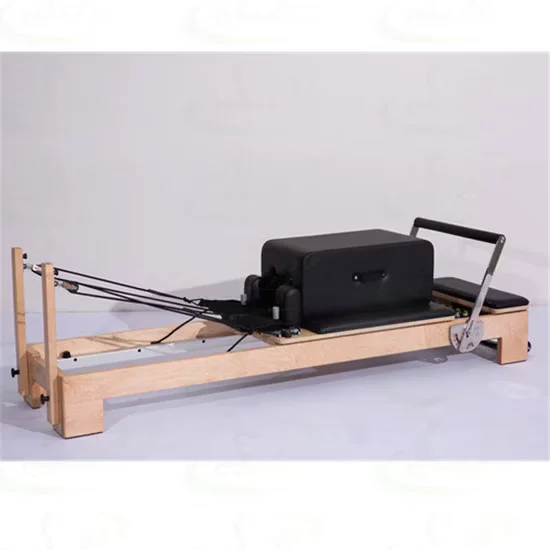
Whisper-Quiet Sliding System — Precision-machined aluminum rails and sealed roller bearings deliver silent, fluid carriage movement suitable for noise-sensitive studio environments.
Technical Specifications
| Parameter | Value |
|---|---|
| Product Type | Pilates Reformer |
| Model NO. | SRY-12B |
| Frame Material | Aluminum Alloy |
| Product Dimensions | 2570 × 730 × 270 mm |
| Net Weight | 90 kg |
| Included Accessories | Long Box, Jump Board, Platform |
| Color | Solid Color (custom options available) |
| Target User | Adult, Unisex |
| Logo | Customized Is Allowed |
| Warranty | 3 Years |
| Production Capacity | 80 Pieces/Month |
| Origin | China |
| HS Code | 9506911900 |
Application Suitability
| Deployment Scenario | Typical Use |
|---|---|
| Pilates studio group class floor | High-frequency class rotation with multiple daily sessions |
| Boutique fitness center mind-body zone | Semi-private reformer sessions alongside mat and equipment work |
| Rehabilitation and physical therapy clinic | Controlled resistance exercise for post-injury and mobility recovery |
| High-end residential home gym | Private daily use with full accessory range for varied programming |
| Hotel fitness center wellness area | Guest-accessible reformer stations in supervised or open-access formats |
Why Sliding Noise Becomes a Studio Reputation Problem Before Anyone Notices
Carriage rattle on a Pilates reformer is the kind of defect members feel before they can name it.
In a shared studio floor with six or eight reformers running simultaneously, cumulative rail noise becomes a constant low-frequency distraction that instructors must talk over and members learn to tolerate — until they stop renewing. [NEED_CITE: acoustic environment standards for group fitness studios] The commercial aluminum Pilates reformer with jump board and box addresses this at the rail-to-bearing interface, where material tolerance and surface finish determine whether the carriage glides or chatters under load. Wooden frames absorb some vibration but warp under humidity cycles common in studio environments, introducing misalignment that accelerates bearing wear and generates progressively worse noise over months of use.
Where This Reformer Sits in a Commercial Mind-Body Equipment Layout
The SRY-12B covers the full resistance spectrum from rehabilitation-level spring tension through athletic jump board plyometrics, placing it as the primary workhorse in any reformer-based programming model. In a studio layout, it pairs with cadillacs and chair units for advanced repertoire while functioning as the standalone station for group class formats where uniformity across positions matters for instructor sightlines. The commercial aluminum Pilates reformer with jump board and box accommodates users across a wide anthropometric range thanks to the 2570 mm rail length and adjustable foot bar positions. It fits facilities running six to ten daily class slots where equipment must reset quickly between sessions without recalibration.
Continuous Class Rotation and the Studio Environment It Demands
A reformer in a group class studio typically sees four to eight hours of active loading per day with rapid user changeover and minimal downtime between sessions. [NEED_CITE: equipment duty cycle expectations in commercial Pilates studios] The aluminum frame resists the humidity and sweat exposure inherent in these environments without the seasonal warping or fastener loosening that affects timber alternatives. Floor deployment requires a level surface with isolation pads beneath each foot to prevent rail-to-floor vibration transmission, particularly on suspended floors above occupied rooms. The 270 mm deck height keeps the center of gravity low for jump board work while allowing adequate undercarriage clearance for cleaning and inspection. Adequate lateral spacing between units — a minimum clearance on each side — ensures instructors can circulate and members can mount safely without crowding adjacent stations.
Rail Geometry, Spring Staging, and What the Specs Actually Control
The 2570 mm rail length provides sufficient carriage travel for full-range exercises including long box prone work and extended-leg foot bar positions, which shorter platforms compromise on larger users. Aluminum extrusion as a frame material delivers consistent cross-sectional rigidity along the entire rail span, meaning the carriage encounters no flex-induced binding at mid-span where wooden rails commonly deflect under load. The spring resistance system operates on progressive staging — multiple springs of differing tension combine to create a load curve that increases through the range of motion rather than applying constant force, which mirrors how muscles actually produce torque through joint angles. The included long box extends the platform surface for supine and seated work, the jump board converts the foot bar end into a plyometric surface for cardiovascular intervals, and the platform extension accommodates standing repertoire. Sealed bearings in the carriage wheels prevent sweat and dust ingress that would otherwise increase rolling friction and produce the grinding sensation that signals premature wear.
The Cost Curve of Specifying Below the Facility’s Actual Duty Cycle
Studios that select reformers based on unit price rather than rail tolerance and bearing specification typically encounter the first failures within the initial high-volume quarter. [NEED_CITE: maintenance cost comparison between commercial and light-commercial Pilates equipment] Carriage wheels develop flat spots from repeated heavy-user loading, springs lose tension calibration creating asymmetric resistance between left and right sides, and wooden frames begin to twist causing the carriage to track off-center. These failures do not arrive as catastrophic breakdowns but as accumulating member complaints about roughness, uneven resistance, and audible clicking — the kind of issues that erode class bookings gradually before management connects them to equipment condition. Facilities running reformer-based programming as their primary revenue model find that the procurement savings from lighter-duty specifications disappear within the first replacement cycle.
Why This Product Line Earns Its Position in a Commercial Deployment
Biketon Sport engineers every cardio and resistance platform around sub-35dB operation verified in hotel floor deployments, and the same acoustic discipline applies to the rail and bearing specification on this reformer. Components undergo 10,000-hour continuous-use testing protocols that simulate the loading patterns of high-frequency class environments. The full six-series equipment family means a facility outfitting both its cardio zone and its mind-body studio can consolidate sourcing, warranty, and technical support through a single supply relationship. OEM customization extends to logo placement, color specification, and accessory bundling so each deployment matches the facility’s brand environment. The 3D layout and airflow planning service accounts for reformer spacing requirements, instructor circulation paths, and HVAC load calculations specific to group exercise occupancy densities. Technical support responds around the clock across export markets, reducing downtime exposure for facilities operating outside standard business hours.
Documentation & Test Records
- CE declaration of conformity covering full equipment assembly
- EN 957 test report validating structural and mechanical safety
- ISO 9001 certificate for manufacturing quality management
- Noise level test report documenting rail and carriage acoustic output
- Durability test record for spring fatigue and bearing lifecycle
- Installation and commissioning guide with spare parts list
Installation, Commissioning & Maintenance
- Position the 2570 × 730 mm footprint with adequate lateral clearance for instructor access on both sides
- Install vibration isolation pads under all feet to decouple aluminum frame resonance from suspended floor structures
- Level the frame using a precision spirit level before tensioning springs, as rail twist accelerates bearing wear
- Verify spring staging symmetry across left and right anchor points during first commissioning
- Inspect carriage wheel bearings and rail surface for debris accumulation monthly in high-frequency class environments
- Wipe aluminum rails and spring housings after each class rotation to prevent sweat-induced corrosion on steel components
Before You Request a Quote
Share your studio floor dimensions and intended reformer count to receive a 3D layout addressing spacing, sightlines, and HVAC requirements. Specify your daily class schedule and expected hours of active equipment loading so spring specification and bearing grade match your actual duty cycle. Identify the deployment floor and adjacent occupied spaces to confirm acoustic isolation requirements. Indicate your target market so accessory packaging and documentation align with local regulatory expectations.
Frequently Asked Questions
Q: What advantages does an aluminum frame offer over wood for commercial Pilates reformers?
A: Aluminum alloy resists humidity-induced warping that causes wooden frames to twist and misalign carriage tracking over time. The extruded profile maintains consistent cross-sectional rigidity along the full rail length, preventing mid-span deflection under heavy users. It also eliminates the seasonal fastener retightening that wooden frames require as timber expands and contracts with studio climate cycles.
Q: How does the rail and bearing system affect noise during group classes?
A: Sealed roller bearings prevent sweat and dust from increasing rolling friction, which is the primary source of carriage grinding noise. Precision-machined aluminum rail surfaces maintain smooth contact geometry that does not degrade with use the way painted or coated steel rails can chip and roughen. This combination keeps cumulative studio noise low when multiple reformers operate simultaneously.
Q: What maintenance does the spring resistance system require?
A: Springs should be inspected quarterly for tension consistency across the set, as individual springs can lose calibration at different rates depending on usage patterns. Replacement springs should always be installed as matched sets to preserve symmetric resistance between left and right anchor points. Visual inspection for coil deformation or corrosion at attachment hooks catches problems before they affect member experience.
Q: How do the included accessories expand programming options?
A: The long box extends the platform for supine pulling straps and seated work that the standard carriage length cannot accommodate. The jump board replaces the foot bar to enable plyometric cardiovascular intervals within the reformer format. The platform extension provides additional standing surface area for balance and proprioception exercises at the head end of the unit.
![== 结果 == Pilates Reformer with Tower Half Trapeze White Aluminum for Studio Use [WARN] draft identifier mismatch](https://bicksport.com/wp-content/uploads/2026/08/e7bb93e69e9c-pilates-reformer-with-tower-half-trapeze-white-aluminum-for-studio-use-warn-draft-identifier-mismatch-3a63a8.webp)