
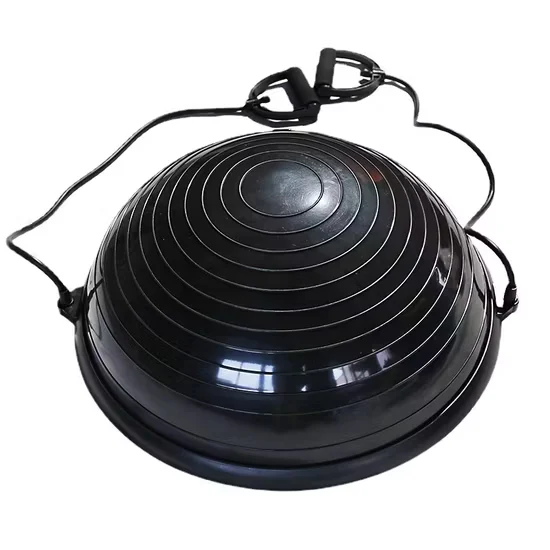
Durable Anti-Slip Construction — Half-ball surface texture tested for sustained grip under high-repetition commercial class use.
Technical Specifications
| Parameter | Value |
|---|---|
| Product Type | Balance Ball |
| Specification | 58*25cm |
| Color | Red (customizable) |
| Weight | 3kgs |
| Age Group | Adult |
| Target Gender | Women |
| Logo | Customized Is Allowed |
| MOQ | 2PCS |
| Production Capacity | 1000PCS/Month |
| HS Code | 9506911900 |
Application Suitability
| Deployment Scenario | Typical Use |
|---|---|
| Yoga studio group class area | Core stabilization and balance sequencing during guided sessions |
| Commercial gym functional training zone | Proprioception drills and strength integration circuits |
| Physical therapy and rehabilitation center | Low-impact stability retraining and post-injury balance work |
| High-end residential home gym | Daily mobility and core activation routines |
| Hotel fitness center group class room | Instructor-led balance and flexibility programming |
Why Grip Degradation Drives Member Complaints in Shared Fitness Spaces
Surface integrity defines the usable lifespan of balance equipment in commercial environments.
In high-traffic group class settings, balance props endure continuous foot traffic, sweat exposure, and repeated repositioning across abrasive flooring. When the anti-slip texture wears smooth within months, users experience instability during weight-bearing poses, leading to safety concerns and a noticeable drop in class participation [NEED_CITE: commercial balance equipment surface durability standards]. Facility operators often replace entire sets prematurely because the surface no longer provides reliable traction, generating waste and recurring procurement costs that were never budgeted.
Where the Half-Ball Sits in a Commercial Functional Training Layout
This commercial exercise stability balance ball serves the low-impact stability and core activation segment of a functional training zone. It complements dynamic equipment like battle ropes and plyometric boxes by providing a controlled, static instability challenge for rehabilitation and mobility work. Deployed along the perimeter or in dedicated group class areas, it accommodates users across a broad range of body types and fitness levels without requiring adjacent equipment clearance. The half-ball form factor supports both flat-side-down stability drills and dome-side-up advanced balance work.
Noise, Vibration, and Floor-Level Deployment Requirements
Unlike motorized cardio machines, balance equipment generates no operational noise or vibration, eliminating acoustic transmission concerns across occupied floors below. This makes the half-ball suitable for deployment on guest room levels in hotel fitness centers and upper-floor residential gyms where noise complaints originate from impact and mechanical sources [NEED_CITE: noise transmission criteria for fitness equipment on upper floors]. No dedicated power circuits or voltage matching is required. Ground-level placement on rubberized flooring provides adequate stability, though uneven subfloors can introduce lateral drift during single-leg exercises and should be leveled before installation.
Interpreting the Material and Dimension Specifications
The 58cm diameter provides a broad contact surface for bilateral stance work while remaining compact enough for storage in multi-purpose rooms where floor space is shared across class formats. At 3kgs, the unit is light enough for instructors to redistribute between classes yet heavy enough to resist sliding during lateral weight shifts. The anti-slip surface texture is a molded-in feature rather than a coating, meaning grip performance does not degrade through surface abrasion the way applied treatments do. The customizable logo and color allow facility operators to maintain visual consistency across a fleet of balance props without relying on external labeling that peels or fades.
The Hidden Cost of Specifying Consumer-Grade Balance Equipment
Consumer-grade balance balls and boards often use thin-shell construction that deforms under sustained commercial load, losing their geometric profile and training value within a single quarter. In group class environments where twenty or more units see daily rotation, premature deformation means members are training on compromised equipment without realizing the instability they feel is structural failure rather than a balance challenge [NEED_CITE: deformation thresholds for commercial balance training equipment]. The resulting loss of member confidence in class quality is difficult to reverse once negative reviews circulate, and wholesale replacement mid-cycle strains the equipment budget.
Why This Product Line Addresses Facility Pain Points
The Senrui balance ball line addresses surface degradation through molded-in texture that maintains grip across extended use cycles. Every unit in the commercial range undergoes durability verification aligned with the same 10,000-hour continuous-use framework applied across our cardio family. The 58cm footprint integrates cleanly into 3D cardio-zone layouts where spacing between balance stations and adjacent equipment must account for lateral movement during single-leg drills. OEM customization covers logo placement and color matching at flexible MOQ, supporting facility branding without extended lead times. Full documentation accompanies each shipment, and 24/7 technical support is available for specification clarification and post-delivery queries.
Documentation & Test Records
- CE declaration of conformity for fitness equipment
- EN 957 test report covering structural and stability requirements
- ISO 9001 certificate for manufacturing quality management
- Surface anti-slip performance verification record
- Material durability test log under repeated load cycles
- Product specification sheet with dimension and weight confirmation
Installation, Commissioning & Maintenance
- Deploy on level flooring with adequate lateral clearance for single-leg exercises
- No power connection required; position away from direct sunlight to preserve material integrity
- Inspect anti-slip texture quarterly for wear patterns in high-traffic class rotations
- Clean surface with pH-neutral disinfectant after each group class session
- Verify logo and color consistency upon delivery against approved OEM sample
- Store vertically or nested to minimize floor footprint between scheduled classes
Planning Your Balance Equipment Procurement
Provide your functional training zone square footage and intended class capacity to receive a 3D layout that positions balance stations with appropriate spacing for lateral movement. Specify whether deployment is on guest room floors or ground-level facilities to confirm subfloor requirements. Indicate target market for color and logo customization scoping and MOQ confirmation. Note any fleet branding requirements so console-adjacent visual identity can be coordinated across equipment categories.
Frequently Asked Questions
Q: What materials ensure long-term anti-slip performance in commercial environments?
A: The half-ball uses molded-in surface texture rather than applied coatings, meaning the grip pattern is integral to the structure itself. This prevents the smoothing effect that occurs when topical treatments wear away under continuous foot contact and cleaning chemical exposure in commercial group class rotations.
Q: How does half-ball design enhance training versatility compared to full balance balls?
A: The half-ball provides a stable flat base for standing and plank exercises while retaining the dome surface for advanced instability drills. This dual-function design reduces the number of separate props a facility needs to purchase and store, which is valuable in group class rooms where floor space must be reconfigured between sessions.
Q: What customization options are available for facility branding?
A: Logo placement and color can be customized to match existing facility visual identity across the equipment fleet. The OEM process covers surface color specification and logo positioning, with flexible MOQ requirements that accommodate both single-facility orders and multi-site rollout programs.
Q: How to maintain balance ball integrity in high-traffic group class settings?
A: Regular surface inspection for texture wear, cleaning with appropriate disinfectants, and proper storage between classes extend service life. Positioning units away from direct UV exposure and sharp-edged equipment prevents material degradation that compromises structural integrity over time.

![Fitness Lady Wooden Alloy White Frame Pilates Reformer for Studio [WARN] draft identifier mismatch](https://bicksport.com/wp-content/uploads/2026/08/fitness-lady-wooden-alloy-white-frame-pilates-reformer-for-studio-warn-draft-identifier-mismatch-e127c2.webp)
![Commercial Aluminum Pilates Reformer Core Bed for Studio [WARN] draft identifier mismatch](https://bicksport.com/wp-content/uploads/2026/08/commercial-aluminum-pilates-reformer-core-bed-for-studio-warn-draft-identifier-mismatch-1f9e4e.webp)
