
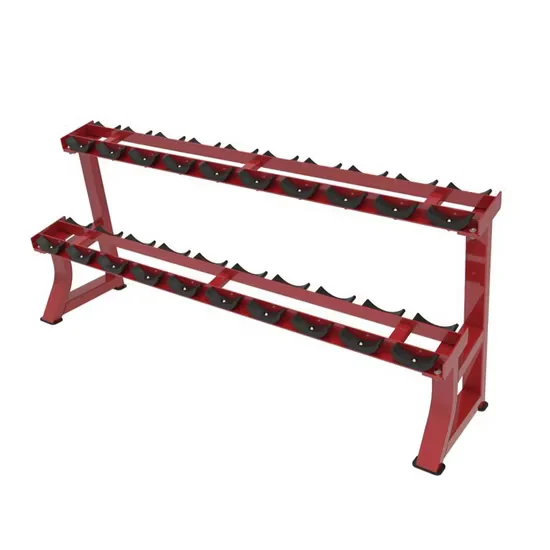
10,000-Hour Frame Endurance — welded steel uprights and reinforced cross-bracing validated for continuous high-frequency loading and unloading cycles in commercial free-weight zones.
Technical Specifications
| Parameter | Value |
|---|---|
| Product Type | Dumbbell Rack |
| Model NO. | 5070 |
| Material | Steel |
| Capacity | 10 Pair |
| Specification | 2210×700×800mm |
| Net Weight | 66kg |
| Main Frame Color | Available according to customer requirements |
| OEM/ODM | Acceptable |
| Certification | ISO 9001, CE |
Application Suitability
| Deployment Scenario | Typical Use |
|---|---|
| Chain gym free-weight zone | High-traffic dumbbell storage with constant member loading and unloading throughout operating hours |
| Hotel fitness center on guest room floors | Compact footprint storage for curated dumbbell sets in space-constrained 24-hour access facilities |
| Corporate wellness room | Organized dumbbell storage supporting group fitness classes and individual strength sessions |
| Professional gym and club | Heavy-duty rack anchoring full dumbbell sets in dedicated free-weight training areas |
| Community fitness center | Durable storage solution withstanding unsupervised public access and varied user handling |
Why Dumbbell Rack Frames Fail Before the Warranty Expires
Weld penetration depth and steel gauge determine whether a rack survives its first year in a commercial free-weight zone.
Walk into any gym that replaced its storage equipment within eighteen months and you will find the same pattern: uprights leaning outward, tier brackets sagging under load, and powder coat flaking at stress points where welds were too shallow to absorb repeated impact [NEED_CITE: structural fatigue testing standards for commercial gym storage equipment]. A commercial dumbbell rack 10 pair steel frame must handle members dropping dumbbells onto tiers rather than placing them gently, and that shock loading travels through every joint in the structure. I have seen facility managers cycle through two or three rack suppliers before finding frames that held alignment past the warranty period, and the difference always came down to steel thickness at the load-bearing uprights and whether the welder ran full-penetration beads at the tier bracket junctions.
Positioning This Rack in the Free-Weight Training Area
A ten-pair dumbbell rack serves facilities that stock a focused dumbbell range, typically covering light to moderate increments for general strength conditioning, rehabilitation work, and group class programming. In a commercial dumbbell rack 10 pair steel configuration, it occupies a linear footprint that fits along walls or between functional training zones, complementing plate trees, kettlebell stands, and barbell racks to create a complete strength equipment cluster. The 2210-millimeter length accommodates standard commercial dumbbell widths while the 800-millimeter height keeps the top tier within comfortable reach for most adult users. This rack suits moderate-to-high traffic environments where members rotate through dumbbell exercises during peak hours, and its open-frame design allows quick visual identification of available weight increments.
Continuous Use Cycles and Floor-Level Deployment Considerations
Free-weight zones see the most concentrated equipment interaction in any gym, with dumbbell racks absorbing hundreds of load and unload events daily across all operating hours [NEED_CITE: equipment utilization frequency in commercial fitness facilities]. Steel gauge and weld specification directly affect how long the frame maintains alignment under this cumulative stress, particularly in 24-hour hotel fitness centers where usage patterns never fully reset. Floor loading calculations must account for the rack’s 66-kilogram base weight plus the combined dumbbell mass at full capacity, which demands level substrate and appropriate flooring beneath the footprint. Placement relative to traffic flow matters for safety: members carrying heavy dumbbells need clear sightlines and unobstructed paths between the rack and training areas. In multi-story facilities, positioning the rack away from quiet zones reduces noise transmission from steel-on-steel contact during dumbbell returns.
Reading the Steel Specification Sheet Beyond the Marketing Claims
Frame longevity under commercial conditions starts with steel gauge at the uprights — thicker gauge resists the bending moment created when members pull heavy dumbbells from upper tiers. Weld quality matters equally; full-penetration welds at tier bracket junctions distribute impact forces across a broader area compared to spot welds that concentrate stress at single points. The 2210×700×800-millimeter footprint provides a length-to-height ratio that resists tipping even when the upper tiers are loaded first, a mistake members make frequently. Powder-coat finish thickness affects scratch resistance and corrosion protection, particularly in facilities where cleaning chemicals contact the frame during daily maintenance routines. Tier angle and lip design determine whether dumbbells seat securely or roll under lateral force, a detail that separates functional storage from frustration during busy training sessions.
What Happens When Storage Equipment Fails Under Load
A rack that sags or leans forces members to wrestle dumbbells out of misaligned tiers, increasing drop risk and generating complaints that reach facility management before maintenance staff notice the structural drift [NEED_CITE: liability exposure from equipment structural failure in commercial gyms]. Frames that cannot hold alignment under full capacity eventually develop cracked welds, creating sharp edges and catastrophic failure points that endanger anyone nearby. Facilities replacing racks prematurely face not only procurement costs but also downtime where members lack organized dumbbell access, disrupting training programming and eroding confidence in the facility’s equipment standards. Poor powder-coat adhesion accelerates cosmetic degradation, making otherwise functional equipment look neglected and prompting premature aesthetic replacement cycles.
Why This Product Line Holds Up Across Deployments
The 10,000-hour durability testing protocol that validates our cardio motors also informs the structural testing standards applied to storage frames, ensuring steel gauge and weld specifications meet continuous commercial demand. Full OEM and ODM capability extends to frame color, allowing facility operators to match existing equipment palettes without minimum-order friction. The 2210-millimeter length factors into our 3D layout planning, where we map dumbbell rack placement relative to training zones, traffic corridors, and ventilation paths to optimize member flow. ISO 9001 manufacturing oversight tracks each frame from raw steel through welding, finishing, and pre-shipment inspection, so the unit arriving at the facility matches the documented specification. Technical support covers installation questions and structural inquiries with 24/7 response, because a misaligned rack on opening day reflects on the entire equipment package.
Documentation & Test Records
- CE declaration of conformity covering structural safety requirements
- ISO 9001 certificate for manufacturing quality management
- EN 957 test report applicable to storage equipment stability
- Steel material specification sheet with gauge and grade documentation
- Powder-coat finish durability and adhesion test records
- Load capacity testing records at maximum ten-pair configuration
Installation, Commissioning & Maintenance
- Position the 2210×700mm footprint on level substrate with clearance on all sides for safe dumbbell retrieval
- Verify floor load capacity supports rack weight plus full dumbbell capacity before installation
- Inspect all weld joints and tier bracket fasteners upon delivery for transit damage before loading
- Apply manufacturer-recommended cleaning agents to preserve powder-coat finish against chemical degradation
- Conduct monthly alignment checks on tier brackets and uprights under full-load conditions
- Re-torque any adjustable foot pads to maintain frame levelness as flooring settles
Planning Your Free-Weight Zone Equipment Layout
Provide the free-weight area dimensions and planned dumbbell pair count to receive a 3D layout showing rack placement relative to training zones, traffic flow, and adjacent equipment clusters. Specify deployment floor level and adjacent occupied spaces so we can address noise transmission from steel contact during dumbbell returns. Confirm target market finishing requirements and color preferences for OEM frame customization matching existing facility aesthetics. Share whether the rack will operate in supervised or unsupervised access environments to guide placement recommendations.
Frequently Asked Questions
Q: How does steel gauge affect the rack’s long-term structural integrity under commercial use?
A: Thicker steel gauge at the uprights resists bending forces generated when members pull heavy dumbbells from upper tiers. Over hundreds of daily load and unload cycles, insufficient gauge leads to gradual frame drift, misaligned tiers, and eventual weld failure. Gauge specification documentation allows facility planners to verify the frame matches the expected usage intensity before procurement.
Q: What weld quality standards apply to commercial dumbbell rack construction?
A: Full-penetration welds at tier bracket junctions distribute impact loads across broader surface areas, preventing stress concentration that causes cracking under repeated dumbbell placement. Weld penetration depth and bead consistency are documented in manufacturing test records. Buyers should request weld inspection documentation to verify structural standards match the commercial deployment environment.
Q: How does powder-coat finish selection affect maintenance frequency in gym environments?
A: Powder-coat thickness and curing process determine scratch resistance when dumbbells contact tier surfaces during returns. Thicker coatings withstand daily cleaning chemical exposure without degrading, preserving corrosion protection and appearance. Finish specification sheets document coating thickness and adhesion test results, allowing facility managers to verify durability before installation.
Q: What spatial planning considerations apply when positioning a ten-pair dumbbell rack?
A: The 2210×700-millimeter footprint requires clearance on approach sides for members to stand while selecting and returning dumbbells safely. Placement should account for traffic flow between the rack and training areas, avoiding bottleneck zones during peak usage hours. Three-dimensional layout planning integrates rack position with adjacent equipment, ventilation paths, and member circulation patterns.
Q: Can the frame finish be customized to match existing facility equipment?
A: OEM and ODM customization covers main frame color according to customer requirements, allowing integration with existing equipment palettes or brand color standards. Color matching documentation confirms finish specifications before production begins. This customization extends to batch orders where multiple storage units need consistent appearance across facility zones.
![OS-H5081 Commercial Half Rack Steel Frame Gym Equipment for Professional Gym [WARN] draft identifier mismatch](https://bicksport.com/wp-content/uploads/2026/08/os-h5081-commercial-half-rack-steel-frame-gym-equipment-for-professional-gym-warn-draft-identifier-mismatch-46a436.webp)

![Popular Gym Equipment Adjustable Bench Incline Flat Decline 5067 [WARN] draft identifier mismatch](https://bicksport.com/wp-content/uploads/2026/08/popular-gym-equipment-adjustable-bench-incline-flat-decline-5067-warn-draft-identifier-mismatch-5211a0.webp)
