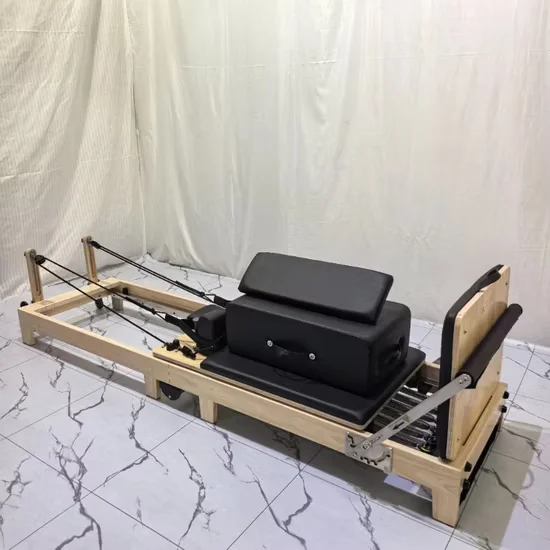
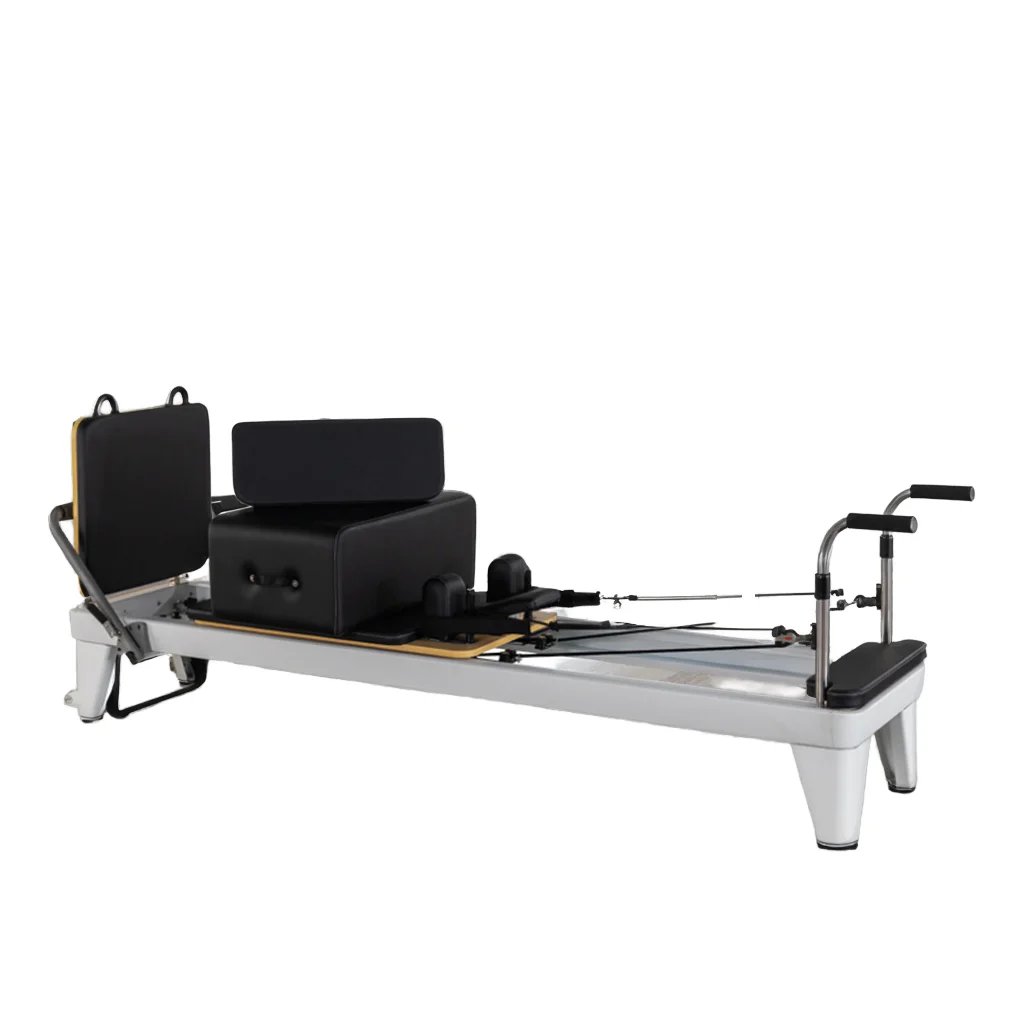
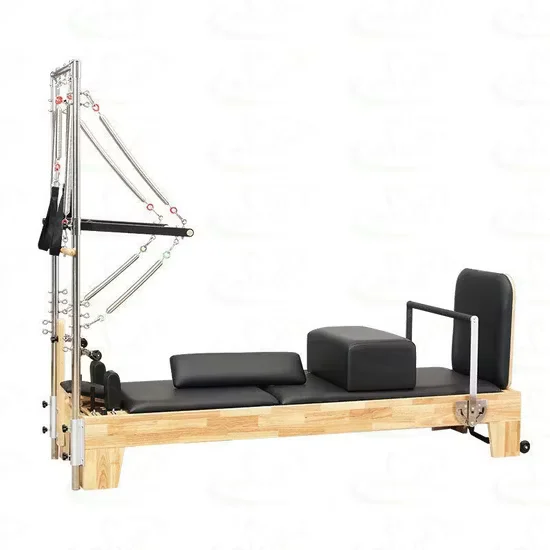
Vibration-Damped Wood Frame — Solid hardwood construction absorbs carriage resonance at the source, keeping studio floors quiet during group reformer sessions.
Technical Specifications
| Parameter | Value |
|---|---|
| Product Type | Pilates Reformer |
| Designation | SRY-24 |
| Frame Material | Solid Wood |
| Color | Solid Color (Customizable) |
| Included Accessories | Long Box / Jump Board / Platform |
| Product Dimensions | 2460 × 730 × 680 mm |
| Net Weight | 100 kg |
| Max User Weight | Not specified |
| Resistance Type | Spring-based |
| Age Group | Adult |
| Gender | Unisex |
| Customization | Available (Logo, Color) |
| Warranty | 3 Years |
| Production Capacity | 80 Pieces/Month |
| HS Code | 9506911900 |
Application Suitability
| Deployment Scenario | Typical Use |
|---|---|
| Boutique Pilates studio on upper commercial floors | Group reformer classes requiring low structure-borne noise |
| Five-star hotel wellness center | Supervised small-group sessions in shared spa zones |
| High-end residential home gym | Private daily practice without disturbing adjacent units |
| Rehabilitation center | Controlled spring-resistance therapy with quiet carriage travel |
| Yoga and movement studio | Cross-discipline use alongside mat and barre programming |
Why Wood Construction Matters Where Noise Complaints Originate
Solid hardwood frames dampen carriage vibration before it reaches the floor structure.
Studio operators on upper floors of mixed-use buildings learn quickly that metal-frame reformers transmit carriage oscillation directly through floor slabs. Guests in the room below hear every return stroke, and front desk complaints accumulate faster than maintenance tickets [NEED_CITE: structure-borne noise transmission in multi-story fitness facilities]. I once watched a boutique studio replace an entire set of steel-frame units after neighboring office tenants filed repeated noise grievances during morning classes. A wooden pilates reformer commercial yoga training environment demands a frame material that absorbs energy rather than conducting it, and kiln-dried hardwood does exactly that by dissipating vibration internally through its grain structure.
Where This Reformer Fits in a Mixed-Discipline Studio Layout
The SRY-24 covers full-range spring-resistance programming from rehabilitation-level light tension through advanced athletic loading, complementing mat zones and barre stations rather than duplicating their stimulus. Its 2460 mm length requires generous linear spacing but pairs naturally with wall-mounted accessory storage to preserve sightlines across the room. The wooden pilates reformer commercial yoga training configuration suits medium-density class schedules where three to five sessions run daily, and the 730 mm width accommodates users of varying torso and limb proportions without adjustment downtime between participants.
Continuous Scheduling and Room-Level Deployment Factors
A reformer in a commercial studio typically sees back-to-back classes with minimal idle time between sessions, so carriage wheel condition and rail cleanliness determine operational noise far more than frame material alone. Deploying units on floors above occupied spaces requires attention to subfloor rigidity; a flexible floor amplifies low-frequency oscillation regardless of frame construction [NEED_CITE: floor deflection criteria for dynamic fitness equipment loads]. Room ventilation must manage ambient humidity because solid wood responds to moisture swings, and seasonal HVAC planning should maintain stable relative humidity year-round. Power requirements are minimal since spring-resistance systems need no electrical supply, but overhead lighting placement affects instructor sightlines across the carriage path.
Reading the Spring and Rail Specifications Correctly
Spring-based resistance offers a progressive load curve that increases linearly with carriage travel, contrasting with friction systems that introduce mechanical noise at higher tensions. The number of springs and their individual tension ratings determine the total resistance envelope; swapping a heavier spring for a lighter one changes the character of every exercise rather than simply reducing load. Precision-machined rail surfaces and sealed carriage wheels maintain smooth glide and keep operational noise low over thousands of cycles. Belt-and-loop attachment points for the long box and jump board must distribute dynamic forces across the frame joint rather than concentrating them at a single fastener. Mortise-and-tenon joinery, when executed in kiln-dried hardwood, outlasts mechanical fasteners because the interlocking geometry resists cyclic shear without loosening. Heart rate monitoring is not built into the frame, so studios integrating biometric data must supply external chest-strap or optical systems independently.
The Hidden Cost of Specifying Below Commercial Duty
Metal-frame reformers purchased on unit price alone often develop carriage rattle within months of daily class use, and the resulting noise complaints force studios into wholesale replacements that erase any initial savings [NEED_CITE: equipment replacement frequency in high-utilization group fitness studios]. Inadequate rail hardness causes wheel flat-spotting under repetitive loading, producing a rhythmic thump that instructors cannot mask with background music. Springs that lack calibration documentation make class programming inconsistent across units, so participants on different reformers experience different resistance at the same setting. Accessories that attach via clamped brackets rather than integrated receivers gradually shift position during jump board work, creating both a safety concern and an audible click each carriage return.
What Sets This Product Line Apart
Sub-35 dB acoustic performance validated in hotel deployments translates directly to reformer rooms on guest floors where any carriage noise travels through ceiling plenums. The 10,000-hour durability testing protocol applied across the cardio range informs the wheel and rail specification on this reformer, ensuring glide consistency through years of daily group sessions. Full OEM and ODM capability extends to frame color and logo placement, letting studio brands match their interior palette without commissioning a separate production run. Free 3D layout and airflow planning accounts for reformer spacing, instructor circulation paths, and HVAC return placement so the room performs as designed from day one. 24/7 technical support covers spring replacement scheduling and carriage wheel inspection intervals specific to your usage pattern.
Documentation & Test Records
- CE declaration of conformity covering full reformer assembly
- EN 957 test report validating structural load capacity
- ISO 9001 certificate for manufacturing quality management
- Noise level test record under simulated class conditions
- Durability test log for carriage wheel and rail assembly
- Spring resistance calibration sheet with replacement schedule
Installation, Commissioning & Maintenance
- Allow minimum 600 mm clearance on all sides of the 2460 × 730 mm footprint for instructor access
- Level the solid wood frame on adjustable feet to prevent carriage drift on uneven floors
- Calibrate each spring set against reference tension before first class use
- Inspect carriage wheels and rail surfaces monthly for debris and flat-spot wear
- Wipe down wood surfaces with pH-neutral cleaner to prevent sweat-salt buildup
- Verify long box and jump board attachment points for secure lock before each session
Planning Your Reformer Room Procurement
Provide your studio floor plan with ceiling height and HVAC layout to receive a 3D placement and airflow study tailored to reformer spacing requirements. Specify expected daily class count and average participant weight so spring configuration and wheel load rating match your actual duty cycle. Identify the floor level and adjacent room usage so acoustic isolation measures align with the wooden pilates reformer commercial yoga training deployment. Confirm whether your member management platform requires usage data integration, which would necessitate external sensor systems.
Frequently Asked Questions
Q: How does a solid wood frame compare to steel for noise control in multi-story buildings?
A: Solid wood dampens vibration through its internal grain structure, reducing structure-borne noise transmitted through floor slabs. Steel frames conduct carriage oscillation directly into the building structure, which becomes audible in rooms below. For studios on upper floors of mixed-use buildings, wood construction meaningfully lowers the risk of noise complaints from neighboring tenants.
Q: What wood treatment is needed to maintain dimensional stability across seasons?
A: Kiln-dried hardwood with a sealed finish resists moisture absorption that causes warping or joint loosening. Studios should maintain stable indoor relative humidity year-round through HVAC control. Periodic inspection of frame joints and rail alignment catches early movement before it affects carriage glide or spring tension consistency.
Q: Which spring configurations suit beginner versus advanced class programming?
A: Lighter spring sets provide the low-tension range needed for rehabilitation and introductory sessions, while heavier springs deliver the progressive resistance advanced practitioners require. Calibrated springs with documented tension ratings ensure consistent feel across every reformer in the room, so participants experience the same load at identical settings.
Q: How often should carriage wheels and rails be serviced under daily class use?
A: Monthly inspection catches debris accumulation and early wheel wear before they produce audible glide irregularities. Sealed bearings reduce maintenance frequency compared to open designs. Rail surfaces should be cleaned with a dry cloth; lubricants attract dust that accelerates wheel wear and degrades smoothness over time.
Q: Can the jump board and platform be swapped frequently without loosening the frame?
A: Integrated attachment receivers distribute dynamic forces across the frame joint rather than concentrating stress at a single fastener point. This design maintains secure lock through repeated reconfiguration cycles. Studios running mixed-format classes benefit from quick-change hardware that does not require tools between back-to-back sessions.