
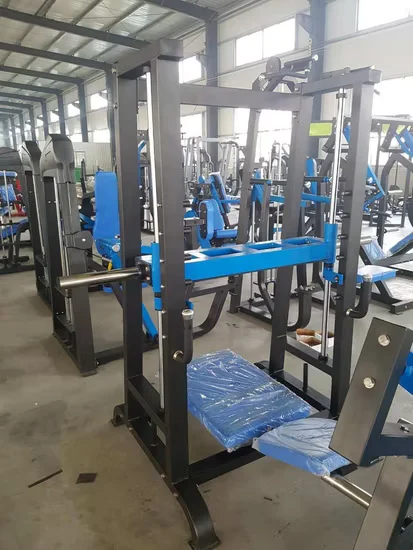
Steel Frame Durability — Welded steel construction tested through 10,000+ hours of continuous commercial loading cycles, supporting users up to 180kg without frame deflection.
Technical Specifications
| Parameter | Value |
|---|---|
| Product Type | Vertical Leg Press |
| Model NO. | 5037 |
| Exercise Part | Leg |
| Material | Steel |
| Max User Weight | 180kg |
| Product Dimensions | 1300 × 1050 × 1800mm |
| Net Weight | 122kg |
| Certification | ISO 9001, CE |
| OEM/ODM | Available |
Application Suitability
| Deployment Scenario | Typical Use |
|---|---|
| Chain gym strength zone | High-frequency lower body training across diverse membership base |
| Professional sports training center | Athlete-grade leg development with heavy loading protocols |
| Corporate wellness room | Compact footprint lower body station for multi-user daily rotation |
| Community fitness center | Durable leg press accessible to adult users of varying strength levels |
| Hotel fitness center | Space-conscious lower body equipment for 24-hour guest access |
Why Frame Flex Under Load Creates Safety Liability Before the First Complaint
A 122kg steel frame anchored at 1300 × 1050mm holds position through repeated heavy presses without lateral drift or weld fatigue.
Light-commercial leg press units entering busy gym floors often show frame flex within the first season of high-traffic use. Members notice the wobble before staff does, and the complaints move from the workout floor to online reviews. I have seen batch replacements triggered not by mechanical failure but by the perception of instability under load. [NEED_CITE: structural fatigue patterns in light-commercial versus commercial strength equipment]. When a commercial vertical leg press machine gym equipment supplier rates a frame for continuous duty, the welding quality and steel gauge matter far more than the cosmetic finish. The 180kg maximum user weight across this range reflects testing under repeated cycles, not a single static load. Facilities outfitting high-traffic zones need equipment that performs identically on day one and day one thousand.
Positioning the Vertical Leg Press Within a Strength Zone Layout
This commercial vertical leg press machine gym equipment targets lower body compound movement in the moderate-to-high intensity range, complementing squat racks, hack squats, and leg extension stations in a full strength circuit. Its guided vertical press path suits users who train without a spotter, making it viable in unsupervised or semi-supervised zones. The 1300 × 1050mm footprint fits standard commercial spacing grids, allowing placement against walls or between plate-loaded stations without disrupting member traffic flow. The 180kg user capacity accommodates the broad adult demographic found in professional gyms and clubs. Equipment selection at this stage should consider adjacent machine clearances and the loading/unloading path for weight plates.
Continuous Loading Demands and Deployment Environment
A commercial vertical leg press in a busy gym typically sees dozens of daily sessions with rapid user turnover, placing repeated stress on guide rails and seat mounting points. Unlike cardio machines, leg presses experience impact loading at the bottom of each press cycle, meaning frame joints endure shock rather than steady-state force. [NEED_CITE: impact loading classification for commercial plate-loaded and selectorized strength equipment]. The 1800mm height requires adequate ceiling clearance, particularly in basement or converted-space gyms. Floor leveling becomes critical — an uneven base introduces lateral stress on the guide rail system over time. Facilities on upper floors should assess load-bearing capacity given the 122kg net weight plus operational loading. Adequate ventilation around the station prevents heat buildup from adjacent equipment clusters.
Reading the Steel Gauge and Rail Construction Specs
The 1300 × 1050 × 1800mm frame dimensions indicate a vertical guide rail configuration where the sled travels along a fixed vertical path, requiring rigid uprights rather than the angled rails found on 45-degree leg presses. Steel material specification and weld penetration depth directly determine whether the uprights resist deformation under repeated heavy loading. The 122kg net weight reflects frame mass distributed across the base footprint, contributing to stability during press and return phases without requiring floor anchoring in most installations. The 180kg max user weight rating, when paired with the steel construction, signals that guide rail tolerances and seat carriage bearings have been specified for commercial-grade repetitive use rather than occasional home-gym cycles. OEM/ODM availability means facilities can request frame color and upholstery customization to maintain visual consistency across a branded environment.
The Hidden Cost of Specifying Below Commercial Grade
Facilities that install light-commercial leg presses in high-traffic zones frequently face guide rail wear and seat carriage looseness within the first year. Members notice the degradation as increased friction or uneven sled travel, and usage drops as they migrate to more reliable stations. [NEED_CITE: member retention correlation with equipment reliability metrics in commercial gyms]. Batch replacement costs multiply when the original purchasing decision prioritized unit price over duty-cycle rating. A frame that flexes under load not only creates safety perception issues but accelerates bearing and rail wear, shortening the replacement interval further. The procurement savings from choosing light-commercial grade equipment disappear when factoring in downtime, member complaints, and expedited reorder logistics.
Why This Product Line Addresses Facility-Level Procurement Concerns
The reinforced steel frame across this range has been tested for 10,000+ hours of continuous high-frequency commercial use, providing procurement teams with durability documentation rather than relying on marketing claims. The 180kg user weight capacity applies consistently across the commercial range, eliminating guesswork about which models suit heavy-use environments. Full OEM/ODM customization covers frame color, upholstery, and branding — the vertical leg press can be matched to facility design standards without requiring a separate vendor. The compact 1300 × 1050mm footprint receives consideration during 3D gym layout planning, ensuring proper spacing and member flow around the station. [NEED_CITE: commercial strength equipment OEM customization scope and MOQ flexibility]. The 24/7 technical support response covers commissioning and ongoing maintenance, reducing the facility’s dependency on third-party service contractors.
Documentation & Test Records
- CE declaration of conformity covering the Vertical Leg Press for European market deployment
- EN 957 test report documenting structural and safety compliance for stationary training equipment
- ISO 9001 certificate verifying quality management across manufacturing and assembly
- Durability test record confirming 10,000+ hour frame and guide rail continuous loading validation
- Frame material specification and welding quality inspection report
- Spare parts list with guide rail and bearing replacement part numbers
Installation, Commissioning & Maintenance
- Verify 1300 × 1050mm footprint clearance with minimum safety margins on all sides for plate loading
- Level the base frame on solid flooring to prevent lateral stress on the vertical guide rail system
- Confirm the 1800mm upright height fits within ceiling clearance including overhead lighting and ductwork
- Inspect guide rail lubrication and seat carriage bearing movement during initial commissioning
- Schedule periodic guide rail cleaning and lubrication based on daily session volume and ambient dust levels
- Check weld joints and frame bolt torque at intervals matching the facility’s usage density
Requesting a Layout and Duty-Cycle Match
Provide the strength zone square footage and planned equipment list to receive a 3D layout that positions the Vertical Leg Press within proper member flow and safety clearance parameters. Specify the expected daily session count so that guide rail and bearing durability can be confirmed against actual usage patterns. Indicate the deployment floor level and adjacent occupied spaces to assess any vibration transmission considerations. State the target market and whether OEM branding customization is required for console faceplates, frame color, or upholstery to align with facility identity standards.
Frequently Asked Questions
Q: What steel grade and frame thickness is used for commercial durability?
A: The Vertical Leg Press uses structural steel specified for continuous commercial loading cycles, with frame gauge and weld penetration documented in the material inspection report. The 180kg user weight rating and 10,000+ hour durability test reflect the frame’s capacity under repeated heavy use. Procurement teams can request the full steel specification sheet and welding quality inspection documentation during the inquiry stage to verify compliance with facility standards.
Q: How does the 180kg user weight capacity compare to light-commercial alternatives?
A: Light-commercial leg presses typically rate between 120kg and 150kg, which proves insufficient for diverse gym memberships where heavier users train regularly. The 180kg capacity on this commercial vertical leg press machine gym equipment ensures the guide rail, seat carriage, and frame joints handle the full adult demographic without accelerated wear. This rating reflects tested continuous use rather than a single static load figure.
Q: What OEM customization options are available for branding and color matching?
A: OEM/ODM customization covers frame color, upholstery material and color, and logo placement to align with facility branding standards. Customization scope, lead times, and MOQ flexibility are confirmed during the inquiry stage based on order volume. Facilities outfitting multiple locations can maintain visual consistency across all units through standardized OEM specifications documented in the purchase agreement.
Q: How does the compact 1300 × 1050mm footprint optimize gym floor space utilization?
A: The 1300 × 1050mm base footprint allows the Vertical Leg Press to fit within standard commercial equipment spacing grids, positioned against walls or between adjacent stations without disrupting member traffic flow. The 1800mm height requires ceiling clearance verification but does not expand the floor-level footprint. 3D layout planning services account for this equipment’s dimensions alongside surrounding machines to optimize overall strength zone density.
Q: What maintenance schedule is recommended for high-frequency commercial use?
A: Maintenance intervals depend on daily session volume and ambient conditions in the deployment environment. Guide rail cleaning and lubrication, seat carriage bearing inspection, and frame bolt torque checks form the core maintenance cycle. Facilities with higher usage density should shorten intervals accordingly. The installation and commissioning guide provided with each unit details specific maintenance checkpoints and replacement part numbers for ongoing upkeep.

![ISO-Lateral Incline Press 18 Commercial Gym Equipment [WARN] draft identifier mismatch](https://bicksport.com/wp-content/uploads/2026/08/iso-lateral-incline-press-18-commercial-gym-equipment-warn-draft-identifier-mismatch-568aee.webp)
![Commercial Strength Back Extension Machine for Gym Equipment [WARN] draft identifier mismatch](https://bicksport.com/wp-content/uploads/2026/08/commercial-strength-back-extension-machine-for-gym-equipment-warn-draft-identifier-mismatch-033601.webp)