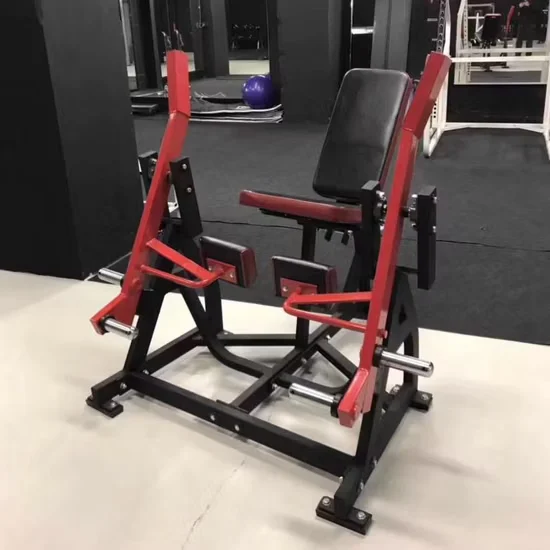
Heavy-Duty Welded Frame — 160kg steel construction anchors V-squat training under maximum load without floor displacement or lateral sway.
Technical Specifications
| Parameter | Value |
|---|---|
| Designation | 5040 |
| Product Type | V-Squat Machine |
| Material | Steel |
| Exercise Part | Leg |
| Age Group | Adult |
| Gender | Unisex |
| Product Dimensions | 1550×1850×1650mm |
| Net Weight | 160kg |
| Certification | ISO 9001, CE |
| Production Capacity | 500 PCS/Month |
Application Suitability
| Deployment Scenario | Typical Use |
|---|---|
| Chain gym strength zone | High-frequency bilateral and unilateral leg training during peak hours |
| Corporate wellness facility | Supervised lower-body sessions for employee fitness programs |
| Community fitness center | Durable leg press alternative accessible to general membership |
| Sports performance training center | Heavy-load squat pattern work for athlete conditioning |
Why Frame Welds Fail Before the Warranty Expires
Full-penetration steel welds and a 160kg footprint prevent the rattle that shuts down squat stations.
In commercial weight rooms, a V-squat machine absorbs cyclical loading that exposes every weak joint in the frame. Light-gauge tubing and spot-welded gussets develop hairline cracks within the first year of heavy use, producing metallic clicking that members interpret as structural failure. I have pulled strength units off gym floors where the carriage guide rails shifted off-axis because the base plate welds fatigued under repeated eccentric loading [NEED_CITE: structural fatigue patterns in commercial strength equipment frames]. The 5040 commercial V-squat machine strength equipment addresses this through reinforced steel construction and a heavy base that resists migration during loaded reps, reducing maintenance callbacks and member complaints about equipment feel.
Role in the Strength Zone Equipment Mix
This unit covers the closed-chain squat pattern, allowing users to load the quads and glutes without the spinal compression of a free barbell back squat. In a commercial layout, it pairs with a leg press for heavy bilateral work and a hack squat or lunge station for unilateral variety. The fixed movement path suits general-population members who lack the mobility for barbell squats, as well as athletes targeting hypertrophy without stabilizer fatigue. The 1550×1850mm footprint positions it along perimeter walls or between rack bays where ceiling height accommodates the 1650mm upright clearance.
Continuous Use and Floor Load Planning
A commercial V-squat machine in a busy gym endures dozens of loaded sets per day, each cycle transmitting force through the guide rails and base anchors. The 160kg net weight provides inherent stability on concrete subfloors, but rubber matting or vibration pads beneath the base prevent walking and protect finished flooring. Facilities on upper levels should verify slab load capacity and position the unit near structural columns rather than mid-span. Adequate clearance on all four sides allows loading and unloading of plates without obstructing adjacent traffic flow [NEED_CITE: floor load distribution for heavy static strength equipment].
Steel Gauge, Weld Profile, and Guide Rail Mechanics
The 5040 frame relies on welded steel tubing to resist the torsional forces generated during heavy eccentric phases. Full-perimeter welds at the base-to-upright junction distribute stress across a broader area compared to tack welds, which concentrate load at discrete points and crack under fatigue. The carriage travels on guide rails whose surface finish and alignment determine whether the movement feels smooth or binds under asymmetric loading. A heavier net weight generally correlates with thicker wall tubing, which resists deformation over thousands of cycles. Commercial-grade bearings or bushings in the carriage reduce friction and maintenance intervals compared to dry metal-on-metal contact surfaces. The V-angle of the sled determines how much shear force the knee joint experiences relative to a traditional barbell squat [NEED_CITE: biomechanical load distribution in V-squat versus barbell squat].
The Hidden Cost of Underbuilt Frames
A strength unit that saves cost on material thickness and weld passes will show its weakness within months in a high-traffic gym. Carriage rattle develops as guide rails wear unevenly, and members abandon the station for equipment that feels solid under load. Frame flex under heavy sets erodes confidence, particularly when users load plates beyond bodyweight. Facilities that replace underbuilt units end up paying twice—once for the original purchase and again for the swap, including freight, downtime, and lost member trust. The commercial V-squat machine strength equipment category demands a frame that holds geometry after years of cyclical stress.
Why This Product Line Holds Up
Every unit from this facility undergoes the same 10,000-hour durability testing protocol applied to the cardio range, meaning frame welds, guide rails, and bearings are cycled under load to verify long-term structural integrity. The steel construction of the 5040 meets EN 957 requirements for commercial strength equipment and carries ISO 9001 and CE certification. OEM customization extends to frame color, pad upholstery, and logo application at flexible MOQ. The in-house 3D layout service plans strength zone spacing, member flow, and ventilation around the 1550×1850mm footprint, ensuring the V-squat station integrates with adjacent racks and plate storage without bottlenecks. Technical support covers commissioning and spare parts availability.
Documentation & Test Records
- CE declaration of conformity for commercial strength equipment
- EN 957 test report covering structural integrity and safety
- ISO 9001 certificate for quality management systems
- Frame weld inspection and material thickness record
- Guide rail and bearing durability test log
- Spare parts list and exploded assembly diagram
Installation, Commissioning & Maintenance
- Verify floor flatness and place vibration pads under the 1550×1850mm base before anchoring.
- Maintain clearance on all sides for plate loading and user approach from the carriage entry point.
- Inspect guide rail lubrication and carriage bearing play at monthly intervals under heavy-use conditions.
- Check all frame bolt torque after the first 30 days and quarterly thereafter.
- Wipe down steel surfaces and upholstery after each session to prevent sweat corrosion.
Plan Your Strength Zone Around This Equipment
Provide your total strength area dimensions and planned equipment list to receive a 3D layout that positions this V-squat station within member flow and ventilation planning. Specify expected daily usage volume to confirm the frame and guide rail specifications match your duty cycle. Identify the target market voltage if the facility includes any powered stations nearby, and note whether adjacent spaces require noise mitigation from plate handling.
Frequently Asked Questions
Q: What structural differences separate a commercial V-squat from a home-gym version?
A: Commercial units use thicker steel wall tubing, full-perimeter welds at load-bearing junctions, and guide rail systems rated for thousands of loaded cycles. Home-gym frames often rely on lighter gauge material and spot welds that fatigue under daily high-frequency use. The 160kg net weight of a commercial unit reflects the material mass required to resist frame flex and maintain carriage alignment over years of continuous operation.
Q: How does the V-squat movement pattern compare to a traditional barbell squat?
A: The V-squat fixes the movement path and supports the torso, reducing the demand on spinal stabilizers and core bracing compared to a free barbell squat. This allows members with limited ankle or thoracic mobility to load the quads and glutes effectively. The sled angle shifts shear force distribution across the knee joint, making it a useful complement to free-weight squat patterns rather than a full replacement.
Q: How does welding quality affect the lifespan of strength equipment?
A: Weld profile and penetration depth determine how cyclical loads transfer through frame joints. Shallow or inconsistent welds create stress concentrations that propagate cracks under repeated heavy use. Full-perimeter welds distribute force across a broader contact area, delaying fatigue failure and maintaining structural geometry. Facilities evaluating strength equipment should request weld inspection records and material thickness documentation before committing to a purchase order.
Q: What layout considerations apply to placing a V-squat machine in a commercial gym?
A: The 1550×1850mm footprint requires clearance for plate loading on both sides and user approach from the carriage entry. Position the unit near structural columns on upper floors to manage point loads. Adequate airflow around the station prevents heat buildup during high-rep sets. Sightline planning ensures the station is visible from the gym floor, encouraging usage and enabling staff supervision during loaded exercises.
Q: What OEM customization options are available for this equipment?
A: Frame color, upholstery material and color, and logo placement can all be specified to match facility branding. Console and pad configurations are adjustable at flexible minimum order quantities. Custom requests are reviewed against the base engineering specifications to ensure structural integrity and certification compliance are maintained throughout the customization process.