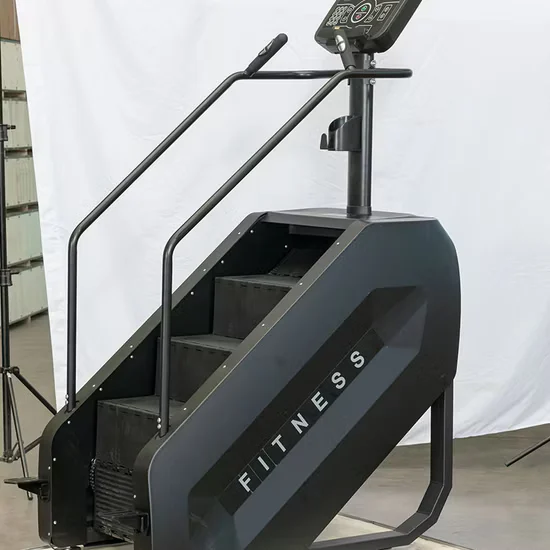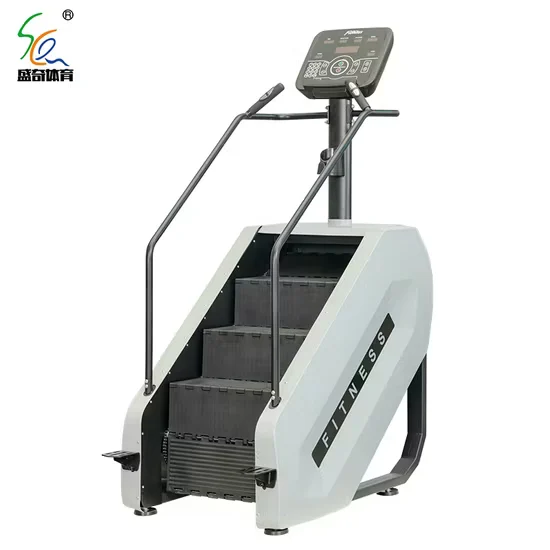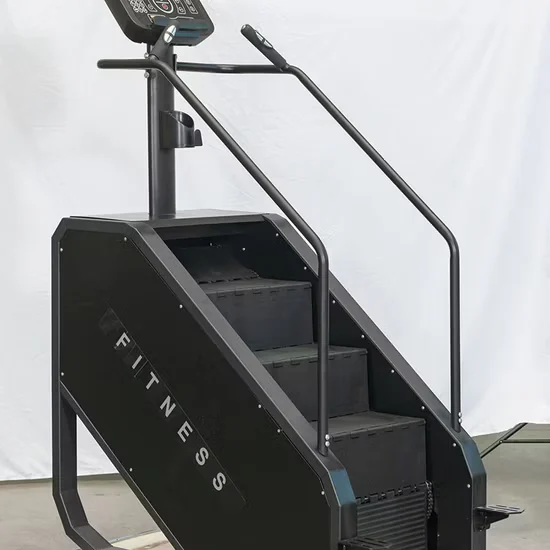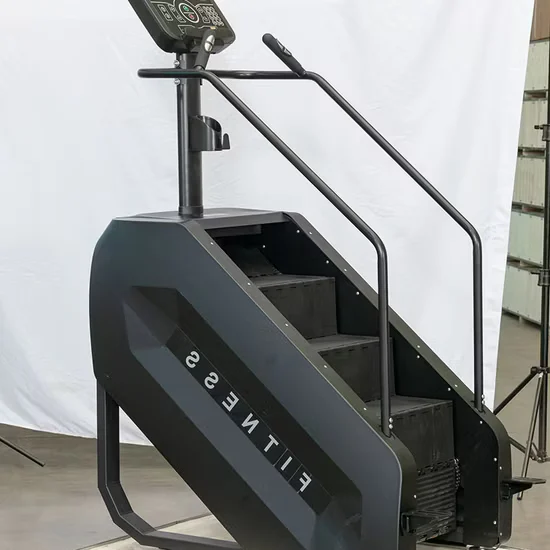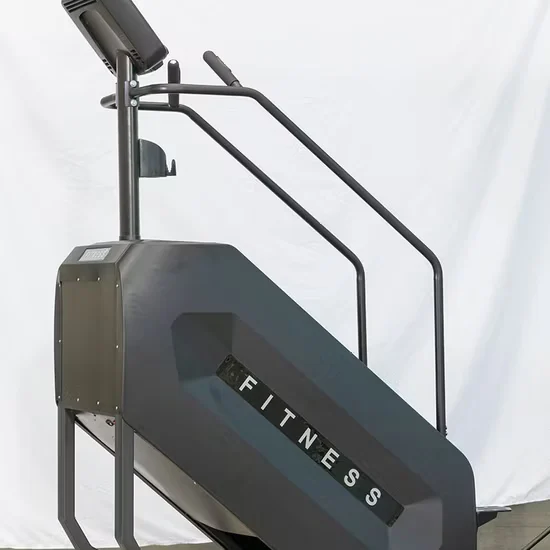
10,000-Hour Endurance Validation — motor drive and transmission components tested through sustained high-frequency cycles to confirm thermal stability under continuous commercial operation.
Technical Specifications
| Parameter | Value |
|---|---|
| Designation | SQ1017 |
| Product Type | Stair Climber |
| Type of Drive | Motor Drive |
| Running Velocity | 15–164 steps/minute |
| Step Area | 560 × 235 × 220 mm |
| Max User Weight | 180 kg |
| Mains Input | AC220V±10% / AC110V±10% |
| Console OSD | Time, Climb, Calories, Steps, Heart Rate |
| Product Dimensions | 1450 × 820 × 2080 mm |
| Net Weight | 148 kg |
| Material | Steel Pipe + PP Plastic |
| Folded | Unfolded |
| Color | Black (customization available) |
| Certification | CE |
| Application | Home, Gymnasium |
Application Suitability
| Deployment Scenario | Typical Use |
|---|---|
| Hotel fitness center on guest room floors | 24-hour self-service cardio access with low noise transmission to adjacent rooms |
| Chain gym cardio zone | High-frequency stair climbing station in rotation with treadmills and ellipticals |
| Corporate wellness room | Compact vertical cardio option for limited square footage environments |
| High-end residential home gym | Motor-driven stepmill for dedicated home training spaces with stable power supply |
| Sports performance training center | Sustained step-rate intervals for athlete conditioning programs |
Why Motor Burnout Happens Before the Warranty Expires
Continuous duty rating is what actually matters in a commercial stair climber motor drive system.
Facilities that run cardio equipment fourteen hours daily discover within months that motors spec’d for light-commercial cycles cannot sustain the thermal load. The winding insulation degrades, the drive board overheats, and the unit trips offline during peak hours. I have pulled apart stair climbers in chain gyms where the motor housing was discolored from repeated thermal cycling — the telltale sign of a component never rated for the workload it was given [NEED_CITE: motor duty cycle classification for continuous commercial operation]. The SQ1017 addresses this mismatch by pairing a motor drive with a velocity range from 15 to 164 steps per minute, engineered to hold consistent output across extended sessions rather than sagging under load.
Where This Stepmill Fits in the Cardio Floor Mix
Stair climbers occupy a distinct niche: they deliver high metabolic demand in a small footprint, making them the vertical-intensity anchor in any cardio zone. The SQ1017 covers steady-state climbing at lower step rates and interval work up to 164 steps per minute, bridging the gap between treadmill running and elliptical cross-training. Its 1450 × 820 mm footprint allows placement against walls or in dedicated climbing bays without blocking sightlines across the floor. The 180 kg max user weight accommodates a broad member demographic, and the motor-driven resistance ensures the step rate holds regardless of user weight shifts. This commercial stair climber motor drive unit pairs naturally beside treadmills and rowing machines, rounding out the high-intensity cardio segment.
Sustained Operation and Environmental Requirements
A motor-driven stepmill running in a hotel fitness center may log eight to sixteen active hours daily, which demands attention to ambient temperature and airflow around the motor housing. The SQ1017’s steel pipe frame and enclosed drive compartment require at least 30 cm clearance on all sides for passive heat dissipation — a detail that matters when units are positioned against walls in compact wellness rooms. Dual voltage input at AC220V±10% and AC110V±10% eliminates the post-delivery discovery that local mains supply does not match the equipment rating. Ground leveling is critical for step climbers; an uneven floor transfers lateral load into the drive mechanism, accelerating wear on sealed bearings [NEED_CITE: floor leveling requirements for commercial stepmill installation]. Facilities planning to integrate console data with member management systems should confirm OSD output format during the specification phase.
Reading Between the Lines on Drive and Control Specs
Motor drive systems in stair climbers replace the manual magnetic resistance found in budget units, providing electronically controlled step velocity that does not drift as components warm up. The SQ1017’s 15–164 steps per minute range covers rehabilitation-grade slow stepping through aggressive athletic intervals, and the electric control maintains target velocity regardless of whether the user weighs 60 kg or 160 kg. The console OSD tracks time, climb distance, calories, steps, and heart rate — a foundational data layer that facility operators use to monitor equipment utilization and member engagement. Heart rate monitoring through the handlebar sensors gives real-time feedback, though chest strap integration offers superior accuracy during high-intensity intervals. The step area of 560 × 235 × 220 mm provides a stable platform that accommodates varied foot sizes without crowding the stride, reducing the lateral instability that causes users to grip handrails excessively and alter their natural climbing pattern.
The Hidden Cost of Specifying Below the Duty Requirement
When a facility installs stair climbers with motors rated for two to four hours of daily use, the units fail in rotation — one every few weeks — creating a maintenance cascade that consumes technician hours and frustrates members who encounter out-of-order signage. Noise complaints follow a similar pattern: a drive system not engineered for sustained operation begins generating audible gear whine that travels through floor structures into occupied spaces below. Voltage mismatches represent another silent cost; containers arriving with single-voltage equipment require transformer installations or full returns. Data gaps compound over time when consoles cannot report usage metrics, leaving operators blind to which units are over-utilized and which sit idle [NEED_CITE: facility management data integration standards for commercial cardio]. These failures are not random — they trace directly to specification decisions made before purchase.
Why This Product Line Holds Up in Deployment
Every SQ1017 leaving the production line has its motor and drive components validated through the 10,000-hour durability testing protocol that covers thermal cycling, load variation, and continuous run periods. The sub-35 dB acoustic target verified in hotel deployments means this unit can operate on guest room floors without triggering noise complaints through the ceiling structure. The console OSD provides the usage data that facility managers need, and the IoT-enabled architecture allows integration with broader equipment monitoring systems. OEM customization extends to console interface design and color specification, so the unit can match a brand’s visual identity across a multi-site rollout. The six-series cardio family means a facility can source treadmills, bikes, ellipticals, rowers, and climbers from one engineering platform, simplifying maintenance training and spare parts inventory. Free 3D cardio-zone layout planning accounts for this unit’s 1450 × 820 mm footprint alongside required clearance for member flow and air circulation. Technical support operates around the clock to address commissioning questions or drive calibration issues as they arise.
Documentation & Test Records
- CE declaration of conformity covering electrical safety and electromagnetic compatibility
- EN 957 test report validating structural integrity and user safety requirements
- ISO 9001 certificate confirming quality management across manufacturing processes
- Noise level test report documenting acoustic output under sustained operation
- Durability test record for motor drive components under continuous load cycles
- Console technical documentation detailing OSD data output and connectivity options
Installation, Commissioning & Maintenance
- Allow minimum 30 cm clearance around the 1450 × 820 mm footprint for airflow and service access
- Verify floor levelness before anchoring; uneven surfaces load the motor drive asymmetrically
- Confirm local mains voltage matches AC220V±10% or AC110V±10% before first power-on
- Calibrate step velocity across the full 15–164 steps/minute range during commissioning
- Inspect motor drive belt tension and step mechanism alignment at scheduled service intervals
- Wipe console OSD screen and handlebar heart rate sensors daily to prevent sweat corrosion
Specifying for Your Facility’s Actual Requirements
Provide your cardio zone square footage and equipment count to receive a 3D layout that accounts for the SQ1017’s footprint, member flow corridors, and ventilation pathways. Specify expected daily operating hours so the motor duty cycle can be matched to your facility’s usage pattern. Identify the deployment floor and adjacent room types to confirm that acoustic performance meets your environment’s requirements. State the target market voltage standard — AC220V or AC110V — to ensure correct electrical configuration before shipment. Indicate whether console usage data needs to integrate with your existing facility management platform.
Frequently Asked Questions
Q: How does motor drive compare to manual resistance for commercial stair climbers?
A: Motor drive systems maintain consistent step velocity electronically, eliminating the resistance drift that occurs in manual magnetic systems as components heat up during extended operation. For facilities running equipment eight or more hours daily, motor-driven units provide predictable performance across all user weights and reduce the calibration adjustments that maintenance teams must perform.
Q: How can I verify the motor is rated for continuous commercial operation?
A: Request the motor specification sheet, which documents the continuous duty rating, thermal management design, and insulation class. Compare this against your facility’s expected daily run hours. Motors built for light-commercial cycles typically carry lower thermal thresholds that degrade under sustained public facility workloads [NEED_CITE: motor continuous duty rating verification methods].
Q: Can the console heart rate and step data integrate with facility management software?
A: The SQ1017 console displays time, climb, calories, steps, and heart rate through the OSD. Data output format and connectivity options are documented in the console technical documentation. Facilities requiring integration with member tracking platforms should confirm compatibility during the specification phase and request sample data output for testing.
Q: Which voltage should I specify — AC220V or AC110V?
A: The SQ1017 accepts both AC220V±10% and AC110V±10%, eliminating the voltage mismatch problem that surfaces after equipment arrives on site. Specify the voltage standard of your target deployment market during ordering. Facilities operating across multiple regions can standardize on one platform while receiving correctly configured electrical systems for each location.
Q: What placement factors affect stair climber usage rates?
A: Sightline positioning matters — units placed where members can see the cardio floor and natural light receive higher utilization. Airflow is critical since climbing generates significant metabolic heat; position units away from dead-air corners. Allow adequate spacing between adjacent climbers so users do not feel crowded during high-intensity sessions.