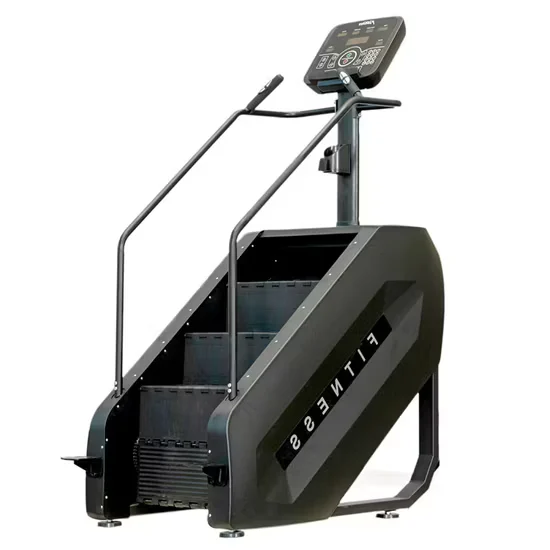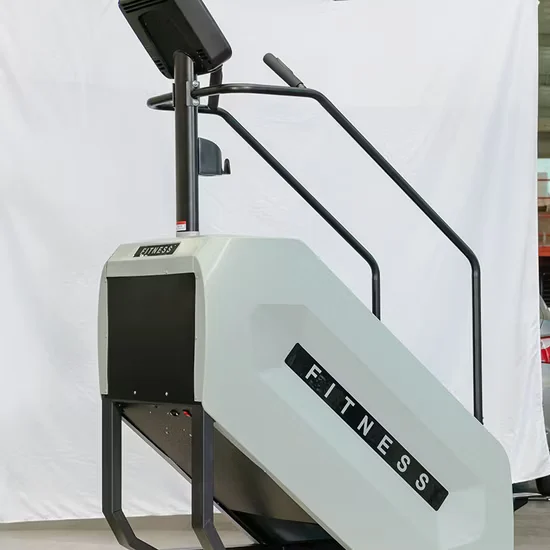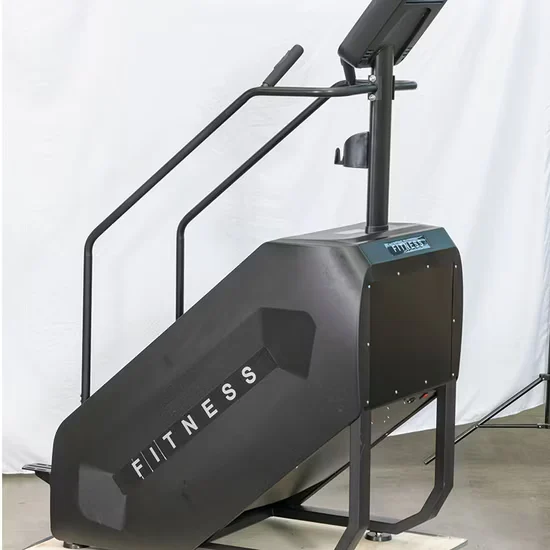
Continuous-Load Motor Validation — The SQ1017’s motor-drive stepper has been subjected to continuous duty-cycle testing to confirm sustained operation across high-traffic facility schedules without thermal degradation.
Technical Specifications
| Parameter | Value |
|---|---|
| Designation | SQ1017 |
| Product Type | Stair Climber |
| Drive Type | Motor Drive |
| Function | Electric |
| Running Velocity | 15 steps/Minute — 164 steps/Minute |
| Step Area | 560 x 235 x 220 mm |
| Max User Weight | 180 kg |
| Console Type | OSD — Time, Climb, Calories, Steps, Heart Rate |
| Heart Rate | Handgrip |
| Power Requirement | AC220V±10% / AC110V±10% |
| Product Dimensions | 1450 x 820 x 2080 mm |
| Net Weight | 148 kg |
| Material | Steel Pipe + PP Plastic |
| Foldable | Unfolded |
| Color | Black |
| Customization | Available (logo, color, console UI, specification) |
| Certification | CE |
Application Suitability
| Deployment Scenario | Typical Use |
|---|---|
| Hotel fitness center on guest room floors | 24-hour access stair training for transient guests with low noise transfer to adjacent rooms |
| Chain gym cardio zone | High-frequency stepper rotations integrated into a mixed-cardio lineup for general membership |
| Corporate wellness room | Moderate-use stair climbing for employee fitness programs during peak before-and-after-work windows |
| High-end residential home gym | Dedicated vertical climbing station for private use with commercial-grade structural longevity |
| Sports performance training center | Variable-cadence step intervals for athletic conditioning and lower-body endurance protocols |
Why Voltage Mismatches Derail Deployment Before the First User Steps On
Dual-voltage input eliminates the most common container-to-floor failure point.
I have seen facilities receive full shipments of cardio equipment only to discover the voltage and plug standard do not match local infrastructure. The equipment sits in crates while electricians source transformers, or worse, operators run machines through undersized adapters that degrade motor windings over weeks of continuous load. A commercial stair climber motor drive electric stepper that accepts AC110V±10% and AC220V±10% natively removes this variable entirely, allowing the same production run to deploy across Middle East hotel towers, European gym chains, and North American corporate wellness rooms without rewiring or adapter chains [NEED_CITE: voltage and plug standard alignment for international fitness equipment deployment].
Positioning the SQ1017 Within a Mixed-Discipline Cardio Floor
The SQ1017 fills the vertical-climbing slot in a cardio zone, complementing horizontal treadmills and ellipticals by targeting glute, quad, and calf engagement through sustained step cadence. Its velocity range from 15 to 164 steps per minute supports slow rehabilitation warm-ups at the low end and high-frequency interval blocks at the upper end. The 180 kg maximum user capacity accommodates a broad body-type spectrum without requiring a separate heavy-duty equipment tier. In terms of deployment density, the 1450 x 820 mm footprint allows placement alongside a commercial stair climber motor drive electric stepper in a stepped row configuration, maintaining sightlines across the cardio floor and supporting natural member flow patterns.
Continuous Duty Cycle and Environmental Load Considerations
Facilities running cardio equipment for eight or more hours daily need motors rated for continuous duty rather than intermittent peak output, because thermal buildup in underspecified windings degrades insulation over weeks of sustained operation. The SQ1017’s motor-drive system is designed for this sustained load profile, but deployment planning must still account for ambient temperature and airflow. Stair climbers generate concentrated heat at the motor housing, and placing units against walls without clearance restricts convective cooling [NEED_CITE: continuous duty motor thermal management in enclosed cardio zones]. The dual-voltage input ensures stable power delivery across regional grids, though dedicated circuits prevent voltage sag when multiple units ramp simultaneously. Floor leveling is essential: the 148 kg steel-pipe frame transmits vibration directly to the substrate, and uneven floors create oscillating loads that accelerate bearing wear and generate structure-borne noise on upper hotel floors.
Motor-Drive Cadence Control and Structural Mass
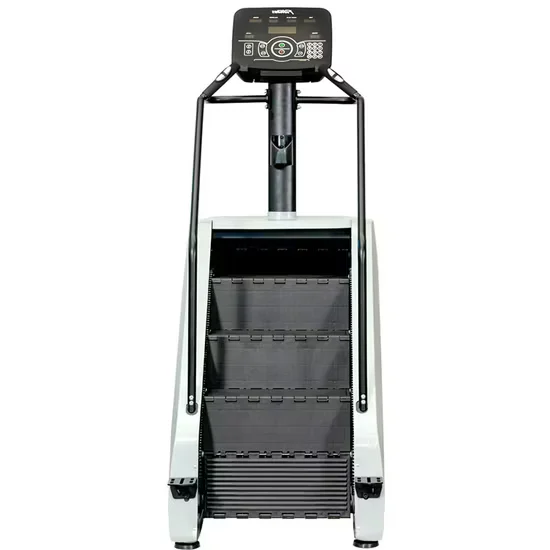
The motor-drive system in the SQ1017 controls step velocity electronically across the full 15–164 steps/min range, eliminating the mechanical gear shifting found in older stepped-resistance designs. This means cadence transitions during interval programming occur through electronic speed regulation rather than physical clutch engagement, reducing mechanical wear points. The step area of 560 x 235 x 220 mm provides sufficient foot placement depth for users across the height spectrum while containing the overall footprint. The 148 kg net weight, built from steel pipe and PP plastic, gives the frame enough structural mass to damp vibration during high-cadence climbing without requiring external ballast. The OSD console displays time, climb distance, calories, steps, and heart rate via handgrip sensors, providing baseline biometric tracking; OEM customization extends this to IoT integration and facility app synchronization where operators require data export to management platforms.
The Hidden Cost of Underspecified Stepper Components
A stepper deployed in a commercial gym that was specified for light-duty cycles will show premature bearing wear within months when subjected to continuous member rotations, generating grinding noise that migrates through floor slabs. In hotel environments, structure-borne vibration from under-massive frames triggers guest complaints in rooms directly below the fitness floor, often resulting in wholesale equipment replacement rather than component-level repair. Console systems that lack data interface protocols leave operators blind to usage patterns, making it impossible to identify underutilized units or schedule preventive maintenance based on actual run-hours rather than calendar intervals [NEED_CITE: console data integration requirements for predictive maintenance scheduling]. Voltage mismatches discovered post-delivery force operators into transformer workarounds that introduce additional failure points and void warranty coverage on motor electronics.
Why This Product Line Addresses Those Failure Modes
The SQ1017’s motor-drive architecture has been validated through continuous duty-cycle testing aligned with the 10,000-hour durability standard applied across the full cardio range. Sub-35dB operation verified in hotel deployments means the unit can sit on guest-room floors without generating noise complaints through the slab. The steel-pipe frame and 148 kg mass provide the structural damping needed for sustained high-cadence use. Console OEM customization allows operators to specify UI layouts and data protocols that integrate with existing facility management ecosystems rather than creating data silos. The six-series cardio family means a facility can source stair climbers, treadmills, ellipticals, bikes, rowers, and spinning bikes from a single production line, ensuring visual and technical consistency across the entire cardio zone. Free 3D layout planning accounts for the SQ1017’s 1450 x 820 x 2080 mm dimensions and overhead clearance requirements, integrating stair climber placement with ventilation paths and member sightlines. 24/7 technical support and spare parts availability reduce mean-time-to-repair for any component-level issues that arise post-commissioning.
Documentation & Test Records
- CE declaration of conformity covering electrical safety and electromagnetic compatibility
- EN 957 test report validating structural and mechanical requirements for stationary training equipment
- ISO 9001 certificate confirming quality management system compliance across production
- Noise level test report documenting sub-35dB operation under continuous load conditions
- Motor specification sheet detailing continuous duty rating and thermal performance data
- Console technical documentation including data interface protocols and OEM UI customization scope
Installation, Commissioning & Maintenance
- Allocate minimum clearance around the 1450 x 820 mm footprint for safe mounting and dismounting
- Level the substrate and install vibration-damping pads to prevent structure-borne noise transmission
- Connect to a dedicated circuit matching the configured AC110V or AC220V input to prevent voltage sag
- Run initial calibration cycle at low cadence to verify motor-drive response and OSD console accuracy
- Inspect step mechanism and drive components at scheduled intervals based on accumulated run-hours
- Apply sweat-resistant cleaning protocols to the steel-pipe frame and PP plastic surfaces after each use
Matching Equipment Specifications to Facility Requirements
Provide your cardio zone square footage and target equipment count to receive a 3D layout that integrates the SQ1017’s footprint with ventilation paths and member flow corridors. Specify daily operating hours so the motor duty cycle can be confirmed against your facility’s usage intensity. Identify the deployment floor and adjacent occupied spaces to validate that sub-35dB operation meets your acoustic requirements. Confirm target market voltage and plug standards so the correct input configuration ships from production. Indicate whether console data needs to interface with existing facility management software or member-facing apps for OEM UI customization scoping.
Frequently Asked Questions
Q: What durability differences exist between motor-drive and manual steppers for commercial deployment?
A: Motor-drive steppers regulate cadence electronically, distributing mechanical load evenly across the drive system during variable-speed use. Manual steppers rely on user-generated momentum through piston or hydraulic resistance, creating uneven load patterns that accelerate seal wear under continuous commercial rotation. Motor-drive systems generally offer more predictable maintenance intervals and consistent resistance feel across the full step-rate range, which matters in facilities running equipment for extended daily hours.
Q: How does dual-voltage input simplify international deployment?
A: Dual-voltage capability at AC110V±10% and AC220V±10% means the same production unit can deploy across regions with different grid standards without external transformers or rewiring. This eliminates post-delivery electrical mismatches that delay installation and introduces fewer failure points in the power chain. Operators ordering for multi-market rollouts can standardize on a single equipment specification rather than maintaining separate SKUs for different voltage regions.
Q: Can the OSD console data be exported to facility management software?
A: The standard OSD console displays time, climb distance, calories, steps, and heart rate locally. OEM customization options include configuring data interface protocols such as UART, BLE, or Wi-Fi to enable export to facility management platforms or member apps. Operators should specify their data ecosystem requirements during the quotation phase so the console firmware and communication module can be configured before production.
Q: What customization is available for branding and console interface?
A: Customization covers logo application, frame color, and console UI layout including branded startup screens, workout program naming, and data display arrangement. Console UI customization also extends to language selection and interface navigation structure to match facility branding guidelines. Operators provide artwork and interface specifications during the OEM scoping phase, and samples are confirmed before full production runs.
Q: How does the 148 kg steel-frame construction affect stability during high-cadence climbing?
A: The 148 kg net weight built from steel pipe provides sufficient structural mass to resist oscillation during rapid step cadences up to 164 steps per minute. Heavier frames absorb and dissipate vibration energy that lighter constructions transmit to the floor, reducing structure-borne noise on upper-level deployments. This mass also contributes to user confidence during aggressive climbing sessions where lateral forces increase with step intensity.
![SQ1017 High Performance Motor Drive Commercial Stair Machine [WARN] draft identifier mismatch](https://bicksport.com/wp-content/uploads/2026/08/sq1017-high-performance-motor-drive-commercial-stair-machine-warn-draft-identifier-mismatch-c50b40.webp)