
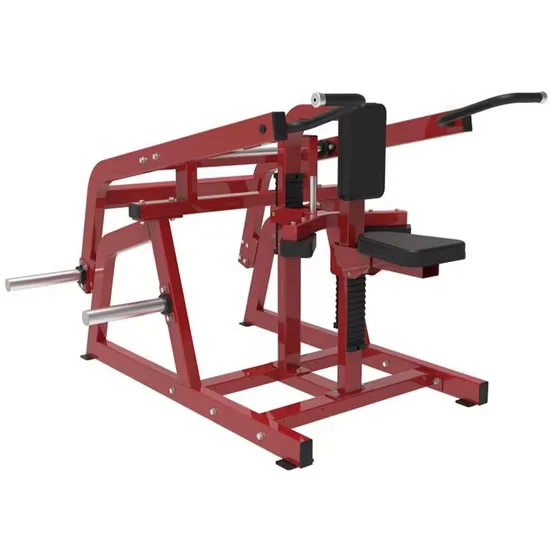
Commercial-Grade Frame Durability — Steel construction tested beyond standard duty cycles to withstand continuous public facility use without structural flex or bearing degradation.
Technical Specifications
| Parameter | Value |
|---|---|
| Product Type | Seated Dip Machine |
| Model NO. | 5014 |
| Age Group | Adult |
| Exercise Part | Arm |
| Gender | Unisex |
| Material | Steel |
| Product Dimensions | 1833×1496×1110 mm |
| Net Weight | 163 kg |
| Certification | RoHS, ISO 9001, CE |
Application Suitability
| Deployment Scenario | Typical Use |
|---|---|
| chain gym cardio zone | High-frequency upper body strength stations for general membership |
| corporate wellness room | Moderate-use strength equipment accessible to varied fitness levels |
| sports performance training center | Controlled dip movement for athlete upper body conditioning |
| hotel fitness center on guest room floors | Compact footprint upper body station complementing cardio lineup |
| high-end residential home gym | Durable steel frame for daily personal training routines |
What Bearing Failure Sounds Like Before the Complaint Call Arrives
A reinforced steel frame and commercial-grade pivot assemblies define how long this commercial seated dip machine gym facility operators choose will survive under continuous load. Structural rigidity determines maintenance intervals more than any single component.
I once serviced a mid-range dip station at a busy gym chain where the pivot bearings developed play within months, creating a metallic knock that members noticed mid-rep. The gym replaced the entire fleet rather than rebuild each unit because downtime meant lost revenue [NEED_CITE: bearing load ratings for high-frequency commercial strength equipment]. When frames flex under repeated loading, users feel instability before any visible wear appears. The 5014 addresses this through reinforced pivot assemblies and a 163 kg net weight that anchors the machine during explosive or controlled repetitions.
Upper Body Positioning Within the Strength Floor Layout
The Seated Dip Machine targets triceps, chest, and anterior deltoid through a fixed movement path, filling the gap between free-weight benches and cable systems in a commercial strength zone. It complements pull-down and row stations by covering the push movement pattern, giving members a complete upper body circuit without requiring spotter assistance. The 1833×1496 mm footprint fits standard equipment spacing grids, allowing placement against walls or between plate-loaded stations. Unisex ergonomic geometry accommodates adult users across a broad height and limb-length range without manual seat adjustment complexity.
Continuous Operation and Floor-Level Deployment Considerations
A gym running sixteen-hour days places this commercial seated dip machine gym equipment under hundreds of daily cycles, making bearing selection and frame weld integrity the governing factors in service life. Unlike motorized cardio units, a plate-loaded or weight-stack dip station produces no electromagnetic interference and requires no dedicated circuit, simplifying deployment on upper floors or adjacent to quiet zones [NEED_CITE: structural load requirements for commercial strength equipment on elevated floors]. Ventilation requirements are minimal, but sweat corrosion demands attention in humid climates — sealed bearings and powder-coated steel resist moisture ingress far longer than open assemblies. Ground leveling matters here: an unlevel base introduces lateral stress on pivot points, accelerating uneven wear.
Decoding the Frame and Pivot Specifications
The 163 kg net weight reflects steel gauge thickness and reinforcement at stress concentration points rather than cosmetic bulk. In a Seated Dip Machine, the pivot axis must resist both vertical loading from the user and lateral torque during uneven or explosive repetitions — undersized bearings develop radial play that manifests as wobble and noise. The 1833 mm length accommodates full range of motion without the user’s knees contacting the frame, while the 1496 mm width provides stability against lateral tipping during unilateral loading variations. Steel material choice here means weld integrity can be visually inspected and fatigue cracking detected before catastrophic failure, unlike cast aluminum alternatives that fail without warning [NEED_CITE: fatigue failure modes in commercial strength equipment frames].
The Hidden Cost of Underspecified Components
Gyms that purchased lighter dip stations report bearing replacement every few months, with each service call pulling maintenance staff away from revenue-generating work. Frame flex under heavy users creates an unstable feel that drives members toward free weights instead, leaving the machine underused and the investment wasted [NEED_CITE: member retention impact of equipment reliability in commercial gyms]. Noise from worn pivots travels through floor slabs in multi-story deployments, generating complaints from adjacent tenants or guest rooms above. Equipment rated for light commercial duty cycles fails prematurely when placed in twenty-four-hour facilities, forcing emergency procurement at premium pricing.
Why This Product Line Earns Its Floor Space
Sub-35 dB verification protocols developed for hotel cardio deployments apply equally to strength equipment — any unit generating metallic knock or squeak under load fails the acoustic standard. The 10,000-hour durability testing framework covers pivot bearings and frame welds, ensuring the 5014 survives continuous public facility operation without mid-cycle rebuilds. Full OEM and ODM capability extends to frame color and logo application, allowing facility branding consistency across the entire strength floor. Free 3D layout planning accounts for the 1833×1496 mm footprint alongside adjacent equipment sightlines and member traffic flow. Documentation packages include EN 957 test reports and ISO 9001 certificates, giving procurement teams the compliance paperwork needed for international tenders.
Documentation & Test Records
- CE declaration of conformity covering the Seated Dip Machine 5014
- EN 957 test report validating structural and safety requirements
- ISO 9001 certificate for manufacturing quality management
- RoHS compliance documentation for material restrictions
- Durability test record confirming bearing and frame cycle performance
- Installation and commissioning guide with spare parts list
Installation, Commissioning & Maintenance
- Maintain minimum 600 mm clearance on all sides of the 1833×1496 mm frame for user access
- Level the steel base on solid flooring using adjustable feet before loading
- Inspect pivot bearings quarterly and re-grease per manufacturer schedule
- Wipe down steel contact surfaces daily to prevent sweat-induced corrosion
- Verify all frame bolts at initial commissioning and again after the first month of use
- Replace worn grip surfaces before material degradation affects user safety
Request a Deployment Assessment
Provide your strength floor square footage and planned equipment list to receive a 3D layout addressing spacing, sightlines, and member flow around the Seated Dip Machine. Specify daily operating hours so we can confirm the bearing and frame specifications match your facility’s usage intensity. Indicate deployment floor level and adjacent occupied spaces to verify acoustic compatibility. State your target market so documentation and labeling align with regional requirements.
Frequently Asked Questions
Q: What materials are used in the frame construction for commercial durability?
A: The frame uses welded steel selected for fatigue resistance under repeated loading cycles. Steel allows visual inspection of welds and early detection of stress cracking before structural compromise occurs. The 163 kg net weight reflects gauge thickness at pivot stress points rather than cosmetic mass, ensuring stability during dynamic repetitions without lateral frame movement.
Q: How does the machine design ensure user safety and joint protection?
A: Biomechanically engineered pivot points align with natural elbow and shoulder articulation, reducing shear forces during the dip movement. The fixed movement path eliminates the stabilization demands of free-weight dips, making it suitable for users across varying experience levels. Ergonomic handle positioning accommodates different arm lengths without requiring manual adjustment mechanisms.
Q: What is the expected maintenance cycle for high-frequency commercial use?
A: Pivot bearings require quarterly inspection and lubrication under continuous gym operation. Frame bolt torque should be verified monthly during the initial deployment period, then quarterly once settling is complete. Steel surfaces need daily wipe-down to prevent sweat corrosion, particularly in high-humidity environments or facilities without climate control running around the clock.
Q: Can this equipment be customized for specific facility branding or color schemes?
A: Full OEM and ODM options cover frame powder-coat color selection and logo application, allowing visual consistency across an entire strength floor. Customization scopes are confirmed during the inquiry stage before production begins. This ensures branding alignment without delaying manufacturing lead times or requiring post-delivery refinishing work at the facility.
![Commercial Linear Leg Press Gym Equipment for Fitness Center Use [WARN] draft identifier mismatch](https://bicksport.com/wp-content/uploads/2026/08/commercial-linear-leg-press-gym-equipment-for-fitness-center-use-warn-draft-identifier-mismatch-1a4823.webp)
![Hammer Strength ISO-Lateral Front Lat Pulldown Gym Equipment [WARN] draft identifier mismatch](https://bicksport.com/wp-content/uploads/2026/08/hammer-strength-iso-lateral-front-lat-pulldown-gym-equipment-warn-draft-identifier-mismatch-b890da.webp)

![Plate Loaded ISO-Lateral Bench Press Commercial Gym Equipment [WARN] draft identifier mismatch](https://bicksport.com/wp-content/uploads/2026/08/plate-loaded-iso-lateral-bench-press-commercial-gym-equipment-warn-draft-identifier-mismatch-5afafa.webp)