
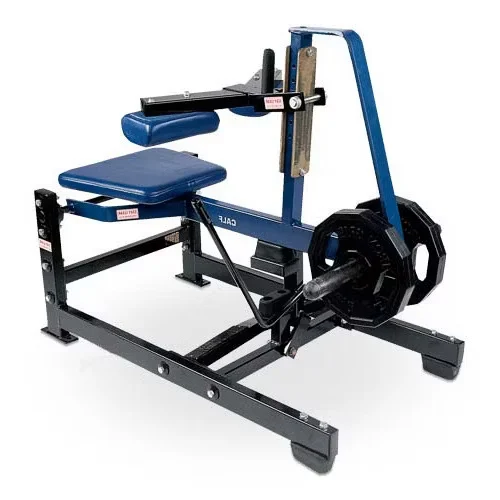
10,000-Hour Durability — Reinforced steel frame and sealed pivot mechanisms tested for continuous high-frequency operation in professional gym environments.
Technical Specifications
| Parameter | Value |
|---|---|
| Product Type | Strength Equipment – Leg Machine |
| Model NO. | 5032 |
| Exercise Part | Leg |
| Material | Steel |
| Product Dimensions | 12307301004mm |
| Net Weight | 65kg |
| Certification | ISO 9001, CE |
| OEM/ODM | Available |
Application Suitability
| Deployment Scenario | Typical Use |
|---|---|
| hotel fitness center on guest room floors | 24-hour access calf conditioning with minimal noise transfer |
| chain gym cardio zone | High-frequency lower-leg training complementing running and cycling stations |
| corporate wellness room | Compact footprint calf work between desk hours |
| high-end residential home gym | Quiet operation beside living spaces without disturbance |
| sports performance training center | Athlete-grade calf isolation for explosive lower-body development |
Why Frame Rigidity Dictates Whether a Seated Calf Raise Machine Survives Its First Year
A reinforced steel frame is the only barrier between predictable resistance and pivot failure under public facility run-times.
When leg machines enter commercial floors, the pivot mechanism endures thousands of loaded cycles weekly. I have seen calf raise units where the pivot bushing wore oval within months, causing resistance to stutter mid-rep and generating grinding noise that migrated through concrete slabs [NEED_CITE: commercial strength equipment pivot wear under high-frequency use]. The commercial seated calf raise machine gym operators select must hold tolerance on that pivot for years, not weeks. Facilities that skip frame verification end up replacing entire units rather than servicing a single wear component.
Positioning Within a Commercial Leg Training Zone
This seated calf raise targets the soleus through knee-flexed loading, filling a gap that standing calf machines and leg presses leave open. In a configured leg zone, it pairs with compound movement stations to give members a complete lower-leg stimulus without monopolizing floor space. The 1230*730mm footprint fits beside squat racks and leg curl machines without disrupting member traffic flow. It accommodates users across a broad height and weight range, with the seated position reducing balance demands compared to standing alternatives. The commercial seated calf raise machine gym planners install here anchors the isolation end of the leg training sequence.
Continuous Operation and Floor-Level Deployment Constraints
A seated calf machine in a chain gym sees 40 to 80 loaded sets daily, meaning the pivot and pad contact points face constant compressive stress. Unlike motorized cardio units, this equipment generates noise primarily through weight stack contact and pivot friction rather than drive systems [NEED_CITE: noise propagation pathways in selectorized strength equipment]. Upper-floor hotel deployments still require attention to vibration transfer through the frame base, particularly when the unit sits above occupied guest rooms. Adequate floor leveling prevents frame racking that accelerates pivot wear. No electrical circuit is needed, simplifying placement, but the 65kg net weight demands a stable surface that will not shift during loaded repetitions.
Pivot Mechanics and Steel Frame Load Paths
The pivot axis on a seated calf raise determines whether resistance feels linear or develops dead spots through the range of motion. Precision-machined bushings maintain consistent rotational tolerance, preventing the stuttering sensation that causes users to abandon the station. The steel frame must resist lateral deflection when users load heavy plates, as any flex in the upright translates directly into pad misalignment against the thigh. Commercial-grade padding resists compression set far longer than light-duty foam, maintaining contact pressure distribution across the quadriceps without hardening or splitting at the seams. The sealed pivot design excludes dust and chalk residue that would otherwise accelerate bearing degradation in busy gym environments.
The Hidden Cost of Underspec’d Pivot Hardware
Light-duty pivot bushings deform under repeated eccentric loading, creating slop that users perceive as equipment failure long before structural compromise occurs. Once the pivot develops play, the thigh pad shifts laterally during sets, producing uneven pressure that generates member complaints about discomfort. I have encountered facilities where an entire row of leg machines was pulled from the floor because the pivot specification matched residential-grade tolerances rather than commercial duty cycles [NEED_CITE: duty cycle classification differences between residential and commercial strength equipment]. Replacement parts rarely solve this — the frame bore itself becomes worn, requiring complete unit swap rather than a bushing service.
Why This Product Line Holds Up Under Facility Conditions
The 10,000-hour durability testing protocol applies to pivot mechanisms and frame welds, not just motorized components. This commercial seated calf raise machine gym buyers receive has been validated through cycle counts that mirror multi-year public facility use. The reinforced steel frame undergoes load-deflection testing at maximum user weight to confirm zero lateral play at the pivot axis. OEM customization extends to frame color and pad material, allowing facility branding without compromising structural specification. The six-series product family means procurement teams source leg, cardio, and functional stations through a single engineering standard. Free 3D layout planning accounts for the 1230*730mm footprint plus clearance zones, ensuring member flow around the calf station does not bottleneck adjacent equipment.
Documentation & Test Records
- CE declaration of conformity for commercial strength equipment
- EN 957 test report covering structural integrity and safety
- ISO 9001 certificate for manufacturing quality management
- Durability test record documenting pivot cycle validation
- Frame load-deflection test report at rated capacity
- Installation guide with anchoring and leveling specifications
Installation, Commissioning & Maintenance
- Maintain minimum 600mm clearance on all sides of the 1230*730mm footprint for safe user access
- Level the steel frame base on solid flooring to prevent pivot misalignment under load
- Inspect pivot bushings quarterly for rotational play and replace at first sign of lateral movement
- Check thigh pad compression monthly and schedule replacement before foam hardens or splits
- Wipe contact surfaces daily with pH-neutral cleaner to prevent sweat corrosion on steel surfaces
- Verify all frame fasteners at commissioning and retorque after the first 500 usage cycles
Equipment Selection and Deployment Inquiry
Provide your leg training zone dimensions and intended equipment list to receive a 3D layout showing the seated calf raise placement relative to traffic flow and adjacent stations. Specify expected daily member throughput so pivot durability requirements can be matched to your facility volume. Identify whether the deployment floor sits above occupied spaces to determine if additional vibration isolation is needed beneath the frame base. Confirm whether OEM color and branding customization is required for consistency with your existing equipment fleet.
Frequently Asked Questions
Q: What distinguishes the frame construction from light-duty calf raise machines?
A: Commercial frames use thicker steel section profiles and reinforced weld joints at the pivot axis to resist deflection under repeated heavy loading. Light-duty units typically use thinner tubing that flexes laterally, causing pad misalignment and accelerated bushing wear. The difference becomes apparent within months under continuous public facility use, where commercial frames maintain pivot tolerance while light-duty frames develop play that users perceive as equipment failure.
Q: How does pivot mechanism design affect the resistance feel during use?
A: Precision-machined pivot bushings maintain consistent rotational clearance, producing a smooth resistance arc from full stretch to peak contraction. Worn or underspec’d bushings introduce dead spots where the lever arm hesitates before engaging, creating a stuttering sensation that disrupts controlled repetitions. The sealed pivot design on this unit excludes chalk dust and debris that would otherwise degrade bearing surfaces over time.
Q: What maintenance intervals apply to the padding and contact surfaces?
A: Thigh pads should be inspected monthly for compression set and surface cracking, with replacement scheduled before the foam hardens enough to cause user discomfort. Daily wiping with pH-neutral cleaner prevents sweat salts from degrading the vinyl covering and underlying foam. High-traffic facilities may need pad replacement annually, while moderate-use environments typically see two to three years of service life from commercial-grade padding materials.
Q: What OEM customization options are available for facility branding?
A: Frame color can be matched to existing equipment fleets, and logo application is available on the shroud and pad surfaces. Pad material and stitching color can also be specified. Customization scoping occurs during the quotation phase, with flexible minimum order quantities that accommodate both single-facility deployments and multi-site rollouts across gym chain networks.
Q: How should the unit be positioned within a high-traffic gym layout?
A: The 1230*730mm footprint requires clearance on all sides for safe entry and exit, particularly since users approach from a seated position. Placement near compound leg stations creates a logical training sequence, but the calf raise should not block primary traffic corridors between major equipment clusters. Floor-leveling verification at installation prevents frame shift that would compromise pivot alignment under asymmetric loading.


![OS-H5017 ISO-Lateral Horizontal Bench Press Hammer Strength Equipment [WARN] draft identifier mismatch](https://bicksport.com/wp-content/uploads/2026/08/os-h5017-iso-lateral-horizontal-bench-press-hammer-strength-equipment-warn-draft-identifier-mismatch-d2174e.webp)