

Reinforced Load Path — Steel frame and sealed bearings tested for 10,000+ hours of continuous high-frequency plate-loaded operation.
Technical Specifications
| Parameter | Value |
|---|---|
| Product Type | Strength Machine (Hammer Strength Series) |
| Model NO. | 5013 |
| Exercise Part | Back |
| Material | Steel |
| Resistance Type | Plate-loaded |
| Max User Weight | 180kg |
| Product Dimensions | 1466 × 1292 × 1502mm |
| Net Weight | 93kg |
| Certification | ISO 9001, CE |
Application Suitability
| Deployment Scenario | Typical Use |
|---|---|
| International gym chain cardio and strength zones | High-frequency isolated arm training between compound lifts |
| Hotel fitness center with 24-hour guest access | Self-guided biceps work with intuitive plate-loading operation |
| Corporate wellness room | Low-maintenance strength station for employee use during breaks |
| Community fitness center | Durable biceps isolation for members of varying experience levels |
| Sports performance training center | Controlled resistance curves for athlete arm conditioning |
Why Frame Flex Under Load Tells You Everything About Commercial Durability
A strength machine that deflects under heavy plates is a strength machine that will develop bearing play and weld fatigue within months.
I once watched a plate-loaded arm station at a busy chain gym develop visible lateral sway during warm-up sets — not even working sets. The uprights were boxed steel with thin-wall construction, and the pivot bearings were open cartridge units that had ingested chalk dust and sweat residue until they ground audibly on every rep [NEED_CITE: structural deflection thresholds for commercial strength equipment under cyclic loading]. That entire row of hammer strength units was pulled from the floor and replaced within a year. The commercial seated biceps hammer strength machine in this lineup takes a different approach: reinforced steel uprights and sealed bearing pivots that keep the resistance path consistent rep after rep, session after session.
Where This Station Fits in a Commercial Strength Floor
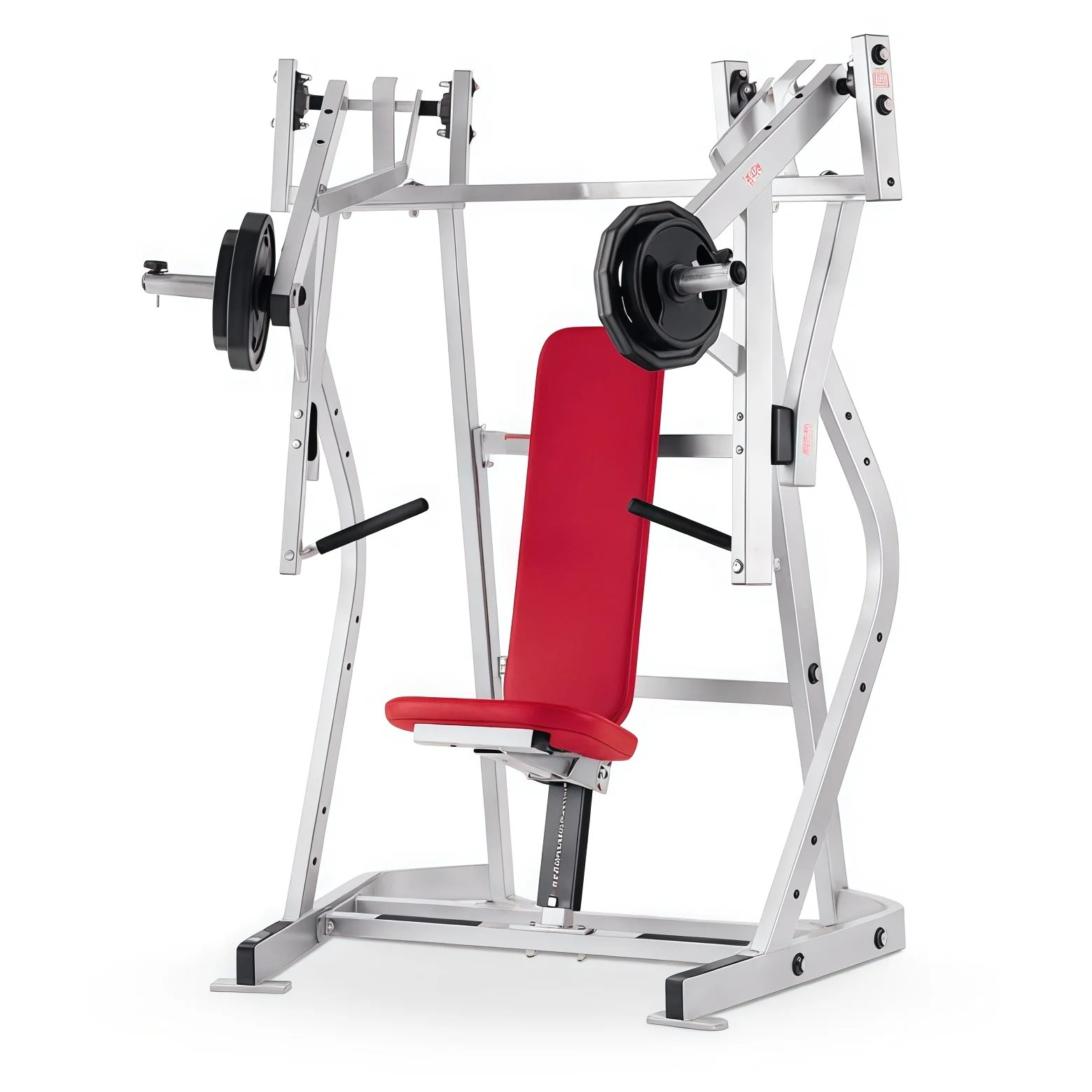
This machine covers isolated biceps loading in the moderate-to-heavy resistance range, filling the gap between free-weight curl stations and cable-based arm work. On a commercial strength floor, it pairs naturally with a triceps press counterpart and compound pulling stations, giving members a complete arm training circuit without competing for the same rack or cable column. The 1466 × 1292mm footprint allows deployment against walls or in dedicated hammer strength rows where traffic flow is linear. The 180kg maximum user weight rating accommodates a broad member demographic, and the plate-loaded commercial seated biceps hammer strength machine design means no cables to inspect, no weight stack pins to replace, and no selector mechanisms to jam under chalk-heavy hands.
Continuous Use Demands and Facility Environment Considerations
Plate-loaded stations carry a reputation for zero maintenance, but the pivot bearings and pad mounting hardware tell a different story in high-throughput environments. A station seeing 50+ users per day accumulates sweat exposure on upholstery and chalk infiltration at every rotating joint [NEED_CITE: bearing contamination failure rates in commercial gym environments]. Sealed bearings on this unit reduce the frequency of bearing replacement and prevent the gritty pivot feel that signals internal wear to experienced lifters. The 93kg net weight and 1502mm height mean the unit stays anchored on standard rubber gym flooring without supplemental bolting in most deployments, though facilities on elevated floors should confirm slab load ratings for concentrated point loads. Adequate clearance on all sides — particularly the 1292mm depth for plate loading and unloading — keeps the station accessible during peak hours.
Plate-Loaded Mechanics Versus Cable and Selectorized Systems
The hammer strength lever arm delivers a resistance curve that mirrors the natural strength curve of the biceps through the elbow’s full range of motion. Unlike cable systems, where the selector pin, cable routing pulleys, and guide rods each introduce friction points that degrade over time, a plate-loaded mechanism has essentially two wear components: the pivot bearing and the plate horn sleeve. The steel lever arm itself does not stretch, fatigue, or lose tension the way aircraft cable does after thousands of cycles. This mechanical simplicity means the resistance felt on day one is the resistance felt on day one thousand — no cable slack, no worn stack bushings, no inconsistent catch points. For facilities, that translates to fewer service calls and a consistent member experience across every unit on the floor.
The Hidden Cost of Specifying Below Commercial Grade
Facilities that install light-duty hammer strength stations in commercial environments typically discover the true cost through member complaints before the finance department does. Pads that compress and split within months. Pivot bolts that work loose under asymmetric loading because the frame tubing cannot maintain torque on the fasteners [NEED_CITE: fastener loosening patterns in light-gauge commercial strength frames]. Upholstery that absorbs sweat and develops odor problems in humid climates. These failures do not happen on a predictable schedule — they happen in clusters, forcing bulk replacement orders that blow annual capital budgets. Specifying a unit with a reinforced frame, sealed bearings, and 180kg user rating from the start avoids the cycle of patch repairs and premature replacement that drains both budget and member trust.
Why Biketon’s Strength Lineup Earns Its Floor Space
Every unit in this lineup shares the reinforced steel construction and sealed bearing specification that defines the commercial range. The 10,000-hour durability testing protocol applies to frame welds, pivot assemblies, and pad mounting points — not just motors and electronics. Full OEM and ODM customization covers frame color, pad material, and logo placement, so a chain operator can brand the entire hammer strength row consistently. The six-series cardio and strength family means a facility can source biceps, triceps, back, chest, shoulder, and leg stations from one production line with matched aesthetics and build standards. Free 3D floor layout planning accounts for this unit’s 1466 × 1292mm footprint, member flow around the plate-loading zone, and sightline considerations that keep the strength area visually open. Round-the-clock technical support covers bearing replacement intervals and pad refurbishment guidance long after the initial installation.
Documentation & Test Records
- CE declaration of conformity for commercial strength equipment
- EN 957 test report covering static and dynamic load verification
- ISO 9001 quality management system certificate
- Durability test record for frame welds and pivot bearing assemblies
- Steel frame material specification sheet with grade and wall thickness
- Installation guide and recommended spare parts list
Installation, Commissioning & Maintenance
- Verify 1466 × 1292mm footprint with clearance for plate loading on both sides
- Level unit on rubber flooring; use shims if slab variance exceeds tolerance
- Inspect sealed pivot bearings and lever arm travel before first member use
- Check pad mounting bolts and upholstery condition weekly in high-throughput zones
- Wipe down steel frame and plate horns daily to prevent chalk and sweat buildup
Planning Your Strength Equipment Specification
Provide your strength zone square footage and planned station count to receive a 3D layout that accounts for plate-loading clearance, member traffic flow, and equipment sightlines. Specify your expected daily user volume so we can recommend bearing service intervals matched to your throughput. Indicate your deployment floor and adjacent room types if noise transmission from plate contact is a concern. Confirm whether frame color, pad material, or logo customization is required for brand consistency across your facility.
Frequently Asked Questions
Q: What is the expected service life of a commercial hammer strength machine?
A: Service life depends on throughput and maintenance discipline. Units with reinforced steel frames and sealed bearings, built to the 10,000-hour durability standard, typically serve high-traffic commercial floors for many years before structural components require attention. Pivot bearings and upholstery are the primary wear items and are designed for straightforward replacement without specialized tools.
Q: How does plate-loaded resistance compare to cable systems for maintenance?
A: Plate-loaded mechanisms eliminate the cable, selector pin, guide rod, and pulley array found in selectorized stations. The only rotating wear point is the pivot bearing, which on this unit is sealed against chalk and moisture ingress. Cable systems require periodic tension checks, cable replacement, and stack bushing inspection — maintenance tasks that plate-loaded designs avoid entirely.
Q: What frame specifications indicate commercial-grade durability?
A: Look for reinforced steel construction with verified wall thickness, sealed bearing pivots rather than open bushings, and a published maximum user weight of 180kg. Frame welds should be covered under durability testing documentation. Request the EN 957 test report to confirm the unit meets static and dynamic load requirements for continuous commercial deployment.
Q: Can this hammer strength machine be customized for facility branding?
A: Full OEM and ODM customization is available, covering frame color, pad material selection, and logo placement on the uprights or shroud panels. Console UI customization applies to the cardio range, while strength stations focus on visual brand alignment through color and upholstery options that match across an entire hammer strength row.
![Hammer Strength Step Up Machine OS-H5058 for Commercial Gym Use [WARN] draft identifier mismatch](https://bicksport.com/wp-content/uploads/2026/08/hammer-strength-step-up-machine-os-h5058-for-commercial-gym-use-warn-draft-identifier-mismatch-3cda3c.webp)

