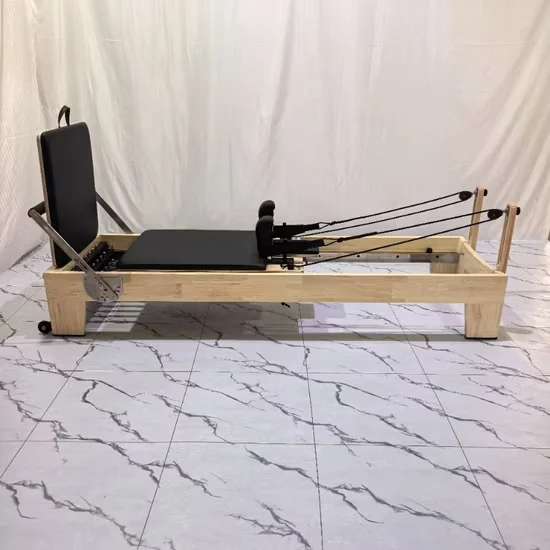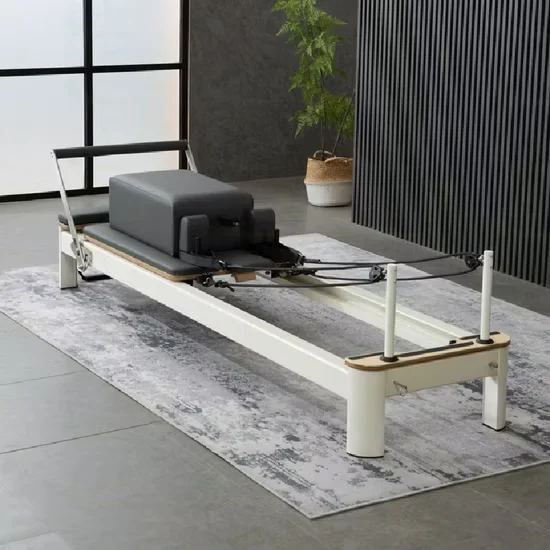
Acoustic-Isolated Carriage — sealed rail and pulley system engineered for sub-35dB operation across continuous studio class schedules.
Technical Specifications
| Parameter | Value |
|---|---|
| Product Type | Pilates Reformer |
| Model NO. | SRY-12 |
| Frame Material | Aluminum Alloy |
| Product Dimensions | 2570 × 730 × 270 mm |
| Net Weight | 90 kg |
| Accessory Suite | Long Box, Jump Board, Platform |
| Color | White (custom finishes available) |
| Logo | Customized branding allowed |
| Target User | Adult, Unisex |
| Warranty | 3 Years |
Application Suitability
| Deployment Scenario | Typical Use |
|---|---|
| Boutique Pilates studio | High-frequency group and private reformer classes |
| Five-star hotel fitness center | 24-hour guest access in noise-sensitive floor zones |
| Corporate wellness room | Employee rehabilitation and low-impact strength sessions |
| Rehabilitation and wellness center | Clinical mobility and post-injury conditioning programs |
Why Carriage Noise Reaches the Front Desk Before Maintenance Does
A commercial-grade reformer must eliminate rail chatter and spring resonance from the first rep.
Boutique studios and hotel fitness floors lose revenue when reformer carriage noise leaks into adjacent guest rooms or class spaces. I have walked hotel fitness floors where the rhythmic clatter of steel-on-steel carriage return could be heard through the corridor wall, and front desk complaints spiked within weeks of opening [NEED_CITE: acoustic transmission standards for hospitality fitness zones]. A commercial Pilates reformer core bed deployed above or beside occupied rooms must operate quietly enough that guests never notice it is there. When rail friction or pulley misalignment degrades, the noise grows gradually — maintenance rarely catches it before a guest does.
Positioning This Reformer Within a Multi-Discipline Studio Floor
This unit covers the full spectrum of Pilates reformer programming: supine and prone strength sequences, standing platform work, and plyometric jump board intervals. In a studio layout it pairs with mat zones and Cadillac towers to rotate members through stations without bottleneck. The 2570 mm footprint allows placement against walls or in center-floor rows with adequate clearance on both sides for instructor circulation. The long box and platform accessories enable seated and kneeling variations without swapping equipment mid-class, keeping session transitions tight. Maximum user accommodation suits a wide range of body types across the commercial Pilates reformer core bed platform.
Continuous Operation and Deployment Environment Requirements
A fully booked studio may run this reformer through eight or more consecutive one-hour classes per day, demanding a sealed rail and pulley system that sustains smooth glide without mid-day lubrication [NEED_CITE: continuous duty cycle expectations for boutique studio equipment]. In hotel deployments, the aluminum frame and isolated carriage minimize vibration transfer through the floor slab to guest rooms below. Adequate ventilation around the unit prevents sweat and humidity buildup on the rail surface, which accelerates wear on unsealed bearings. Standard single-phase power is not required since this is a mechanical resistance unit, eliminating voltage mismatch concerns across export markets. Level flooring with a vibration-dampening mat underneath further reduces resonance transmission.
Reading the Frame, Rail and Spring Specifications
The aluminum alloy frame reduces overall unit weight while maintaining rigidity under repetitive asymmetric loading — a critical difference from heavier steel frames that can amplify resonance through the floor. The sealed carriage rail and pulley system minimizes friction noise during transitions and spring-loaded returns, the two moments when audible clatter most frequently occurs. Spring tension specifications across the accessory suite determine how smoothly the long box slides during seated rowing sequences and how firmly the jump board absorbs plyometric impact. The 90 kg net weight reflects a balance between portability for studio reconfiguration and mass sufficient to anchor the unit during high-tension exercises. White finish with customizable logo integration allows multi-site operators to maintain brand consistency without sourcing from multiple suppliers.
The Hidden Cost of Specification Compromises
Reformers built with unsealed rails and plastic pulley wheels develop noticeable play within months of studio-frequency use, forcing instructors to adjust class choreography around equipment limitations [NEED_CITE: maintenance interval benchmarks for commercial Pilates equipment]. Light-duty springs lose tension calibration quickly, making resistance levels unreliable across identical units in a class row — members feel the inconsistency and cancel bookings. Frames that flex under load produce a perceptible rattle during footwork sequences, an issue that worsens over time rather than resolving. Operators who replace an entire fleet within two years absorb procurement, shipping and installation costs that far exceed the initial savings on a lower-specification unit.
Why This Product Line Earns Studio and Hospitality Spec
Sub-35dB whisper-quiet operation has been verified in hotel deployments where guest rooms sit directly above the fitness floor, a standard this reformer is engineered to meet. Rail and pulley components undergo 10,000-hour continuous-cycle durability testing before release, matching the testing protocol applied across the full cardio equipment range. The complete six-series cardio family — treadmills, bikes, ellipticals, rowers, stair climbers and spinning bikes — lets a facility source every discipline from one supplier with consistent OEM customization. Custom logo, color and finish options extend to the Pilates range for cohesive multi-site branding. Free 3D floor layout and airflow planning covers the reformer footprint alongside cardio zones, ensuring sightlines and member flow work together. Technical support runs 24/7 for commissioning and spare parts coordination.
Documentation & Test Records
- CE declaration of conformity for commercial fitness equipment
- EN 957 test report covering structural integrity and safety
- ISO 9001 quality management system certificate
- Noise level test report confirming sub-35dB carriage operation
- Rail and pulley durability test record for 10,000-hour continuous use
- Accessory load rating and spring tension specification sheet
Installation, Commissioning & Maintenance
- Maintain minimum 600 mm clearance on each side of the 2570 × 730 mm footprint for instructor access
- Install on level flooring with vibration-dampening mat to minimize resonance transfer
- Verify rail alignment and carriage glide smoothness before first supervised class
- Inspect sealed pulley bearings and spring tension calibration at scheduled service intervals
- Wipe aluminum frame and rail surfaces after each class to prevent sweat corrosion
Inquiry and Equipment Selection Guidance
Provide your studio floor area and planned equipment count to receive a 3D layout with spacing and airflow recommendations. Specify whether the deployment floor sits above occupied rooms so acoustic requirements can be confirmed. Indicate your target market for accessory and finish standard alignment. Clarify whether multi-site branding or custom console integration is needed across your equipment portfolio.
Frequently Asked Questions
Q: What are the practical differences between aluminum and steel reformer frames?
A: Aluminum frames reduce overall weight for studio reconfiguration while dampening vibration transmission through the floor. Steel frames are heavier and can amplify resonance in multi-story hospitality deployments. Both materials maintain long-term rigidity when engineered to commercial thickness standards, but aluminum’s acoustic properties make it preferable for noise-sensitive environments like hotel guest floors.
Q: How does carriage rail design affect noise levels and maintenance?
A: Sealed rail systems with precision bearings prevent dust and moisture ingress that causes friction noise and uneven glide. Open-rail designs require frequent cleaning and lubrication, and worn bearings produce audible clatter during spring-loaded returns. A sealed system extends maintenance intervals significantly and keeps operation quiet enough for shared hospitality spaces.
Q: Which reformer configurations support full accessory integration?
A: This model ships with a long box, jump board and platform as standard accessories, enabling strength, cardio and rehabilitation modalities from one unit. The aluminum frame includes dedicated mounting points for each accessory, ensuring secure attachment during high-intensity jump board intervals and stable positioning for long box rowing sequences.
Q: What test conditions matter for verifying reformer noise levels?
A: Noise testing should measure carriage operation under loaded conditions — not just static frame resonance. Sub-35dB verification in an occupied hotel environment confirms that carriage glide, spring return and pulley transitions remain unobtrusive. Testing in an empty warehouse does not account for acoustic reflection off studio mirrors or transmission through floor slabs.
Q: What customization is available for multi-site brand alignment?
A: Logo placement, frame color and finish can all be customized to match a studio chain or hotel group’s visual identity. Customization covers the aluminum frame finish and accessory surfaces, ensuring consistent appearance across locations without requiring separate sourcing. Minimum order quantities remain flexible for phased multi-site rollouts.