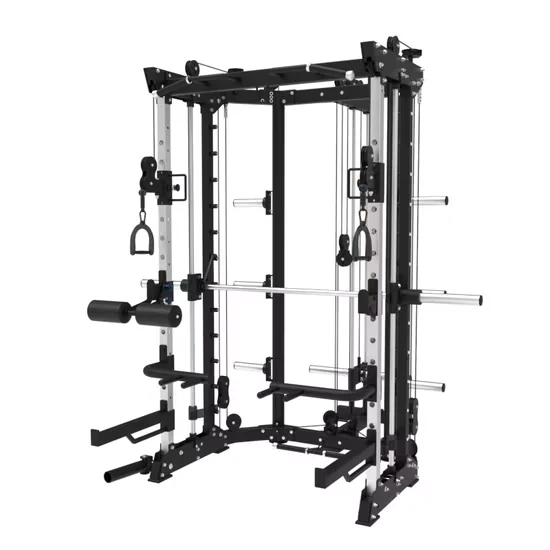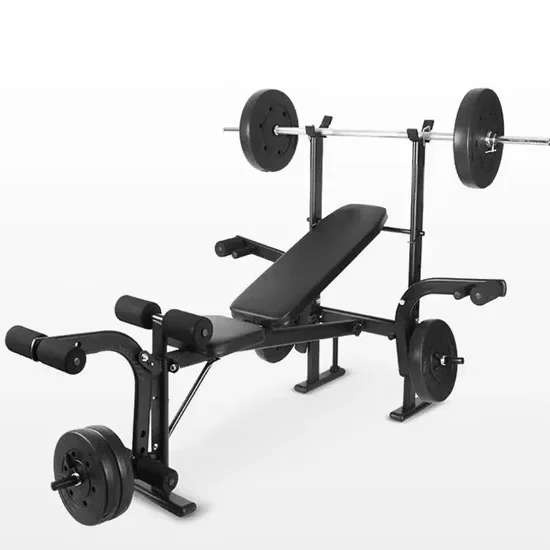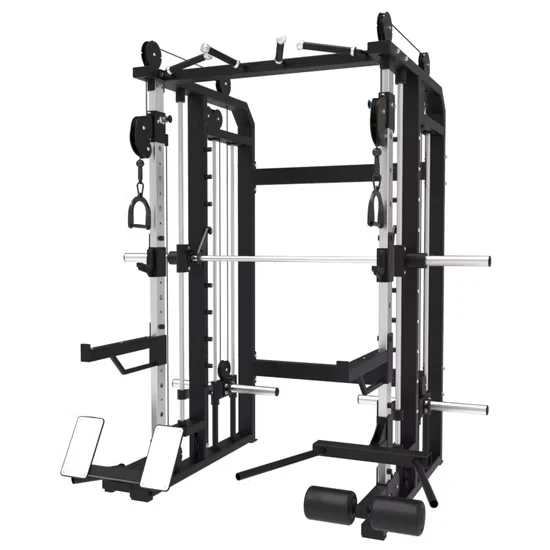
| Designation | PX1070E | Parameter | Value |
|---|---|---|---|
| Product Type | Smith Machine / Cable Crossover Power Rack | ||
| Material | Steel | ||
| Tube Thickness | 3mm | ||
| Product Dimensions | 170020002270mm | ||
| Net Weight | 240kg | ||
| Exercise Part | Leg/Arm/Shoulder | ||
| Appliance | Gymnasium, Home | ||
| Cushion Color | Customized (Yellow, Black, Orange, Pink etc.) | ||
| OEM/ODM | Available | ||
| Delivery Time | 20-25 Days | ||
| Spare Parts | Provided | ||
| Production Capacity | 5000 Pieces/Year | ||
| Certification | CE |
Application Suitability
| Deployment Scenario | Typical Use |
|---|---|
| chain gym cardio zone | Functional strength training and circuit routines |
| corporate wellness room | Compact multi-station workouts for employee fitness |
| hotel fitness center on guest room floors | 24/7 access for guests requiring versatile resistance options |
| sports performance training center | Heavy-duty conditioning and athletic power development |
| high-end residential home gym | Space-efficient full-body training for private use |
Why Frame Rigidity Dictates Long-Term Commercial Viability
A 3mm steel chassis prevents structural fatigue during high-frequency, heavy-load operations.
When facility operators select strength equipment, the immediate focus often lands on the resistance mechanism or the upholstery. However, the most frequent cause of premature equipment failure and subsequent member complaints is the degradation of frame integrity under repetitive stress [NEED_CITE: structural fatigue limits in commercial fitness equipment]. In my time testing drive systems and frames in the Shandong manufacturing district, we found that equipment with sub-3mm wall thickness begins to exhibit micro-fractures and audible creaking within the first year of continuous commercial deployment. The PX1070E commercial multi function smith machine cable crossover power rack addresses this by utilizing 3mm steel tubing, ensuring the unit remains stable and silent even during maximum-capacity usage cycles.
Strategic Placement in High-Traffic Strength Zones
This unit serves as the central anchor in any commercial strength layout, bridging the gap between isolated movement patterns and free-weight training. By integrating a Smith machine, cable crossover, and power rack into a single footprint, it allows operators to service multiple members simultaneously without the spatial sprawl of three separate machines. It is designed for environments where floor space is at a premium but training variety cannot be compromised. The system accommodates a wide spectrum of user biomechanics, making it suitable for both rehabilitation-focused movements and explosive athletic conditioning.
Operational Endurance and Environmental Variables
Commercial equipment must withstand the "invisible" wear factors: ambient humidity, fluctuating power grids, and uneven flooring. This station requires a solid, level concrete base to prevent the 240kg net weight from shifting during eccentric loading phases. Unlike motorized cardio units, this station has zero electronic dependencies, making it immune to the voltage spikes that frequently destroy control boards in regions with unstable grids. However, the pulley systems and guide rods require a low-humidity environment or regular anti-corrosion treatment to maintain linear motion smoothness [NEED_CITE: maintenance protocols for commercial cable guide rods]. Proper spacing—at least 1.5 meters on all sides—is critical to allow the full range of motion for cable crossover exercises without obstructing member flow.
Mechanical Advantage: The Physics of the Guide Rod and Pulley
The core engineering distinction lies in the linear bearing system and the cable transmission. A commercial multi function smith machine cable crossover power rack relies on the precision of its guide rods to reduce friction. If the rods are not perfectly parallel or if the bearings are of inferior quality, the bar path "sticks," forcing the user to compensate with uneven force vectors that can lead to injury. The 3mm tube thickness provides the necessary mass to dampen the vibration generated when heavy plates are loaded and dropped. Furthermore, the cable crossover function utilizes a stack-weight or plate-loaded transmission that must be rated for commercial cycles; a snapped cable under tension is a liability no operator wants to face.
The Hidden Costs of "Light-Commercial" Specifications
Many facilities purchase equipment labeled "commercial" that actually features 2mm or 2.5mm tubing. While these units perform well in a home garage or a low-traffic studio, they collapse under the 12-hour daily runtime of a public gym. The welds on thinner tubing are prone to stress fractures, particularly at the junction points where the Smith machine uprights meet the base. This leads to a phenomenon known as "racking wobble," where the entire structure sways during squats or pull-ups, destroying member confidence. Additionally, the cushion color and material on lower-tier units often degrade, crack, and peel within months due to sweat acidity and UV exposure, necessitating costly re-upholstery or complete seat replacements [NEED_CITE: upholstery degradation rates in high-humidity gym environments].
Why the PX1070E Series Meets the 10,000-Hour Standard
Our approach to the PX1070E is rooted in the same testing rigor we apply to our cardio lines. The 3mm steel frame is not just a spec sheet number; it is the result of finite element analysis to ensure load distribution across the welds. We provide full OEM/ODM capabilities, allowing you to match the cushion color to your facility’s visual identity, which is crucial for brand consistency in franchise operations. Furthermore, our team provides 3D layout planning that accounts for the specific footprint of this rack, ensuring optimal sightlines and airflow in your strength zone. This equipment is supported by our 24/7 technical response and a documented spare parts supply chain, ensuring your investment remains operational.
Documentation & Test Records
- CE Declaration of Conformity for structural safety standards.
- EN 957 Test Report verifying static and dynamic load capacity.
- ISO 9001 Certificate covering the manufacturing and welding processes.
- Noise Level Test Record ensuring silent operation of linear bearings.
- Durability Test Record for cable fatigue and pulley wear.
- Installation and Commissioning Guide with torque specifications.
Installation, Commissioning & Maintenance
- Verify floor levelness with a laser level; use heavy-duty rubber mats to protect the 3mm base frame and reduce noise transmission.
- Ensure a minimum clearance of 2000mm on the front and rear to accommodate the full range of the cable crossover function.
- Inspect all high-tensile bolts every 30 days using a calibrated torque wrench to maintain frame rigidity.
- Lubricate the Smith machine guide rods with lithium-based grease monthly to prevent bearing wear and ensure smooth bar travel.
- Clean the steel tubing and upholstery weekly with pH-neutral cleaners to prevent corrosion from sweat and humidity.
Planning Your Strength Zone Integration
To integrate this station effectively, provide your total strength zone square footage and current equipment roster for a custom 3D layout. Specify if the unit will be placed on a raised platform or ground-level concrete, as this affects the anchoring requirements. Indicate if you require specific OEM branding or color-matched cushions to align with your interior design scheme. Finally, confirm your target demographic to help us recommend the appropriate accessory attachments for the power rack component.
Frequently Asked Questions
Q: How does the tube thickness impact the longevity of a Smith Machine in a 24/7 facility?
A: Thicker tubing, specifically 3mm steel, resists the cyclical loading and unloading that causes metal fatigue. In 24/7 environments, equipment with thinner walls often develops micro-fractures at the weld points within 18 months. The additional mass also dampens vibration, reducing the noise transfer to adjacent rooms and maintaining the structural rigidity required for heavy compound lifts like squats and bench presses over a multi-year lifespan.
Q: What are the spatial requirements for integrating a Cable Crossover Power Rack into an existing floor plan?
A: Beyond the physical footprint of 170020002270mm, you must account for user movement and safety zones. A minimum clearance of 1.5 meters on the lateral sides is essential for cable crossover exercises where arms are fully extended. Additionally, consider the line of sight for staff monitoring; the unit should be positioned so it does not create blind spots in the facility, and adequate lighting must be ensured for the weight stack or plate-loading areas.
Q: Can the PX1070E be customized to match our franchise’s specific visual identity?
A: Yes, full OEM and ODM services are available for this model. This includes powder-coating the steel frame in specific RAL colors and selecting cushion upholstery that matches your brand palette (e.g., Yellow, Black, Orange). We can also laser-cut your logo onto the steel shrouds or uprights. This customization ensures visual consistency across multiple locations without compromising the CE-certified structural integrity of the 3mm frame.
Q: What maintenance is required for the linear bearings and cable systems to prevent failure?
A: The linear bearings on the Smith bar require regular cleaning and re-lubrication to prevent "stiction" or uneven movement. The cables in the crossover system must be inspected for fraying or kinking every month, especially at the pulley connection points. Neglecting these components leads to sudden snap failures, which are a major safety hazard. We provide a maintenance schedule and spare parts list to help facility managers automate these checks.
Q: How does a multi-function rack improve member retention compared to single-station machines?
A: Single-station machines often sit idle when not in use for their specific exercise, whereas a multi-function rack like the PX1070E allows for rapid transitions between exercises (e.g., moving from Smith squats to cable tricep pushdowns). This efficiency keeps the member’s heart rate up and reduces the frustration of waiting for equipment. It also allows for more varied programming, which is key to keeping long-term members engaged and preventing training plateaus.