
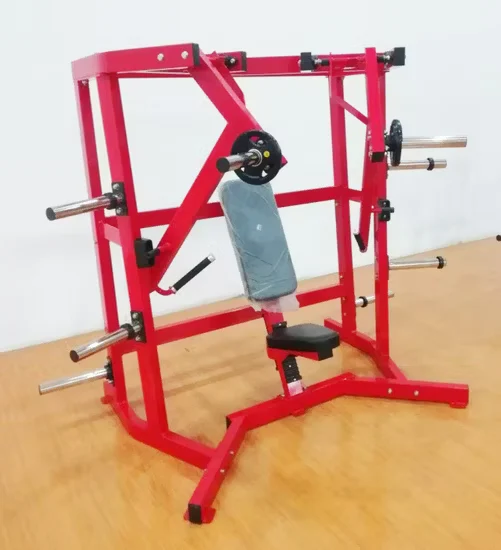
Engineered for High-Volume Training — ISO-Lateral independent arm mechanics paired with a reinforced steel frame sustain biomechanical precision under continuous facility use.
Technical Specifications
| Parameter | Value |
|---|---|
| Designation | 5019 |
| Product Type | ISO-Lateral Chest Press (Strength Equipment) |
| Exercise Part | Chest |
| Resistance Type | Manual |
| Frame Material | Steel |
| Product Dimensions | 1343 × 1981 × 1761 mm |
| Net Weight | 141 kg |
| Foldable | No |
| Target User Group | Adult |
| Certification | ISO 9001, CE |
| OEM / ODM | Available |
Application Suitability
| Deployment Scenario | Typical Use |
|---|---|
| Chain gym strength training zone | Primary horizontal pressing movement in split-routine programming |
| Corporate wellness room | Low-maintenance chest training accessible across fitness levels |
| Community fitness center | High-traffic pressing station for general membership |
| Sports performance training center | Bilateral strength assessment and sport-specific conditioning |
| Hotel fitness center | Durable pressing option for transient users without supervision |
Why Frame Rigidity Defines the Commercial ISO-Lateral Chest Press Machine Experience
A steel frame weighing 141 kg anchors every rep against drift, not just gravity.
When a chest press unit flexes under load, the movement path shifts rep by rep. Members feel the asymmetry before they can name it, and trainers spend sessions compensating for equipment behavior instead of coaching. In high-frequency commercial environments, that frame deflection compounds across hundreds of weekly repetitions [NEED_CITE: frame deflection standards for commercial strength equipment]. A rigid structure keeps the ISO-lateral arms tracking consistently, so the lifter controls the movement rather than the machine controlling the lifter.
Positioning Within the Strength Training Floor
This unit fills the horizontal pressing slot in a commercial rack layout, complementing incline and cable machines rather than duplicating them. The independent arm design accommodates unilateral assessment, which trainers value during initial movement screenings and return-to-training protocols. Deployed on a standard rubber-matted strength floor, the 1343 × 1981 mm footprint allows bilateral access without crowding adjacent stations. The manual resistance system serves users across strength levels without requiring weight-stack pin selection adjustments between sets, keeping turnover fast during peak hours. The commercial ISO-lateral chest press machine handles athletes and general membership alike, with a stable base suited to heavy single-rep efforts and higher-volume hypertrophy sets.
Floor Loading and Facility Infrastructure Requirements
A 141 kg static frame, plus user and plate load, concentrates point forces that demand a level concrete subfloor rather than suspended timber or raised access flooring. Deploying on upper hotel levels requires confirmed structural load ratings before installation [NEED_CITE: floor load capacity for commercial gym equipment deployment]. No electrical circuit is needed, which simplifies placement in rooms without dedicated power runs, but ventilation still matters for user comfort during sustained pressing work. Equipment spacing should account for plate loading clearance on both sides and a rear approach path for spotters. Rubber drop pads beneath the footprint manage vibration transfer to neighboring rooms, particularly important in mixed-use buildings where training zones share walls with office or guest spaces.
Dissecting the Manual Resistance and Independent Arm Design
The manual resistance system eliminates motor, solenoid, and electronic wear points entirely, meaning maintenance intervals focus on mechanical joints rather than electrical components. ISO-lateral arms allow each side to move independently, which reduces compensatory patterns when one limb is stronger than the other, a common scenario in both rehabilitation and athletic populations. Sealed pivot bearings at each arm junction sustain smooth arc movement through thousands of articulation cycles without requiring frequent lubrication. The steel frame mass itself contributes to stability: rather than relying solely on floor bolting, the frame weight resists the lateral sway that lighter structures produce during heavy eccentric control. Handle positioning and grip diameter remain constant across loading ranges, so users build familiarity with the contact points regardless of training phase.
The Hidden Cost of Underspecified Strength Stations
Facilities that source chest press units built around thinner steel or narrower stance widths encounter frame resonance that grows worse as loading increases. Members perceive it as instability, trainers perceive it as liability, and management perceives it as a replacement cycle they did not budget for. Units with shared-arm linkages force symmetrical movement on asymmetrical bodies, generating complaints that surface as "the machine doesn’t feel right" rather than as specific mechanical feedback [NEED_CITE: bilateral strength equipment injury reporting patterns]. Bearing play that develops within the first year shifts the pressing arc, turning a precise movement into an unpredictable one and prompting equipment swaps that disrupt floor layout planning.
Why This Product Line Holds Up Across Deployment Scenarios
Every frame in this line is built around the 10,000-hour continuous use durability standard that governs our cardio range, applied here to pivot bearings and weld joints instead of motors. The six-series equipment family means a facility can source pressing, pulling, and leg stations from one engineering philosophy and one warranty relationship. OEM options cover frame color, upholstery specification, and brand identification, so the visual language matches the venue without requiring aftermarket refinishing. The free 3D strength-zone layout we provide accounts for this unit’s 1981 mm depth and the clearance needed for plate handling, preventing the tight-corner problem that forces members to load plates in a traffic lane. Technical support covers mechanical troubleshooting around the clock, which matters when a pivot bearing develops play during a weekend rush.
Documentation & Test Records
- CE declaration of conformity covering the complete 5019 unit assembly
- EN 957 test report verifying structural and mechanical safety requirements
- ISO 9001 certificate for manufacturing quality management
- Durability test record documenting pivot bearing cycle performance
- Frame weld inspection and material certification report
- Installation guide with anchor bolt specification and torque values
Installation, Commissioning & Maintenance
- Confirm level concrete subfloor capable of supporting combined static and dynamic loads exceeding 300 kg at this footprint
- Maintain minimum 600 mm side clearance on each arm for plate loading and spotter positioning
- Install rubber vibration pads beneath all four contact feet to manage transfer to adjacent spaces
- Verify all pivot bolts at commissioning and re-torque after the first 500 hours of use
- Inspect sealed bearings quarterly and replace per schedule rather than waiting for play detection
- Wipe steel contact surfaces and handle grips daily to prevent corrosive sweat buildup on powder-coated finishes
Request a Specification Match
Provide your strength zone square footage and planned unit count to receive a 3D layout that integrates this press with your pulling and leg equipment while respecting plate-loading clearance. Specify expected daily traffic volume so we can align pivot bearing service intervals to your actual use pattern. Identify the deployment floor and adjacent occupancy types to confirm vibration management requirements. Note any OEM color or upholstery preferences early, as these affect lead time within the standard production cycle.
Frequently Asked Questions
Q: What distinguishes ISO-lateral arms from fixed-path chest press designs?
A: Fixed-path machines force both arms along a single linked trajectory, requiring the user’s stronger side to compensate for the weaker side throughout every repetition. ISO-lateral arms move independently, allowing each side to work at its own capacity and reducing compensatory movement patterns. This design benefits both rehabilitation populations rebuilding unilateral strength and athletes needing balanced pressing power assessment before competition seasons.
Q: What structural standards govern commercial chest press frame construction?
A: Commercial strength equipment must meet EN 957 requirements for static load capacity, fatigue cycling, and stability under off-center loading. Frame steel thickness, weld penetration depth, and pivot bearing specifications all factor into certification. Facilities sourcing equipment should request the EN 957 test report alongside the CE declaration, as the declaration alone confirms compliance while the test report documents how that compliance was measured under controlled conditions.
Q: How does manual resistance affect long-term maintenance requirements?
A: Manual resistance systems eliminate electronic components, motors, and wiring harnesses that require periodic calibration or replacement in motorized alternatives. Maintenance concentrates on mechanical elements: pivot bearing inspection, bolt torque verification, and upholstery condition checks. This reduces both parts inventory requirements and the specialized electrical troubleshooting skills that on-site maintenance teams must maintain, which is particularly relevant for facilities operating without dedicated equipment technicians.
Q: What factors influence strength zone layout planning around pressing equipment?
A: The 1343 × 1981 mm footprint requires clearance on three sides: both lateral sides for plate loading and the rear for spotter access during heavy sets. Placing this unit against a wall eliminates the rear approach path and forces spotters to reach over the user. Layout planning must also account for sightlines from the training desk, airflow from HVAC registers, and the traffic flow between pressing stations and cable machines that members typically pair in supersets.
Q: What customization options are available for facility-branded equipment orders?
A: OEM and ODM customization covers frame powder-coat color selection, upholstery material and density specification, and brand identification placement on both the frame and seat back. Minimum order quantities remain flexible to accommodate single-venue deployments alongside multi-site chain rollouts. Customization scoping happens during the quotation phase, and production lead time adjusts based on the complexity of color matching and logo application requirements.


