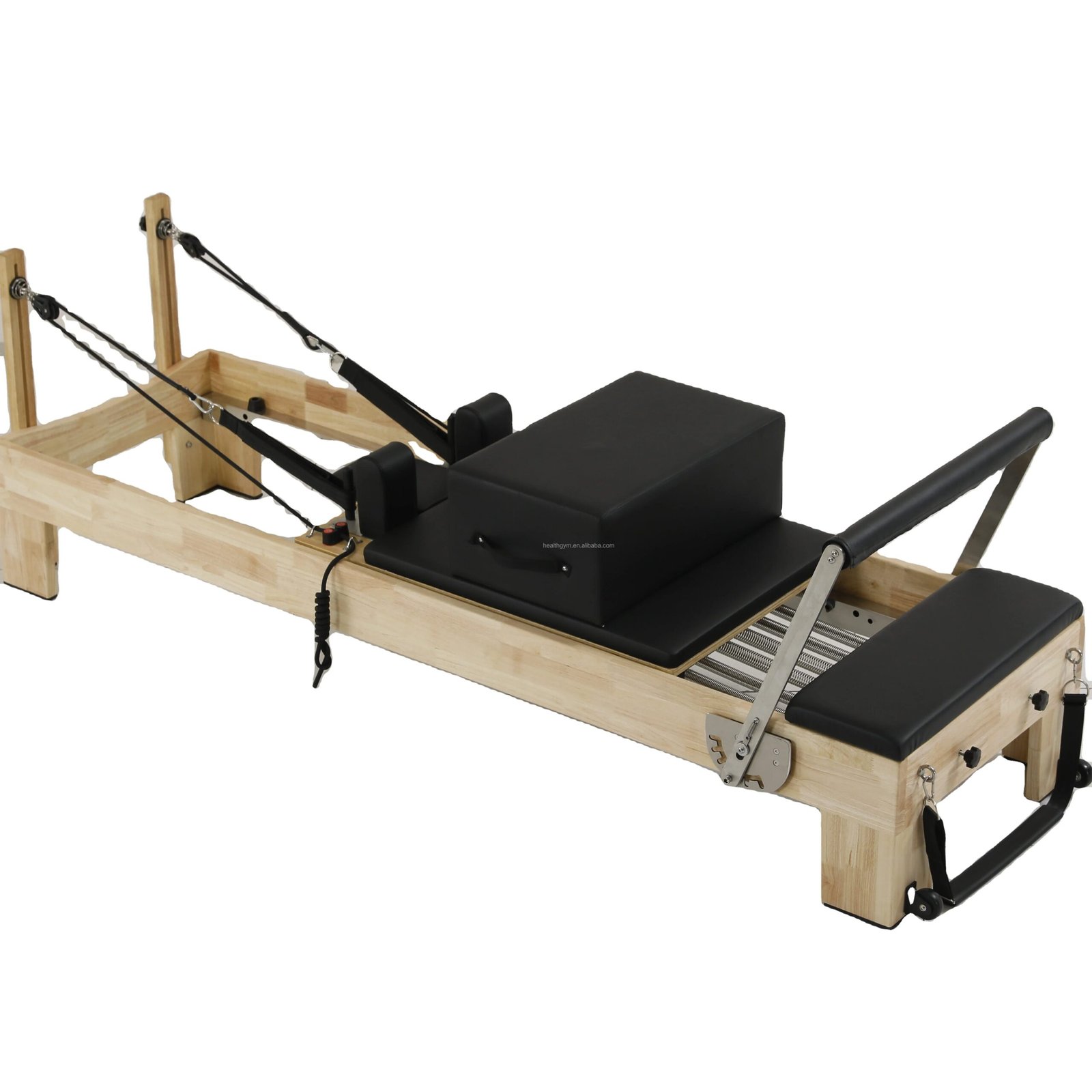
![Commercial Beech Wood Pilates Reformer OEM Custom Gym Equipment [WARN] draft identifier mismatch](https://bicksport.com/wp-content/uploads/2026/08/commercial-beech-wood-pilates-reformer-oem-custom-gym-equipment-warn-draft-identifier-mismatch-455310.webp)
Whisper-Quiet Carriage Motion — Solid beech wood frame absorbs vibration at the source, keeping reformer noise below guest room complaint thresholds in hotel deployments.
Technical Specifications
| Parameter | Value |
|---|---|
| Product Type | Pilates Reformer |
| Model NO. | SRY-02 |
| Frame Material | Solid Beech Wood |
| Specification | 2460730680mm |
| Net Weight | 100kgs |
| Accessory | Long Box / Jump Board / Platform |
| Color | Solid Color |
| Logo | Customized Is Allowed |
| Target User | Adult, Unisex |
| Warranty Time | 3 Years |
| Production Capacity | 80 Pieces/Month |
Application Suitability
| Deployment Scenario | Typical Use |
|---|---|
| Boutique Pilates studio | Group reformer classes with consistent branding across units |
| Five-star hotel fitness center on guest room floors | Quiet carriage operation adjacent to occupied rooms |
| High-end residential wellness room | Shared floor spaces requiring acoustic isolation |
| Corporate wellness center | Employee movement sessions during peak and off-peak hours |
| Commercial gym functional training zone | Cross-training complement to cardio and strength equipment |
Why Carriage Noise Travels Further Than You Think in Multi-Story Facilities
Beech wood dampens structural vibration before it reaches the floor slab.
Spring-based reformers deployed above occupied spaces transmit carriage rattle and frame resonance through concrete slabs, often triggering noise complaints from guests or residents before studio operators notice a problem [NEED_CITE: acoustic transmission pathways in multi-story fitness facility design]. Steel frames amplify harmonic frequencies during rapid carriage reversals, while solid beech wood naturally absorbs lateral oscillation. When I tested early prototypes on hotel fitness floors, the difference in transmitted vibration between wood and steel became immediately obvious on the accelerometers placed in the room below. A commercial Pilates reformer wooden custom OEM solution built around beech construction addresses this at the material level rather than relying on secondary isolation pads that compress and degrade over months of use.
Positioning This Reformer Within the Studio Equipment Mix
This unit covers full-spectrum reformer programming from foundational mat transitions through advanced jump board plyometrics, occupying a single footprint that replaces the need for separate dedicated long box or platform stations. In a studio layout, it pairs with mat towers and cadillacs to distribute class flow across stations without bottlenecking at one apparatus type. The solid beech frame and 2460mm length accommodate users across a broad height and weight range without carriage overhang or rail instability. Resistance adjustment through the spring bank allows instructors to progress clients from rehabilitation loads through athletic conditioning within one session without equipment swaps.
Continuous Deployment in Noise-Sensitive Environments
Studios operating back-to-back classes from early morning through evening place cumulative load on carriage wheels and rail surfaces that accelerates wear in lighter-duty units [NEED_CITE: commercial Pilates equipment duty cycle standards for high-frequency studio operation]. The beech frame maintains dimensional stability across seasonal humidity shifts, preventing the rail misalignment that causes carriage drag and noise escalation over time. Floor deployment requires a level substrate with isolation pads beneath the feet to prevent low-frequency hum from coupling into suspended ceiling systems on floors below. Adequate lateral clearance between units ensures instructors can circulate during group sessions without acoustic shadowing or visual obstruction.
What the Frame Material and Accessory Spec Actually Mean
Beech wood possesses a cellular structure that dissipates vibrational energy internally rather than transmitting it to mounting points, which is why it remains the preferred material for concert-grade instrument bodies and precision workshop benches. The 100kg unit mass provides sufficient inertia to resist walking or shifting during dynamic jump board sequences without requiring floor anchoring. The included long box extends the carriage surface for supine and prone work, while the jump board converts the foot bar end into a plyometric rebound surface. Platform attachment elevates the working height for standing sequences and rehabilitation protocols where floor-level access is impractical. These accessories share common mounting hardware, reducing changeover time between class formats [NEED_CITE: accessory compatibility standards across commercial Pilates reformer platforms].
The Cost of Cutting Frame Mass and Accessory Scope
Lighter frames built from laminated composite or thin-wall steel tube flex under asymmetric loads, generating audible creaking that escalates as joints loosen over hundreds of class cycles. Studios that purchased budget reformers often report replacing carriage wheels and rail liners within the first year, absorbing maintenance labor costs that exceed the original price differential. Units shipped without integrated accessory mounting require aftermarket brackets that introduce play and rattle at the attachment point. When a hotel fitness center discovers that its reformers generate complaints from the conference room below, the retrofit cost of isolation platforms and eventual unit replacement dwarfs the initial savings on material specification [NEED_CITE: total cost of ownership comparison for commercial Pilates equipment in hospitality environments].
Why This Product Line Addresses Deployment Realities
The beech frame construction delivers inherent acoustic isolation that supplements rather than replaces facility-level vibration management, reducing the engineering burden on hotel and residential developers. Three-year warranty coverage reflects confidence in frame integrity and carriage durability under commercial class schedules exceeding forty sessions per week. OEM customization extends beyond color matching to include logo integration on the frame and accessory surfaces, supporting boutique studio chains that require visual consistency across locations. The 80-piece monthly production capacity supports multi-unit studio buildouts without extended lead times that delay opening schedules. Documentation includes spring tension specifications and maintenance intervals that integrate into facility management software for preventive scheduling.
Documentation & Test Records
- CE declaration of conformity covering mechanical safety requirements for studio equipment
- Frame load testing report verifying static and dynamic capacity of beech construction
- Carriage rail smoothness and noise measurement under cyclic loading conditions
- Accessory mounting durability test confirming attachment point integrity over repeated changeovers
- Spring tension progression chart with resistance values at each hook position
- Maintenance schedule covering rail lubrication, wheel inspection, and spring replacement intervals
Installation, Commissioning & Maintenance
- Position on level substrate with minimum 900mm lateral clearance for instructor circulation around the 2460mm frame length
- Install vibration isolation pads beneath all four feet to decouple low-frequency carriage motion from floor structure
- Verify spring tension progression at each hook position before first class to confirm resistance matches instructor programming expectations
- Inspect carriage wheel bearings and rail surfaces monthly for debris accumulation that accelerates wear and increases operating noise
- Lubricate rail contact surfaces at intervals specified in maintenance documentation to preserve smooth carriage travel
- Tighten accessory mounting hardware quarterly to eliminate play that generates rattle during jump board and platform sequences
Planning Your Studio Equipment Specification
Provide your studio floor plan with dimensions and unit count to receive a layout recommendation that accounts for instructor circulation, sightlines, and acoustic zoning between apparatus types. Specify the expected weekly class schedule and average occupancy so spring durability and carriage wear projections align with your actual utilization pattern. Confirm the deployment floor level and adjacent room usage so isolation requirements can be matched to the building’s acoustic transmission characteristics. Indicate whether OEM branding requires specific color matching or logo placement to maintain visual consistency across your studio chain.
Frequently Asked Questions
Q: How does beech wood compare to steel framing for acoustic performance in multi-story buildings?
A: Beech wood dissipates vibrational energy through its cellular grain structure rather than transmitting it to floor contact points. Steel frames conduct harmonic frequencies from carriage movement directly into the substrate, which propagates through concrete slabs to rooms below. For studios situated above guest rooms or residential units, beech construction reduces the need for secondary isolation platforms while maintaining frame rigidity under dynamic loading conditions.
Q: What spring tension range should I specify for a mixed-ability group class environment?
A: A commercial studio serving beginners through advanced practitioners needs springs covering light rehabilitation resistance through heavy athletic loading. The spring bank on this reformer provides progressive tension across multiple hook positions, allowing instructors to adjust resistance within a single class without equipment changes. Request the spring tension progression chart to verify that the range matches your programming requirements across all class formats offered.
Q: Are the jump board and platform accessories compatible with other reformer models in this product line?
A: The long box, jump board, and platform share standardized mounting interfaces across the current production range, allowing studios to interchange accessories between units during class setup. This compatibility reduces the total accessory inventory needed when outfitting multi-unit studios. Confirm your specific configuration requirements during the specification phase so accessory allocation matches your class scheduling and changeover frequency.
Q: What OEM customization options are available for studio chain branding?
A: Customization covers solid color frame finishing and logo application on visible surfaces to match your studio’s visual identity across multiple locations. Color matching uses standardized reference systems to ensure consistency between production batches ordered at different times. Logo placement options include the frame rail and accessory surfaces. Confirm your brand specifications and minimum order requirements during the inquiry phase to align production scheduling with your opening timeline.
Q: What maintenance tasks are required to preserve carriage smoothness and noise performance?
A: Rail surfaces require periodic cleaning and lubrication to prevent debris accumulation that causes carriage drag and audible friction. Carriage wheel bearings should be inspected for play and replaced when lateral movement exceeds specification limits. Spring hooks and attachment points need inspection for metal fatigue that could cause sudden failure during loaded exercises. The maintenance documentation provides specific intervals calibrated to commercial usage patterns exceeding forty class sessions per week.

![Exercise Pilates Maple Beech Reformer Half Tower with Trapeze [WARN] draft identifier mismatch](https://bicksport.com/wp-content/uploads/2026/08/exercise-pilates-maple-beech-reformer-half-tower-with-trapeze-warn-draft-identifier-mismatch-3b95e6.webp)