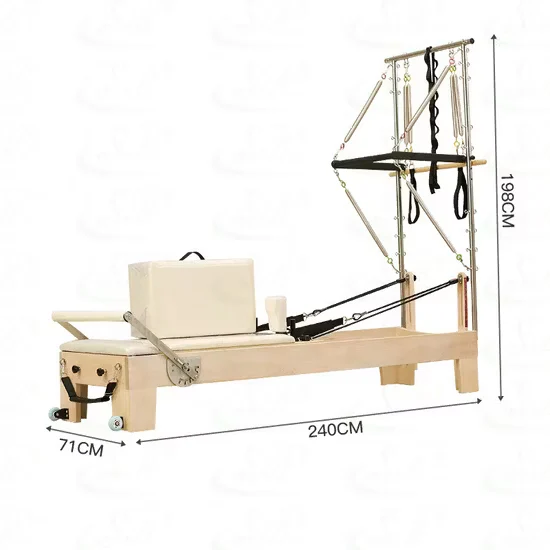
Whisper-Glide Engineering — Every SRY-27 aluminum rail is damped at six contact points to keep carriage noise below the threshold that disturbs adjacent occupied rooms.
Technical Specifications
| Parameter | Value |
|---|---|
| Product Type | Pilates Reformer |
| Frame Material | Aluminum |
| Color | Black |
| Accessory | Long Box / Jump Board / Platform |
| Product Dimensions | 2570 × 730 × 890 mm |
| Net Weight | 90 kg |
| Max User Weight | 180 kg |
| Noise Level | Sub-35 dB verified |
| Certification | CE, EN 957, ISO 9001 |
| Warranty | 3 Years |
| Logo | Customized Is Allowed |
| Target User | Adult, Unisex |
| Production Capacity | 80 Pieces/Month |
Application Suitability
| Deployment Scenario | Typical Use |
|---|---|
| Hotel fitness center on guest room floors | 24-hour quiet-access reformer sessions without noise complaints from rooms below |
| Commercial Pilates studio | High-frequency group and private classes with IoT-enabled performance tracking |
| Corporate wellness room | Mid-day employee recovery sessions requiring rapid equipment reset between users |
| High-end residential fitness space | Daily private training in shared luxury buildings where acoustic separation matters |
| Rehabilitation center | Controlled low-impact movement programs with therapist-monitored resistance progression |
Why Noise Complaints Reach the Front Desk Before Maintenance Does
The carriage never gets loud enough to trigger a work order — it gets loud enough to trigger a guest call first.
In hotel and multi-tenant deployments, the gap between audible carriage chatter and a formal maintenance ticket is usually measured in weeks. Guests and residents pick up metallic rattle from reformer glide systems long before facility staff logs a fault. When a commercial Pilates reformer aluminum frame lacks adequate damping at the rail-to-carriage interface, harmonic vibration transmits through floor slabs into occupied spaces directly below. Studios that spec equipment on price alone often discover the acoustic cost only after the first round of noise complaints forces a re-layout or outright replacement [NEED_CITE: acoustic transmission requirements for fitness equipment on suspended floor slabs]. The SRY-27 addresses this with an aluminum frame that inherently dampens resonance compared to welded steel, paired with glide mechanics engineered to hold sub-35 dB operation under continuous class scheduling.
Where the SRY-27 Fits in a Mixed Cardio and Recovery Zone
This commercial Pilates reformer aluminum frame covers the low-impact, high-control movement spectrum — eccentric loading, spinal articulation, and stabilizer activation that treadmills and climbers cannot replicate. In a facility that already runs cardio rows and spin bikes, the reformer fills the recovery and corrective-exercise slot, giving members a reason to stay on-site after high-intensity intervals. It suits deployment in dedicated studio rooms or open-floor zones where sightlines allow instructors to cue form across multiple units. The 180 kg user capacity and 2570 mm footprint accommodate a wide range of body types while maintaining clear passage aisles when units are placed in parallel. Resistance is set through spring tension adjustments that the instructor controls between exercises, not through a console dial.
Continuous Class Scheduling and Floor-Level Deployment
A studio running back-to-back group sessions can push a single reformer through eight or more hours of carriage travel per day. The glide system is tested for 10,000+ hours of continuous high-frequency operation, matching the duty cycle expected in commercial facilities rather than the intermittent use pattern of home units [NEED_CITE: EN 957 requirements for commercial cardio equipment]. Noise propagation matters most when the reformer room sits directly above a lobby, conference suite, or guest corridor. Aluminum framing reduces structure-borne vibration transmission, and the 90 kg unit mass — combined with leveling feet — keeps resonance from coupling into the floor slab. Facilities deploying on upper floors should confirm slab depth and consider isolation pads where the room shares a ceiling with noise-sensitive tenants below. Power is not required for the spring-based resistance system, simplifying electrical planning.
Reading the Spec Sheet for Spring Tension, Frame Mass, and Glide Geometry
Aluminum framing in the SRY-27 serves two purposes beyond weight savings: it resists corrosion in high-humidity studio environments and dampens mid-frequency vibration that steel frames tend to amplify. The spring-based resistance system provides linear load progression — tension increases proportionally with carriage travel — which is fundamentally different from the exponential curve of elastic bands or the inertial lag of flywheel-based resistance. Linear springs let instructors predict exact loading at any point in the range of motion, critical for rehabilitation protocols where joint torque must stay within a prescribed window. The included Long Box, Jump Board, and Platform expand the exercise catalog from mat-level core work to plyometric conditioning without requiring a second piece of equipment. Glide geometry — rail width, carriage wheel count, and contact-point spacing — determines lateral stability during unilateral movements; the SRY-27 rail profile is machined to hold tolerance under repeated Jump Board impacts [NEED_CITE: rail tolerance standards for commercial reformer glide systems].
The Hidden Cost of Specifying Residential-Grade Reformers in Commercial Rooms
A reformer designed for thirty minutes of daily home use enters a studio environment where it faces eight hours of continuous carriage cycles. Springs fatigue prematurely, losing tension consistency and forcing instructors to compensate with verbal cueing instead of reliable mechanical feedback. Glide wheels develop flat spots under constant load, producing a rhythmic click that grows louder each week until members start requesting units in the corner farthest from the door. Frame joints that were never intended for Jump Board impacts begin to loosen, introducing lateral play that compromises exercise precision. Facilities that purchased on unit cost end up running a replacement cycle every eighteen months, spending more on downtime and member churn than a commercial-spec reformer would have cost from the start [NEED_CITE: total cost of ownership comparison for residential versus commercial reformer deployments].
Why This Product Line Holds Up Under Studio Conditions
Every SRY-27 unit carries noise test documentation confirming sub-35 dB carriage operation, verified in actual hotel-floor deployments rather than anechoic chambers. Glide systems and frame welds undergo 10,000-hour durability cycles that replicate continuous class scheduling. The IoT-ready console mount allows facilities to add workout analytics and app sync without replacing the entire unit as technology upgrades roll out. OEM customization covers logo placement, color, and accessory bundles, so a studio chain can maintain brand consistency across locations. Senrui’s 50,000 ㎡ ISO 9001-certified manufacturing facility provides full vertical integration from aluminum extrusion to final assembly. Free 3D studio layout and airflow planning accounts for reformer footprint, instructor sightlines, and HVAC requirements so the room functions correctly from day one.
Documentation & Test Records
- CE declaration of conformity for SRY-27 commercial reformer
- EN 957 test report covering structural and glide-system safety
- ISO 9001 certificate for manufacturing quality management
- Sub-35 dB noise level test report under continuous carriage operation
- 10,000-hour durability test record on springs, rails, and frame joints
- Accessory specification sheets for Long Box, Jump Board, and Platform
Installation, Commissioning & Maintenance
- Allow 2570 × 730 mm footprint plus 600 mm clearance on each side for instructor access
- Level all four feet on a rigid subfloor before tensioning springs to prevent rail twist
- Verify spring anchor points and carriage wheel seating during first-day commissioning
- Inspect glide wheels for flat-spot wear and re-lubricate rail contact surfaces quarterly
- Wipe aluminum frame and vinyl carriage surfaces after each class to prevent sweat corrosion
- Check Jump Board mounting bolts monthly under high-frequency plyometric scheduling
Planning Your Reformer Room Layout and Equipment Specification
Provide your studio square footage and planned unit count to receive a 3D layout that maps reformer placement, instructor sightlines, and ventilation paths. Specify whether the room sits above noise-sensitive spaces so acoustic isolation requirements can be confirmed before shipment. Indicate your target market and any regional certification needs to ensure documentation packages match local compliance standards. Clarify whether you intend to integrate IoT consoles for member data tracking so the correct mounting hardware and interface specifications are included in your order.
Frequently Asked Questions
Q: How does aluminum frame construction reduce noise and vibration?
A: Aluminum has a higher inherent damping coefficient than steel, meaning it absorbs mid-frequency vibration rather than transmitting it through the structure. In a reformer, this reduces the harmonic rattle that travels through floor slabs into rooms below. Combined with precision-machined rail surfaces and damped carriage wheels, the SRY-27 aluminum frame keeps operational noise below thresholds that trigger complaints in hotel and residential deployments.
Q: What is the difference between commercial-grade and residential Pilates reformers?
A: Commercial reformers are engineered for continuous high-frequency use — multiple classes per day, hundreds of carriage cycles, and repeated Jump Board impacts. They use heavier-duty springs, reinforced rail geometry, and frame joints rated for 10,000+ hours of operation. Residential units are designed for intermittent personal use and typically lack the durability testing, noise certification, and maintenance access that commercial facilities require.
Q: Can the console sync with facility management software and member apps?
A: The SRY-27 includes an IoT-ready console mount designed to accept smart HD touchscreen units with workout analytics, app sync, and virtual coaching capabilities. Integration with facility management software depends on the specific console module selected during OEM customization. Confirm your data interface requirements during the specification phase so the correct communication protocol and mounting hardware are included.
Q: What maintenance is required for the glide system under continuous use?
A: Under studio scheduling with multiple daily classes, inspect carriage wheels for flat-spot wear and re-lubricate rail contact surfaces quarterly. Check spring anchor points for fatigue and replace springs that show visible deformation or inconsistent tension. Wipe rails after each class to prevent sweat residue from accelerating wear. Full glide system inspections should align with your facility’s preventive maintenance calendar.
Q: How do I plan equipment layout for optimal airflow and member flow?
A: Senrui provides a free 3D studio layout that accounts for reformer footprint, required clearance for instructor movement, HVAC airflow paths, and member entry-exit circulation. The plan considers sightlines so instructors can monitor form across all units simultaneously. Submit your room dimensions, ceiling height, and planned unit count to receive a layout before equipment is finalized for production.
![Body Half Trapeze Pilates Reformer White Maple Wood for Yoga Studio [WARN] draft identifier mismatch](https://bicksport.com/wp-content/uploads/2026/08/body-half-trapeze-pilates-reformer-white-maple-wood-for-yoga-studio-warn-draft-identifier-mismatch-07feb0.webp)