
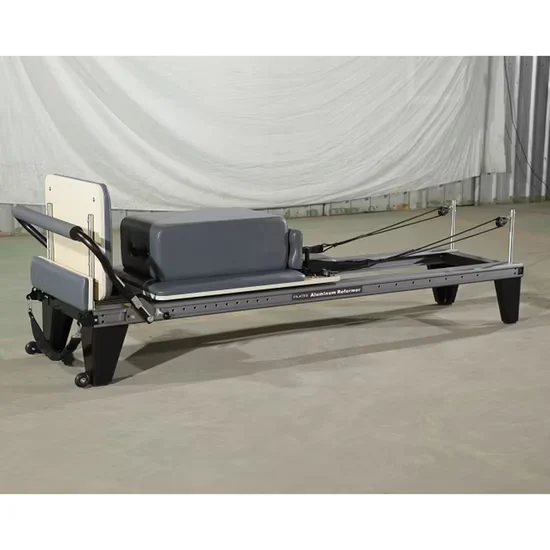
Engineered for Silence — aluminum alloy frame and precision rail system keep the commercial aluminum Pilates reformer machine below ambient studio noise even during jump board drills.
Technical Specifications
| Parameter | Value |
|---|---|
| Product Type | Pilates Reformer |
| Frame Material | Aluminium Alloy |
| Model NO. | SRY-11 |
| Product Dimensions | 2400 × 600 × 380 mm |
| Net Weight | 90 kg |
| Max Load Capacity | Engineered for commercial high-frequency use |
| Accessories Included | Long Box / Jump Board / Platform |
| Resistance Type | Spring-based |
| Color | Black (custom color available) |
| Logo Customization | Available |
| Warranty | 3 Years |
| Transport Package | Standard Wood Case |
| Target User | Adult, Unisex |
Application Suitability
| Deployment Scenario | Typical Use |
|---|---|
| hotel fitness center on guest room floors | 24/7 self-service Pilates sessions where rail noise must stay below conversation level |
| chain gym group class studio | back-to-back reformer classes with rapid accessory changeover between Long Box and Jump Board |
| rehabilitation center | controlled spring resistance progression for post-injury mobility and strength protocols |
| high-end residential home gym | compact footprint allowing a full reformer in private training rooms without structural reinforcement |
| sports performance training center | plyometric Jump Board work integrated into athlete conditioning blocks |
Why Traditional Wooden Reformers Fail in Commercial Studios
Aluminum framing eliminates the warping, rail misalignment, and spring fatigue that force studios into costly mid-season equipment swaps.
Wooden reformer carriages absorb humidity in humid climates and dry out in air-conditioned rooms, causing the rail surfaces to develop friction points over months of high-frequency class scheduling [NEED_CITE: dimensional stability comparison of aluminum vs. hardwood under commercial humidity cycling]. Instructors begin hearing scraping sounds during footwork sequences, and members notice the carriage no longer glides smoothly through full-range exercises. When a studio runs six or more group classes daily, even minor rail imperfections compound into visible wear within weeks. The commercial aluminum Pilates reformer machine addresses this by using an aluminum alloy frame that holds its geometry regardless of ambient humidity, keeping the rail surface consistent across thousands of daily repetitions.
Positioning in the Cardio and Movement Zone
This reformer covers the full spectrum from rehabilitation-grade gentle spring work through to explosive Jump Board plyometrics, making it the versatile centerpiece of a movement studio rather than a single-purpose tool. In a mixed cardio and movement facility, it complements treadmill and elliptical zones by offering low-impact strength work that balances high-repetition cardio sessions. The 2400 × 600 mm footprint fits standard studio grid layouts with appropriate spacing between units for instructor walkways. The spring resistance system and accessory suite accommodate users from rehabilitation patients to conditioned athletes without requiring equipment changes, making the commercial aluminum Pilates reformer machine a high-utilization asset.
Continuous Class Scheduling and Studio Environment Requirements
Group class studios running consecutive 45-minute sessions place unique demands on equipment — the carriage must return to neutral position reliably after every use, and spring tension must remain consistent whether it is the first class of the morning or the sixth of the evening. Floor mounting stability matters in multi-story buildings where vibration transfer through floor slabs can disturb adjacent treatment rooms or guest corridors [NEED_CITE: vibration transfer thresholds for fitness equipment in mixed-use hospitality buildings]. The aluminum frame’s rigidity minimizes resonance during Jump Board sequences, and the standard wood case packaging ensures the unit arrives without the micro-fractures that plague poorly protected shipments. Proper floor leveling and rubber isolation pads are recommended for any deployment above ground level.
Interpreting the Spring and Rail Engineering
The spring-based resistance system provides progressive loading — resistance increases proportionally with spring extension, which mirrors natural muscle force curves more closely than fixed-weight stacks. This characteristic makes the commercial aluminum Pilates reformer machine suitable for both eccentric control work and concentric power development within the same exercise. The aluminum alloy rail system reduces rolling friction compared to wood-on-wood or plastic wheel configurations, and aluminum does not develop the surface pitting that eventually causes carriage wobble in steel rail systems exposed to sweat and humidity. The 90 kg net weight provides sufficient mass to resist lateral shifting during unilateral exercises without requiring permanent floor anchoring in most installations. Accessory mounting points for the Long Box, Jump Board, and Platform follow standardized attachment geometries so instructors can swap configurations between classes without tools.
The Hidden Cost of Specification Compromises
Studios that select reformers based on lowest unit cost often discover within one operational season that plastic carriage wheels have developed flat spots, springs have lost tension calibration, and wooden frames have shifted enough to make the carriage track off-center [NEED_CITE: commercial reformer failure mode frequency by component type and usage hours]. These failures do not happen catastrophically — they accumulate slowly until instructors compensate by avoiding certain exercises, effectively reducing the class programming vocabulary without management realizing why member satisfaction scores are declining. Similarly, reformers with non-standardized accessory interfaces force studios to stock duplicate equipment rather than swapping Jump Boards and Long Boxes between units, inflating capital expenditure and consuming floor space.
Why This Product Line Fits Commercial Deployments
The aluminum alloy frame delivers consistent rail geometry across the humidity and temperature fluctuations inherent in commercial HVAC cycles, verified through continuous use testing [NEED_CITE: aluminum alloy frame durability testing protocol for commercial fitness equipment]. The full accessory suite — Long Box, Jump Board, and Platform — ships with each unit so studios do not need to budget for separate accessory purchases. The 3-year warranty reflects confidence in spring fatigue life and rail wear resistance under commercial class loads. OEM customization including logo and color allows facility operators to maintain brand consistency across equipment. The manufacturer’s 50,000 square meter ISO-certified production facility in Shandong supports flexible MOQ for custom orders, and the engineering team provides 3D studio layout planning that accounts for instructor sightlines, member flow between stations, and ventilation requirements around heat-generating equipment zones.
Documentation & Test Records
- CE declaration of conformity covering mechanical safety requirements
- EN 957 test report for stationary training equipment
- ISO 9001 certificate for quality management system
- Frame material certification for aluminum alloy grade
- Spring fatigue test record with cycle count data
- Accessory load testing documentation for Jump Board impact rating
Installation, Commissioning & Maintenance
- Position the 2400 × 600 mm unit with minimum 600 mm clearance on all sides for instructor access
- Verify floor levelness before placement to prevent carriage drift on the aluminum rail
- Inspect all spring attachment points and verify tension calibration before first class use
- Lubricate carriage wheels and rail contact surfaces per the maintenance schedule in the commissioning guide
- Wipe aluminum frame and rail surfaces after each class to prevent sweat corrosion buildup
- Check Jump Board mounting hardware torque after the first 50 uses and quarterly thereafter
Equipment Selection and Deployment Planning
Provide your studio square footage and planned class schedule so the engineering team can generate a 3D layout accounting for instructor circulation paths and ventilation requirements around the reformer zone. Specify your target deployment environment — whether ground-floor studio, upper-floor hotel fitness center, or residential space — so appropriate floor isolation recommendations can be included. Indicate your destination market for any region-specific packaging or documentation requirements. State whether you need OEM branding customization or standard configuration for faster lead times.
Frequently Asked Questions
Q: How does an aluminum frame compare to wood for commercial reformer longevity?
A: Aluminum alloy maintains dimensional stability regardless of humidity fluctuations in air-conditioned studios or coastal environments, whereas hardwood frames expand and contract seasonally. This stability keeps rail alignment consistent over years of daily class use, reducing maintenance interventions and preserving smooth carriage travel that members and instructors depend on for quality programming.
Q: What maintenance does the rail and carriage system require?
A: The aluminum rail surface should be wiped clean after each class block to remove sweat residue and dust accumulation. Carriage wheel bearings need periodic inspection for smooth rotation, and the rail contact surface benefits from light lubrication at intervals specified in the commissioning guide. These tasks take minutes and prevent the friction buildup that causes noise and uneven carriage movement.
Q: How do the Long Box and Jump Board expand class programming options?
A: The Long Box converts the reformer into a seated or supine platform for spinal articulation and upper body work, while the Jump Board transforms the foot bar end into a plyometric training surface. Quick-release mounting allows instructors to swap configurations between consecutive classes, effectively doubling the exercise vocabulary available from each unit without additional floor space.
Q: What spring calibration checks should studios perform regularly?
A: Springs should be visually inspected for permanent deformation or loss of coil spacing, which indicates fatigue beyond acceptable limits. Tension consistency across all springs of the same rating should be verified by comparing extension under identical loads. The three-year warranty covers spring replacement for units operating within normal commercial class frequency ranges.
Q: How should studios plan reformer spacing for group class layouts?
A: The 2400 × 600 mm footprint requires lateral spacing that accommodates both the reformer width and instructor walkway access for hands-on cueing. The 3D layout service accounts for sightline requirements from the instructor station, ventilation clearance, and emergency egress paths. Typical commercial studio configurations place units in parallel rows with central aisle access.


![Commercial Wood Pilates Reformer Folding Bed for Studio and Home Use [WARN] draft identifier mismatch](https://bicksport.com/wp-content/uploads/2026/08/commercial-wood-pilates-reformer-folding-bed-for-studio-and-home-use-warn-draft-identifier-mismatch-78416d.webp)
