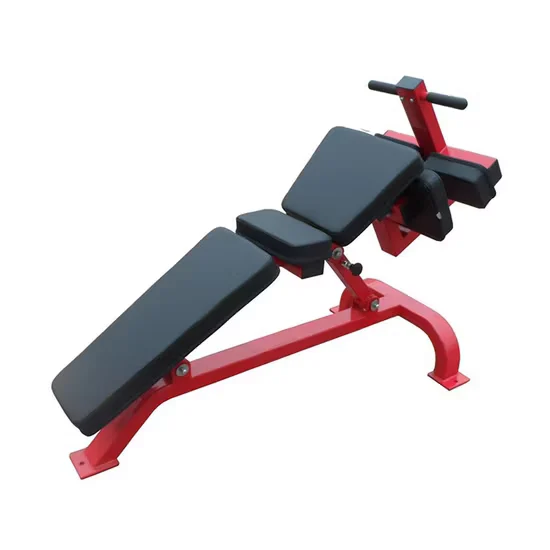
Heavy-Duty Frame Construction — 48kg steel structure resists displacement during high-intensity abdominal training cycles, tested for continuous multi-user facility deployment.
Technical Specifications
| Parameter | Value |
|---|---|
| Product Type | Adjustable Abdominal Board |
| Model NO. | 5060 |
| Exercise Target | Abdominal |
| User Profile | Adult / Unisex |
| Frame Material | Steel |
| Net Weight | 48kg |
| Product Dimensions | 1400 × 680 × 600mm |
| Max User Weight | 180kg |
| Certification | ISO 9001, CE |
| OEM/ODM | Available |
Application Suitability
| Deployment Scenario | Typical Use |
|---|---|
| Chain gym strength zone | Core conditioning circuits during peak membership hours |
| Corporate wellness room | Quick abdominal sessions between work blocks |
| Community fitness center | Durable daily use across diverse age and fitness levels |
| Sports performance training center | Athlete core stabilization and weighted decline work |
| High-end residential home gym | Space-efficient dedicated abdominal training station |
Why Angle Adjustment Mechanisms Fail Before the Frame Does
Precision locking hardware determines whether an adjustable abdominal board survives six months in a commercial gym.
When facility managers report equipment failures on the strength floor, it is rarely the steel frame that gives out first. The adjustable pivot points and locking pins endure repetitive stress every time a member changes the decline angle, and cheap detent systems develop play within weeks of high-frequency rotation. Members notice the wobble, trainers write it off as a maintenance headache, and the unit gets dragged to the corner. [NEED_CITE: mechanical fatigue testing standards for adjustable gym equipment pivot mechanisms]
The commercial adjustable abdominal board machine gym operators keep on the floor is the one where the locking mechanism was engineered for thousands of adjustment cycles, not hundreds.
Positioning in the Strength and Functional Training Zone
This adjustable abdominal board occupies a compact footprint within the core training or functional strength area, complementing cable machines, captain’s chairs, and stability ball stations. It covers decline crunches, weighted sit-ups, and isometric core holds across a range of angles. Positioned near free-weight racks, it fits the workflow of members rotating between compound lifts and isolation core work. The 1400 × 680mm profile accommodates users of varying torso lengths without consuming the floor space of a full bench station. One commercial adjustable abdominal board machine gym placement typically serves a 15- to 20-member rotation during peak hours.
What Continuous Multi-User Rotation Demands from the Frame
A busy gym floor sees the abdominal board in near-constant use between morning and evening peaks, with members cycling through sets every few minutes. Each mounting, dismounting, and angle change transmits force through the welds and locking hardware. The 48kg net weight anchors the unit against lateral shift without requiring bolt-down installation, though a level rubber-matted floor remains essential for stability. Sweat exposure demands corrosion-resistant surface treatment on all contact points and adjustment collars. For facilities running 16+ hours daily, quarterly inspection of the pivot mechanism and locking pins should be part of the standard preventive maintenance rotation. [NEED_CITE: EN 957 requirements for structural integrity of static training equipment]
Steel Gauge and Locking Pin Mechanics Explained
The 48kg mass of this unit signals substantial steel section thickness throughout the main frame, directly correlating to rigidity under loaded decline exercises where user weight plus external plates can exceed 180kg at the pivot. The adjustable angle mechanism relies on a positive-lock pin engaging precision-drilled detent holes, eliminating the incremental slip common in friction-based adjustment systems. Welding quality at the base-to-upright junction determines whether lateral torque during oblique work introduces visible deflection over time. Commercial-grade powder coating on the steel surfaces resists the corrosive combination of sweat salts and cleaning chemicals applied multiple times daily.
The Cost of Specifying Light-Duty Boards in Commercial Floors
Facilities that procure residential-grade abdominal boards for commercial deployment encounter predictable failure sequences. Lightweight frames under 25kg shift on the floor during weighted sets, requiring constant repositioning by staff. Thin-gauge steel at the adjustment collar deforms under repeated loading, leaving the back pad unable to hold a fixed angle. Members compensate by avoiding the equipment entirely, and what was meant to be a core training asset becomes dead floor space. [NEED_CITE: comparative failure rates of light-commercial versus full-commercial strength equipment in high-traffic facilities]
Why This Line Holds Up Under Facility Conditions
Every unit in this product family undergoes structural load testing aligned with the 10,000-hour durability benchmark applied across the commercial range. The adjustable abdominal board is evaluated through repeated angle-change cycles under maximum user load to verify locking pin retention and frame rigidity. For facility planners, the 1400 × 680mm footprint fits standard strength-zone spacing grids, allowing clean sightlines and member flow between adjacent stations. OEM customization covers frame color and pad upholstery to match facility branding. A free 3D layout positions this board relative to cable machines and free-weight zones with proper clearance. 24/7 technical support covers adjustment mechanism troubleshooting for maintenance teams.
Documentation & Test Records
- CE declaration of conformity for adjustable abdominal board structural safety
- EN 957 test report covering static load and pivot mechanism endurance
- ISO 9001 certificate for manufacturing quality management systems
- Noise and vibration assessment for strength floor deployment
- Durability test record documenting angle-adjustment cycle counts
- Spare parts list covering locking pins, pads, and hardware
Installation, Commissioning & Maintenance
- Maintain 600mm clearance on all sides of the 1400 × 680mm footprint for safe user access
- Position on level rubber-matted flooring to prevent lateral drift during loaded sets
- Verify locking pin engagement at every angle position before opening to member use
- Inspect pivot mechanism and detent holes quarterly for wear under high-frequency rotation
- Wipe steel frame and upholstery daily with pH-neutral cleaner to prevent sweat corrosion
- Replace back pad upholstery when surface cracking compromises user grip
Planning Your Strength Zone Equipment Specification
Provide your facility floor area and existing equipment list to receive a 3D strength-zone layout that integrates this abdominal board with proper spacing and member flow patterns. Specify your daily operating hours and expected member throughput so the locking mechanism duty cycle matches your rotation demands. Confirm whether the deployment floor sits above occupied spaces, which may influence padding and matting requirements beneath the unit.
Frequently Asked Questions
Q: What distinguishes a commercial abdominal board from a residential version structurally?
A: Commercial units use heavier-gauge steel tubing and reinforced welds at stress junctions to withstand continuous multi-user loading throughout daily operating hours. The locking mechanism employs hardened steel pins and precision-drilled detent holes rated for thousands of adjustment cycles, whereas residential versions typically rely on lighter friction-based systems that develop play within months of regular use.
Q: What angle range does the adjustment mechanism support?
A: The board offers multiple fixed decline positions secured by a positive-lock pin system, covering flat through steep decline angles suited to progressive core loading. Each detent position provides a secure, wobble-free lock that maintains consistency across repetitions, which is essential for members performing weighted abdominal work with external plates or medicine balls.
Q: What steel specification and surface treatment does the frame use?
A: The frame is constructed from commercial-grade steel sections selected for rigidity under the 180kg maximum user load, with full welding at structural junctions. The surface receives a powder-coated finish resistant to sweat salts and repeated chemical cleaning, preventing the corrosion that compromises adjustment collars and locking hardware on untreated equipment in humid gym environments.
Q: What maintenance does the adjustment mechanism require in high-frequency use?
A: Facility maintenance teams should inspect the locking pin and detent holes quarterly for wear signs, cleaning debris from the pivot area that can impede smooth angle changes. The pivot bolt requires periodic torque verification to maintain rigidity without overtightening, and any visible elongation of the detent holes warrants immediate pin and collar replacement to preserve angle-locking precision.
Q: How much floor space should be allocated per unit in a commercial layout?
A: Allocate a minimum clearance zone of approximately 2.0 × 1.4 meters per unit, accounting for the 1400 × 680mm board footprint plus safe mounting and dismounting space on all sides. In high-traffic strength zones, orient the board so the decline head position faces away from primary member traffic lanes, preventing accidental contact during loaded abdominal sets.