
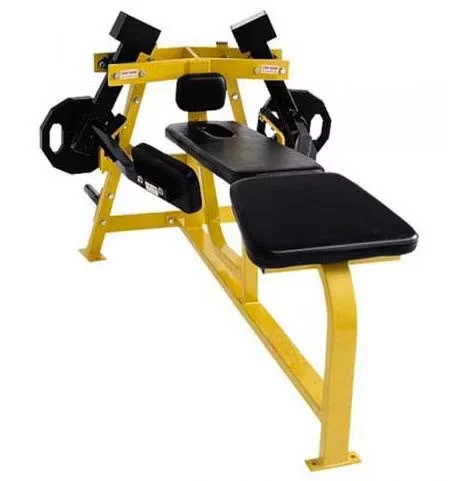
Continuous Commercial Durability — Sealed bearing pivot system and reinforced steel frame tested through 10,000 hours of high-frequency operation across international gym deployments.
Technical Specifications
| Parameter | Value |
|---|---|
| Product Type | ISO-Lateral Rear Deltoid Machine |
| Product Dimensions | 19821003925mm |
| Net Weight | 83kg |
| Material | Steel |
| Exercise Part | Back |
| Max User Weight | 180kg |
| Certification | ISO 9001, CE |
| OEM/ODM | Available (frame color, upholstery, branding) |
Application Suitability
| Deployment Scenario | Typical Use |
|---|---|
| Five-star hotel fitness center on guest room floors | Low-noise strength training adjacent to occupied rooms |
| International gym chain cardio and strength zone | High-frequency rear deltoid and upper-back work |
| Corporate wellness room | Compact footprint for diverse employee populations |
| High-end residential home gym | Durable steel construction for daily private use |
| Sports performance training center | ISO-lateral independent arm movement for athlete programming |
Why Vibration Complaints Reach Management Before Maintenance Does
Sealed bearing pivot systems prevent structural vibration transmission through floor slabs.
Strength equipment placed on guest floors or above occupied spaces often generates complaints not from the machine itself but from vibration traveling through pivot points into the building structure. Weight stack guides, cable pulleys, and arm hinges all create resonance paths that standard bearings cannot isolate. Facility managers typically hear about this from the front desk long before the maintenance team flags any mechanical issue [NEED_CITE: structural vibration transmission standards for fitness equipment in mixed-use buildings].
I first encountered this problem at a property in Mexico City, where an entire batch of plate-loaded machines had to be pulled from an upper-floor gym because guests below reported a rhythmic hum during evening hours. The culprit was not the plates — it was the metal-on-metal pivot contact at each arm joint, amplifying every rep through the concrete slab. That experience changed how I evaluate every pivot and bearing specification before a unit ships.
An ISO-Lateral Rear Deltoid Machine commercial gym operators install on shared floors must address these resonance paths at the engineering level, not through after-market padding.
Role Within a Commercial Strength Training Zone
This machine targets the posterior shoulder and upper-back musculature through independent arm convergence, complementing cable rows and lat pulldown stations already present in most commercial layouts. Its ISO-lateral design lets each arm move independently, accommodating users with asymmetrical strength or rehabilitation requirements without forcing bilateral compensation. The 180kg maximum user weight rating covers the full spectrum of commercial gym demographics.
The compact 1982mm length footprint fits standard strength zone aisles, leaving room for plate storage and user circulation. The ISO-Lateral Rear Deltoid Machine commercial gym planners position near other plate-loaded or selectorized upper-body units creates a logical flow from compound pulling movements to isolation work, keeping member traffic predictable and reducing congestion during peak hours.
Floor Loading, Noise Transmission, and Continuous Duty Considerations
At 83kg net weight, the unit distributes load across four floor contact points, keeping point pressure well within typical commercial slab ratings without requiring supplemental reinforcement [NEED_CITE: floor load requirements for commercial strength equipment deployment]. However, when installed on elevated floors above guest rooms or office spaces, vibration isolation pads under each foot are recommended to decouple the steel frame from the slab.
The sealed bearing pivot system eliminates scheduled lubrication intervals, which matters in 24/7 facilities where maintenance windows are narrow. Unlike open bushings that degrade and develop play over months of continuous use, sealed bearings maintain consistent friction characteristics throughout their service life. For facilities running extended hours, this means the machine holds its original movement feel without generating the metallic rattle that signals wear to both users and adjacent occupants.
Engineering the Pivot: Why Bearing Selection Defines Long-Term Smoothness
The ISO-lateral independent arm mechanism relies on pivot bearings at every hinge point where the arm connects to the main frame. Standard commercial machines often use sintered bronze bushings, which perform adequately under light use but develop axial play once the lubricant film breaks down under repetitive loading. Sealed cartridge bearings eliminate this failure mode by enclosing the rolling elements in a contamination-proof race, keeping grease integrity intact for the bearing’s full rated life.
The reinforced steel frame construction provides the rigidity needed for these bearings to function as designed. A frame that flexes under load transfers lateral forces into the bearing race, accelerating wear and generating the grinding noise members associate with neglected equipment. The 19821003925mm dimensions reflect a geometry that keeps moment arms short, reducing torsional stress on both frame welds and pivot hardware.
The 180kg maximum user weight rating is not simply a static load figure — it reflects dynamic testing where users at maximum weight perform controlled repetitions across the full range of motion without frame deflection exceeding tolerance thresholds [NEED_CITE: dynamic load testing methodology for commercial strength equipment frames].
The Hidden Cost of Underspecified Pivot Hardware
Facilities that source strength equipment based primarily on price often discover the true cost six to twelve months into operation. Open bushings wear to the point where arm play becomes visible during use, creating a perception of poor maintenance that drives member attrition even when the facility has a spotless cleaning record. Replacement requires partial disassembly, labor costs, and downtime during which the machine sits out of service.
Noise from worn pivots transmits differently than cardio motor hum — it arrives as sharp metallic clicks that penetrate walls more readily than low-frequency vibration. In hotel deployments, this has led to entire strength zones being relocated away from guest floors after repeated complaints, at a cost far exceeding the original equipment price differential. Voltage mismatches discovered after delivery add another layer of avoidable rework when deployment markets are not confirmed during the specification stage.
Why This Product Line Meets Commercial Deployment Requirements
Every unit undergoes sealed bearing verification where pivot smoothness is checked across the full range of motion before it leaves the assembly line, ensuring no binding or play reaches the customer. The 10,000-hour durability testing protocol covers both frame welds and pivot hardware under continuous cyclic loading, matching the demands of facilities that operate around the clock.
OEM and ODM customization covers frame color, upholstery, and branding, allowing the ISO-Lateral Rear Deltoid Machine commercial gym buyers specify to match existing interior design standards without aftermarket refinishing. The complete six-series cardio family means facilities can source every cardio discipline from the same production facility, simplifying logistics and ensuring consistent finish quality across the entire equipment order. Free 3D zone layout planning accounts for the 19821003925mm footprint and required clearance on all sides, ensuring member flow and sightline considerations are addressed before equipment arrives.
Documentation & Test Records
- CE declaration of conformity covering the complete ISO-Lateral Rear Deltoid Machine unit
- EN 957 test report verifying structural integrity and safety requirements
- ISO 9001 certificate documenting manufacturing quality management systems
- Noise level test report measuring operational sound output at standard distance
- Durability test record confirming pivot bearing and frame performance under cyclic loading
- Spare parts list with bearing and upholstery replacement specifications
Installation, Commissioning & Maintenance
- Position the 19821003925mm frame with minimum clearance on all sides for safe user access and plate loading
- Install vibration isolation pads under each foot when deploying on elevated floors above occupied spaces
- Verify all pivot bearing bolts are torqued to specification after initial assembly and again after the first week of use
- Inspect sealed bearing pivots quarterly for contamination ingress or unusual resistance during full-range movement
- Clean steel frame and upholstery with non-corrosive agents to prevent sweat accumulation and finish degradation
Planning Your Deployment Specification
Share your strength zone dimensions and adjacent equipment list to receive a 3D layout that accounts for this unit’s footprint and required user clearance on all sides. Specify your daily operating hours so pivot durability can be matched to expected repetition volume. Confirm the deployment floor level and adjacent occupied spaces to determine whether supplemental vibration isolation is required. State your target market so all hardware and documentation meet local compliance standards.
Frequently Asked Questions
Q: What is ISO-lateral movement and how does it benefit users in a commercial setting?
A: ISO-lateral movement allows each arm to operate independently along its own converging path, rather than forcing both arms through a single fixed bar. This means users with strength imbalances or those returning from shoulder injury can load each side appropriately without the stronger side compensating. In a commercial gym, this versatility reduces the need for multiple single-arm cable attachments and keeps one machine serving a broader membership profile.
Q: How does the sealed bearing pivot system reduce ongoing maintenance requirements?
A: Sealed cartridge bearings enclose the rolling elements within a contamination-proof housing, preventing sweat, dust, and cleaning chemicals from reaching the internal grease. Unlike open bushings that require periodic lubrication to prevent wear and noise, sealed bearings maintain their original friction characteristics throughout their rated service life. This eliminates scheduled maintenance intervals and keeps the machine available to members without planned downtime.
Q: What customization options are available for frame finish and branding?
A: Frame color, upholstery material and color, and logo placement are all configurable through the OEM/ODM program. This allows facility operators to match existing interior design standards or brand identity without resorting to aftermarket painting or reupholstering. Minimum order quantities apply, and lead times should be confirmed during the quotation stage to align with project delivery schedules.
Q: How does this machine integrate into a commercial strength training zone layout?
A: The 19821003925mm footprint fits within standard commercial aisle spacing, typically positioned among other selectorized or plate-loaded upper-body machines to create a logical training flow. The free 3D layout service accounts for user clearance on all sides, plate storage positioning, and sightline requirements so the machine placement supports both member traffic patterns and staff supervision across the floor.
![Hammer Strength ISO-Lateral D. Y. Row Machine 5003 for Commercial Gyms [WARN] draft identifier mismatch](https://bicksport.com/wp-content/uploads/2026/08/hammer-strength-iso-lateral-d-y-row-machine-5003-for-commercial-gyms-warn-draft-identifier-mismatch-02baf9.webp)
![Professional Plate Loaded ISO-Lateral Leg Curl Machine for Commercial Gyms [WARN] draft identifier mismatch](https://bicksport.com/wp-content/uploads/2026/08/professional-plate-loaded-iso-lateral-leg-curl-machine-for-commercial-gyms-warn-draft-identifier-mismatch-c75aee.webp)

