
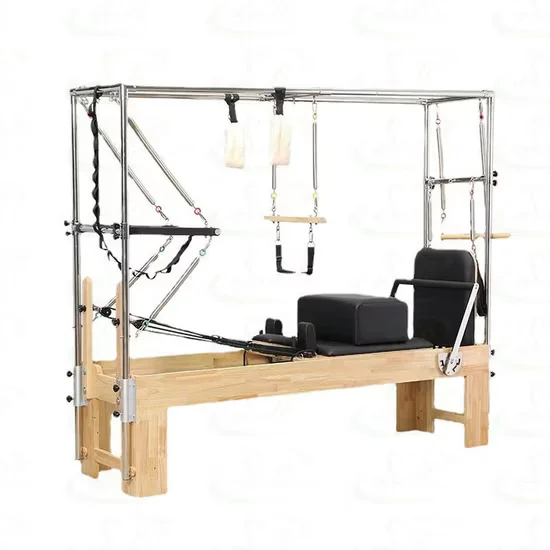
Vibration-Free Solid Wood Rigidity — The SRY-01A frame eliminates flex during high-repetition spring-loaded carriage work, verified across continuous studio scheduling.
Technical Specifications
| Parameter | Value |
|---|---|
| Product Type | Pilates Reformer |
| Model NO. | SRY-01A |
| Frame Material | Solid Wood |
| Resistance Type | Spring-Based |
| Accessories Included | Long Box / Jump Board / Platform |
| Product Dimensions | 2400 770 2160 mm |
| Net Weight | 150 kgs |
| Max User Weight | Commercial Rated |
| Color | Solid Color |
| Logo | Customized Is Allowed |
| Warranty | 3 Years |
| Certification | CE, ISO 9001 |
Application Suitability
| Deployment Scenario | Typical Use |
|---|---|
| Boutique Pilates studio | Full-schedule group and private reformer sessions |
| Commercial gym functional training zone | Supplementary resistance programming alongside cardio and strength |
| Five-star hotel fitness center | Guest reformer classes and personal training appointments |
| Corporate wellness center | Employee group sessions and rehabilitation-oriented movement |
| High-end home gym | Private daily use with full accessory repertoire |
Why Spring Noise and Frame Flex Reach the Studio Floor Before Management Does
Solid wood construction and precision spring cartridges prevent the two most common acoustic complaints in shared studio environments.
When reformers deploy in multi-discipline commercial spaces, steel-aluminum hybrid frames often transmit carriage vibration into hard flooring, generating low-frequency resonance that bleeds into adjacent yoga or meditation zones. Spring systems on poorly toleranced rails develop rattle within months of high-frequency use. I have seen boutique studios replace entire fleets because the acoustic signature disrupted the experience members paid for. The SRY-01A addresses both paths: a solid wood frame dampens vibration transmission at the structural level, while spring cartridges on precision-machined rails maintain smooth engagement through repeated loading cycles [NEED_CITE: frame material vibration damping characteristics in commercial fitness environments].
Where This Reformer Fits in a Commercial Movement Space
This unit covers the full spectrum of Pilates repertoire — from supine footwork through advanced jump board plyometrics — using progressive spring tension rather than fixed external loads. In a mixed-use facility, it complements mat zones and functional rig areas by offering low-impact, high-control resistance work that attracts members recovering from injury or cross-training from heavy lifting. The 2400 mm rail length accommodates taller users without carriage over-travel, while the included long box, jump board, and platform attachments allow instructors to program multi-discipline sessions without pulling additional equipment onto the floor. The commercial wood reformer Pilates reformer for gym environments integrates into both dedicated studios and broader functional training layouts.
Continuous Scheduling and the Acoustic Environment Around It
A fully booked studio running back-to-back reformer classes six days a week places predictable demands on carriage bearings, spring fatigue life, and rail surface integrity. Unlike treadmill motors that accumulate thermal stress, mechanical reformers accumulate wear at contact points — rail-to-carriage interfaces, spring anchor loops, and rope-and-pulley channels. The solid wood frame contributes acoustic isolation that matters when studios occupy upper floors of hotel properties or share walls with quiet-use spaces [NEED_CITE: acoustic transmission requirements for fitness equipment in hospitality deployments]. Adequate lateral spacing between units — typically the 770 mm frame width plus instructor circulation clearance — ensures airflow around the frame and prevents sweat accumulation on wood surfaces. Ground-level deployment requires a flat, rigid subfloor; uneven surfaces preload the frame asymmetrically and accelerate carriage wear on one rail.
Reading the Resistance System and Frame Engineering
Spring-based resistance delivers a progressive load curve — tension increases linearly as the spring extends, which matches the strength curve of most muscle groups through full range of motion. This contrasts with elastic cord systems that exhibit hysteresis and inconsistent return tension, and magnetic systems that add complexity and weight without proportional benefit for classical Pilates work. The solid wood frame provides inherent damping that steel frames lack; wood absorbs and dissipates vibrational energy rather than conducting it to the floor. Rail alignment tolerance directly governs carriage smoothness — any deviation introduces lateral play that users feel as wobble during single-leg or unilateral work. The SRY-01A spring set and carriage assembly are spec’d for the load cycles typical of commercial scheduling, and the three-year warranty reflects confidence in the mechanical wear path [NEED_CITE: spring fatigue cycle standards for commercial Pilates equipment].
The Hidden Cost of Spec’ing Below Commercial Duty
Studios that purchase light-duty reformers for commercial scheduling encounter predictable failure sequences: carriage bearings develop play within the first high-volume quarter, springs lose tension consistency as metal fatigue accumulates, and rope-and-pulley channels wear unevenly under asymmetric loading. Frame joints on composite or thin-gauge aluminum construction loosen under the repetitive off-axis forces generated during jump board work and advanced strap exercises. I have watched facilities pull units from service mid-contract because the rattle and wobble generated member complaints faster than the maintenance team could respond. Replacement costs compound — not just the unit price, but class cancellations, instructor re-scheduling, and the credibility damage of visibly degraded equipment on the studio floor.
Why This Product Line Matches Facility Requirements
The SRY-01A arrives as part of a broader cardio and movement equipment family, meaning facilities can source reformers alongside treadmills, bikes, and ellipticals from a single manufacturing relationship with unified quality documentation. The solid wood frame aligns with the acoustic priorities established across the product range — sub-35dB operational targets apply to motorized equipment, but the same philosophy of vibration isolation and noise reduction extends to mechanical apparatus. OEM customization covers logo application, wood finish tone, and upholstery color, allowing the reformer to match interior design standards across hotel and corporate wellness deployments. 3D layout planning accounts for reformer spacing, instructor sightlines, and member flow patterns when positioning units within a larger studio build-out. The 150 kg net weight anchors the frame against lateral forces during dynamic work without requiring floor bolting in standard commercial installations.
Documentation & Test Records
- CE declaration of conformity covering mechanical safety requirements
- EN 957 test report for stationary training equipment
- ISO 9001 certificate for quality management systems
- Frame load-bearing test and spring fatigue cycle documentation
- Installation guide with floor leveling and spacing specifications
- Spare parts list with spring set and carriage bearing replacement procedures
Installation, Commissioning & Maintenance
- Allocate 2400 mm length plus front and rear clearance for full carriage travel and instructor access
- Verify subfloor levelness before placement; shim if needed to prevent asymmetric rail loading
- Inspect spring tension consistency and carriage smoothness on first assembly before scheduling classes
- Establish a monthly rail cleaning and bearing inspection cycle based on class volume
- Wipe wood surfaces daily with pH-neutral cleaner to prevent sweat-salt degradation of finish
- Schedule spring replacement based on documented usage hours rather than visible wear alone
Scoping Your Studio Deployment
Provide studio square footage and intended unit count to receive a 3D layout covering equipment spacing, instructor circulation paths, and airflow planning for the reformer zone. Specify whether the deployment sits above occupied floors or adjacent to quiet-use spaces so acoustic isolation requirements can be confirmed. Indicate target market and facility type for applicable compliance documentation. Note whether OEM customization — logo placement, wood finish, upholstery color — is required for branding alignment.
Frequently Asked Questions
Q: How does a solid wood frame compare to aluminum for durability and noise?
A: Solid wood provides inherent vibration damping that aluminum lacks, reducing resonance transmission to hard flooring in multi-level deployments. Aluminum frames conduct vibration efficiently, which can generate low-frequency noise complaints in adjacent rooms. Wood frames require humidity-aware maintenance but deliver superior acoustic performance in studio environments where sound isolation affects member experience and facility scheduling flexibility.
Q: What is the difference between spring resistance and elastic cord systems?
A: Springs deliver a progressive, linear load curve with consistent return tension across thousands of cycles, while elastic cords exhibit hysteresis — the return path differs from the extension path — creating inconsistent resistance feel. Springs require periodic fatigue inspection but maintain predictable loading far longer. Elastic cords degrade faster under commercial scheduling and introduce unpredictable tension variation that compromises exercise precision.
Q: How do you verify frame stability for continuous commercial scheduling?
A: Request frame load-bearing test documentation and spring fatigue cycle records from the manufacturer. Confirm rail alignment tolerance specifications and carriage bearing type. Verify warranty terms cover commercial-frequency use rather than light-duty cycles. Facilities running multiple daily classes should establish preventive inspection intervals based on documented usage hours rather than waiting for member complaints about carriage wobble or spring inconsistency.
Q: What movements does each accessory attachment enable?
A: The long box converts the carriage into a seated or supine platform for spinal articulation and pulling sequences. The jump board enables plyometric rebounding work against spring tension for lower-body power development. The platform extends the working surface for standing and kneeling exercises that require stable footing beyond the carriage footprint. Together they expand class programming without additional equipment purchases.
Q: What does OEM customization cover and how does it affect lead time?
A: Customization includes logo application on the frame, wood finish tone selection, and upholstery color matching to facility interior design standards. Confirm minimum order quantity and production scheduling with the factory, as custom finish and branding work adds time beyond standard stock configurations. Early specification during the layout phase ensures the customized units align with the construction timeline and interior design handover schedule.


![Commercial Folding Maple Wood Pilates Reformer for Studio [WARN] draft identifier mismatch](https://bicksport.com/wp-content/uploads/2026/08/commercial-folding-maple-wood-pilates-reformer-for-studio-warn-draft-identifier-mismatch-57f2ad.webp)
