
![Wood Folding Pilates Reformer Portable Quality Machine [WARN] draft identifier mismatch](https://bicksport.com/wp-content/uploads/2026/08/wood-folding-pilates-reformer-portable-quality-machine-warn-draft-identifier-mismatch-ef90b8.webp)
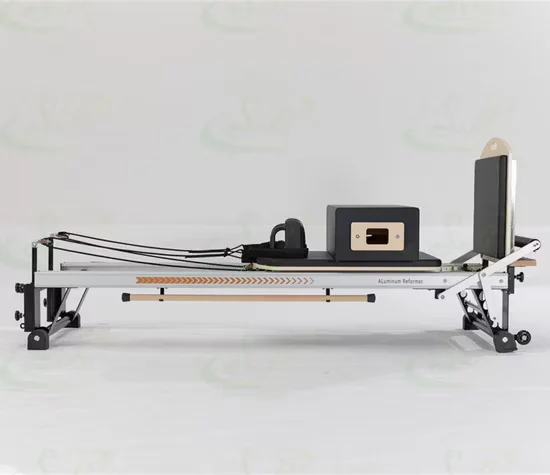
Whisper-Quiet Frame Design — Solid wood construction and folding mechanism eliminate spring noise transmission across shared floors and multi-purpose rooms.
Technical Specifications
| Parameter | Value |
|---|---|
| Designation | SRY-20C |
| Product Type | Wood Folding Pilates Reformer |
| Frame Material | Solid Wood |
| Foldable | Yes |
| Accessory Compatibility | Long Box / Jump Board / Platform |
| Product Dimensions | 2400 x 600 x 350 mm |
| Net Weight | 100 kg |
| Max User Weight | Not specified |
| Color Options | Solid Color |
| Logo | Customized Is Allowed |
| Warranty | 3 Years |
| Production Capacity | 80 Pieces/Month |
| Target User | Adult / Unisex |
Application Suitability
| Deployment Scenario | Typical Use |
|---|---|
| Boutique Pilates studio on upper floors | Group classes requiring quiet spring resistance and fold-away storage between sessions |
| Hotel wellness suite adjacent to guest rooms | Individual or semi-private reformer sessions where transmitted vibration must remain minimal |
| Rehabilitation clinic treatment zone | Low-impact therapeutic movement with accessory integration for progressive loading |
| High-end residential home gym | Space-constrained environments requiring equipment to fold when the room serves other functions |
| Corporate wellness center multi-purpose room | Lunchtime and after-work reformer classes in rooms shared with yoga or functional training |
Why Spring Noise Travels Further Than You Expect in Mixed-Use Buildings
Wood frames absorb harmonic vibration that metal frames transmit directly into floor slabs.
When a Pilates studio operates above occupied hotel rooms or office spaces, the repeated engagement and release of carriage springs generates low-frequency oscillation. Metal frames conduct this energy straight into the concrete, where it propagates to adjacent ceilings. Facility operators often discover this problem only after noise complaints reach management [NEED_CITE: vibration transmission through structural slabs in commercial fitness deployments]. A commercial wood folding Pilates reformer addresses this at the material level: solid wood possesses inherent dampening characteristics that interrupt vibration pathways before they reach the building structure.
Positioning Within a Studio Equipment Matrix
This reformer covers the full spectrum of classical and contemporary Pilates repertoire, from supine footwork through advanced overhead pulling straps. In a studio layout, it pairs naturally with Cadillac towers for decompression work and Wunda chairs for closed-chain loading. The folding mechanism allows operators to clear floor space for mat classes or functional training without relocating equipment entirely. Its accessory ecosystem — Long Box for seated and prone work, Jump Board for plyometric intervals, Platform for extended range — means instructors program complete sessions from a single footprint. The commercial wood folding Pilates reformer accommodates adult users across a wide anthropometric range, and the solid wood frame maintains rigidity during high-tension spring configurations.
Continuous Session Scheduling and Room-Level Environment
Studios running four to six reformer classes daily place cumulative load on every carriage spring and pulley component. Operators scheduling back-to-back sessions with minimal turnover time need equipment that does not require mid-day recalibration. Room ventilation deserves attention: reformer upholstery and wood finishes respond to sustained humidity, so climate control setpoints protect both materials and user comfort [NEED_CITE: environmental control standards for wood-frame fitness equipment]. Ground-floor installations simplify logistics but require moisture barriers beneath the equipment; upper-floor deployments benefit from the wood frame’s vibration isolation. Dedicated circuits are unnecessary for passive resistance equipment, but overhead lighting must avoid casting shadows across the carriage track that could distract users during supine exercises.
Decoding Frame Material and Resistance Mechanics
Solid wood frame construction offers two measurable advantages over welded steel in reformer applications. First, the cellular structure of hardwood dissipates vibrational energy internally rather than transmitting it to mounting surfaces. Second, wood’s natural coefficient of thermal expansion remains negligible across normal studio temperature ranges, meaning carriage track alignment does not drift seasonally. The spring resistance system operates on a linear tension curve — each spring addition increases load proportionally, allowing instructors to prescribe precise incremental progressions. Folding mechanisms introduce a structural consideration: hinge points must resist lateral shear forces during exercises like side-lying leg work. This unit’s hinge assembly distributes load across the full frame width rather than concentrating stress at a single pivot. Accessory attachment points — particularly the Jump Board mount — experience cyclical impact loading and require hardened insertion hardware.
The Price of Underspecified Frames in Daily Studio Operations
Facilities that procure reformers based solely on price discover frame integrity issues within the first year of commercial scheduling. Metal frames with inadequate cross-bracing develop audible squeaks at welded joints, and these sounds amplify through hard flooring into neighboring spaces. Springs that lack consistent tension calibration across a production batch force instructors to individually mark each machine, preventing class-wide cueing. Folding mechanisms that rely on friction-fit pins rather than positive-lock hardware introduce lateral play that users perceive as instability during standing work [NEED_CITE: structural fatigue in folding fitness equipment under commercial use]. These compromises accumulate into member attrition — clients who experience equipment inconsistency simply book sessions at competing studios.
Why This Product Line Earns Studio Procurement Shortlists
Noise-sensitive deployments — hotel floors, mixed-use commercial buildings, residential wellness suites — require equipment validated for minimal acoustic transmission, and this reformer’s solid wood construction addresses that requirement at the material level. The three-year warranty reflects confidence in frame durability under continuous studio scheduling. Full OEM customization extends beyond cosmetic branding to include logo placement and finish selection, allowing boutique operators to maintain visual identity across their equipment fleet. The folding mechanism enables 3D studio layout planning that accounts for class changeover workflows and multi-purpose room conversion. Production capacity of 80 units monthly supports both single-studio procurement and multi-location rollouts without extended lead times.
Documentation & Test Records
- Frame material grade certification and finish durability test documentation
- Spring tension consistency verification across production batch records
- Folding mechanism cycle-life test report with load specifications
- Accessory attachment point static and dynamic load capacity verification
- Assembly, commissioning, and routine maintenance guide with exploded diagrams
- Spare parts catalog with interchangeability notes across the product family
Installation, Commissioning & Maintenance
- Maintain minimum 900 mm clearance on all sides for safe carriage travel and instructor circulation around the 2400 mm length
- Level installation surface before assembly; use isolation pads beneath frame feet to protect finished flooring and further reduce transmitted vibration
- Inspect spring tension consistency and carriage track alignment during initial commissioning; document baseline measurements for future reference
- Lubricate carriage wheels and pulley axles at intervals determined by weekly session volume; replace springs showing visible deformation
- Tighten folding hinge fasteners quarterly; verify positive lock engagement before each operating session
- Clean upholstery and wood surfaces with pH-neutral solutions; avoid solvent-based products that degrade finish or spring coatings
Equipment Selection Inquiry
Provide your studio floor plan and target class capacity to receive a 3D layout that accounts for reformer spacing, instructor circulation, and accessory storage zones. Specify average daily session count per unit so we can confirm spring and carriage component suitability for your scheduling density. Indicate deployment floor level and adjacent occupied spaces to validate acoustic isolation requirements. State your destination market so documentation and finish options align with local regulatory expectations.
Frequently Asked Questions
Q: How does solid wood frame construction compare to metal for commercial Pilates reformers?
A: Solid wood provides natural vibration dampening that metal frames cannot replicate without added isolation components. This reduces transmitted noise to floors below, which matters in hotels and multi-story buildings. Wood also maintains dimensional stability across temperature ranges, keeping carriage track alignment consistent. Metal frames may offer lighter weight, but in permanent studio installations, the acoustic advantage of wood outweighs portability considerations.
Q: What maintenance cycle do the springs require under daily studio scheduling?
A: Springs under continuous commercial use gradually lose tension consistency. Studios running four or more sessions daily should verify spring calibration monthly and plan replacement based on visible coil deformation rather than a fixed calendar schedule. Uneven tension across springs on the same reformer forces instructors to compensate during cueing. Procurement contracts should include spring replacement intervals tied to documented session volume.
Q: How does the folding mechanism hold up under repeated daily use?
A: The hinge assembly must resist lateral shear forces generated during exercises like standing leg presses and side-lying work. Positive-lock hardware outperforms friction-fit pins in maintaining structural rigidity over thousands of fold cycles. Operators should verify lock engagement before each session and inspect hinge fasteners quarterly. The folding feature is engineered for spatial flexibility, not for frequent daily reconfiguration — plan storage zones that minimize unnecessary handling.
Q: Are the Long Box, Jump Board, and Platform interchangeable across different reformer models?
A: Accessory compatibility depends on attachment point geometry and load rating specific to each reformer model. Before mixing accessories across a mixed-brand studio fleet, verify that mounting hardware aligns and that load ratings match the intended exercise repertoire. Jump Board attachments in particular experience impact loading and require model-specific validation. Ordering accessories as matched sets with each reformer procurement eliminates cross-compatibility uncertainty.
Q: What spatial planning factors apply when deploying folding reformers in multi-purpose rooms?
A: Beyond the equipment footprint itself, account for carriage travel extension, instructor circulation paths, and the clearance needed to physically fold and unfold each unit. Storage orientation — whether folded units stack against walls or nest in a dedicated zone — affects how quickly the room converts between use modes. Floor finish selection should accommodate both reformer feet and whatever other activities share the space.

![White Aluminum Pilates Reformer Machine for Home Use [WARN] draft identifier mismatch](https://bicksport.com/wp-content/uploads/2026/08/white-aluminum-pilates-reformer-machine-for-home-use-warn-draft-identifier-mismatch-1f1dec.webp)