

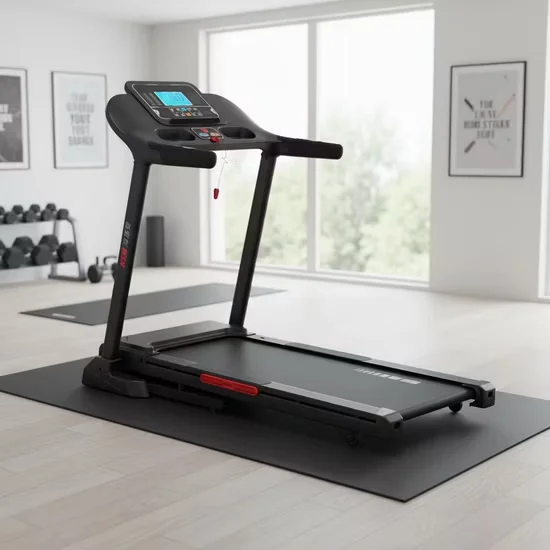
Compact Foldable Chassis — The W08 stores at 220mm height while maintaining a 1200 x 450 mm running surface for full-stride accommodation in space-constrained deployments.
Technical Specifications
| Parameter | Value |
|---|---|
| Product Type | Foldable Treadmill |
| Designation | W08 |
| Motor Type | DC |
| Motor Power | 1.5HP (peak or continuous not specified) |
| Speed Range | 1–16 km/h |
| Running Surface | 1200 x 450 mm |
| Console Type | LCD (Speed / Distance / Time / Calories) |
| Programs | 16 preset programs |
| Max User Weight | 100–160 kg |
| Material | ABS housing |
| Foldable | Yes |
| Product Dimensions (Unfolded) | 1500 x 740 x 1150 mm |
| Product Dimensions (Folded) | 1810 x 740 x 220 mm |
| Net Weight | 42.0 kg |
| Certification | CE, RoHS |
| OEM/ODM | Available |
Application Suitability
| Deployment Scenario | Typical Use |
|---|---|
| High-end residential home gym | Daily personal cardio sessions with fold-and-store convenience after use |
| Corporate wellness room | Employee fitness access during breaks, equipment concealed after hours |
| Boutique studio with limited floor space | Intermittent cardio stations between group class scheduling |
| Light commercial shared fitness area | Low-to-moderate daily traffic in apartment complex or co-living fitness rooms |
What Peak Horsepower Hides About Continuous Duty in Foldable Treadmills
A 1.5HP DC rating means nothing until the duty cycle is confirmed against actual deployment intensity.
When I first started on the motor assembly line, I learned quickly that foldable treadmills equipped with light-duty DC motors routinely overheat when pushed through back-to-back sessions in shared residential fitness rooms. The W08’s 1.5HP DC motor delivers adequate output for intermittent residential and light commercial use, but the source specification does not distinguish between peak and continuous horsepower [NEED_CITE: motor duty cycle classification for continuous commercial operation]. A motor rated at peak output may sustain that level only for short bursts before thermal protection triggers a shutdown. Buyers deploying this foldable motorized treadmill DC motor commercial grade unit in environments with sustained daily traffic must verify continuous duty rating before committing to volume orders.
Where the W08 Sits in a Mixed Cardio Floor Plan
The W08 occupies the compact walking and light jogging segment, covering speeds from 1 to 16 km/h across 16 preset programs that guide users through varied intensity intervals without requiring external app connectivity. In a cardio zone configured with full-size commercial treadmills and ellipticals, this foldable motorized treadmill serves as a secondary station for warm-up, cool-down, or low-impact sessions in tighter corners. The 1200 x 450 mm running surface accommodates moderate stride lengths, making it suitable for users who prioritize walking and steady-state jogging over sprint work. The LCD console captures speed, distance, time, and calorie data directly, supporting basic workout tracking for self-guided users in residential and corporate wellness environments.
Deployment Environment Constraints for DC-Driven Foldable Units
Daily run-time expectations must align with the motor’s thermal capacity. DC motors in foldable chassis designs typically rely on passive or small-fan cooling, meaning sustained sessions beyond 60 minutes in warm environments risk thermal throttling. Floor placement matters: units deployed on upper residential floors transmit vibration through structural slabs, and the 42.0 kg net weight provides limited mass damping compared to heavier commercial frames [NEED_CITE: vibration transmission thresholds for cardio equipment on elevated floor slabs]. Power requirements must be confirmed per target market — voltage and plug standards differ across regions, and mismatches discovered after container arrival generate costly rework. The foldable design demands a flat, stable surface for both deployed and stored positions, and the 220mm folded profile requires adequate wall clearance and secure latching to prevent accidental deployment.
Interpreting the DC Motor and LCD Console Specification Set
DC motors operate on direct current, typically delivering quieter low-speed operation than equivalent AC motors but with lower continuous thermal capacity. The distinction between peak and continuous horsepower is critical: peak rating indicates maximum short-duration output, while continuous rating reflects sustained thermal equilibrium under load. The W08 lists 1.5HP without specifying which measurement applies, so procurement teams should request the motor specification sheet to confirm. The LCD console provides straightforward readouts — speed, distance, time, calories — across 16 preset programs without Bluetooth or Wi-Fi connectivity, meaning workout data remains on-device rather than syncing to facility management software. The ABS housing keeps unit weight manageable for repositioning but offers less acoustic dampening than steel-enclosed commercial units. The 1200 x 450 mm belt area provides adequate length for walking and jogging gaits, though taller users with longer strides will find the surface limiting at speeds approaching 16 km/h.
The Hidden Cost of Underspecified Motor Duty Cycles
I have seen entire batches of foldable treadmills pulled from hotel fitness floors because the motor specification listed peak horsepower while the deployment demanded continuous output across eight-hour operating windows. When a DC motor runs beyond its thermal design envelope, insulation degradation accelerates and bearing lubrication breaks down, producing noise complaints that reach management long before maintenance teams flag the failure [NEED_CITE: thermal degradation patterns in light-duty DC treadmill motors]. Noise from an underspecified motor does not stay contained — it transmits through floor slabs into occupied rooms below, generating guest complaints that force reactive equipment swaps. The cost of replacing a failed unit in the field far exceeds the procurement savings from accepting an unverified motor rating. Voltage mismatches compound the problem: a motor designed for 220V markets will underperform or overheat when connected to 110V supply without proper transformer staging.
Why This Product Line Earns Deployment Trust
Every W08 unit passes through our testing department where motors, frames, and bearings undergo 10,000-hour continuous operation verification — the same protocol applied across our six-series commercial cardio family. The sub-35dB acoustic target verified in hotel deployments informs our cushioning and drive calibration, ensuring the W08 meets noise expectations when deployed on shared residential floors. OEM customization extends to console UI, housing color, and logo application, allowing facility operators to match branding requirements without minimum volume barriers. When you provide floor dimensions and adjacent room layouts, we deliver a 3D cardio-zone plan that accounts for the W08’s 1500 x 740 mm deployed footprint, required clearance for the folding mechanism, and airflow paths that prevent heat buildup around the DC motor housing. Technical support remains available around the clock for commissioning questions and spare parts coordination.
Documentation & Test Records
- CE declaration of conformity covering electrical safety and EMC requirements
- EN 957 test report validating structural and mechanical safety for stationary training equipment
- ISO 9001 certificate confirming quality management across production and testing
- RoHS compliance documentation for restricted substance limitations
- Motor specification sheet detailing duty cycle, thermal rating, and electrical parameters
- Console technical documentation with program logic and display interface reference
Installation, Commissioning & Maintenance
- Maintain minimum 500mm rear clearance and 200mm side clearance around the W08’s 1500 x 740 mm deployed footprint for safe mounting and dismounting
- Place on level flooring with vibration-dampening mat to reduce structure-borne noise transmission through elevated slabs
- Confirm local voltage and plug standard before power connection; DC motor requires dedicated circuit with stable supply
- Run belt tension and tracking calibration during first commissioning, recheck after initial 20 hours of operation
- Inspect belt lubrication and deck surface condition at 90-day intervals under regular residential use patterns
- Wipe ABS housing and console display after each session to prevent sweat corrosion on electronic contacts
Requesting a Deployment-Matched Quotation
Provide your cardio zone square footage and planned unit count to receive a 3D layout addressing the W08’s spatial requirements and airflow planning. Specify expected daily run-time per unit so we can confirm whether the DC motor duty cycle matches your operational intensity. Indicate deployment floor level and adjacent occupied spaces to determine whether supplemental acoustic isolation is advisable. Confirm target market voltage and plug standard, and state whether console data integration with facility management software is required for your operation.
Frequently Asked Questions
Q: What is the difference between continuous and peak horsepower in treadmill motors?
A: Peak horsepower represents the maximum output a motor can deliver for a brief interval before thermal limits intervene. Continuous horsepower reflects the sustained output the motor can maintain indefinitely at thermal equilibrium. The W08’s 1.5HP rating does not specify which measurement applies, so verifying the motor specification sheet is essential before deploying in environments with prolonged daily use.
Q: How does a DC motor compare to AC for commercial gym duty cycles?
A: DC motors generally deliver quieter operation at lower speeds and suit intermittent residential or light commercial patterns well. AC motors sustain higher continuous thermal loads, making them standard for heavy commercial cardio zones running ten or more hours daily. The W08’s DC motor serves environments with moderate session frequency rather than continuous high-traffic rotation.
Q: What noise level can be expected from a foldable DC treadmill in residential settings?
A: DC motors produce less electromagnetic noise than comparable AC units at walking and jogging speeds. Actual perceived noise depends on deck cushioning, belt condition, floor construction, and user weight. We provide a noise level test report upon request so deployment teams can evaluate acoustic compatibility with adjacent occupied rooms before installation.
Q: Can the LCD console data sync with facility management or member apps?
A: The W08’s LCD console displays speed, distance, time, and calorie data locally across 16 preset programs. It does not include Bluetooth or Wi-Fi connectivity for external data sync. Facilities requiring integrated usage tracking should evaluate units from our range with IoT-enabled consoles that support app synchronization and management software integration.

![Hsm MT23B Foldable Treadmill with Transport Wheels for Home Gym Use [WARN] draft identifier mismatch](https://bicksport.com/wp-content/uploads/2026/08/hsm-mt23b-foldable-treadmill-with-transport-wheels-for-home-gym-use-warn-draft-identifier-mismatch-aa6efa.webp)
![W08 Folding Electric Treadmill for Home Use Cardiopulmonary Training [WARN] draft identifier mismatch](https://bicksport.com/wp-content/uploads/2026/08/w08-folding-electric-treadmill-for-home-use-cardiopulmonary-training-warn-draft-identifier-mismatch-e53750.webp)