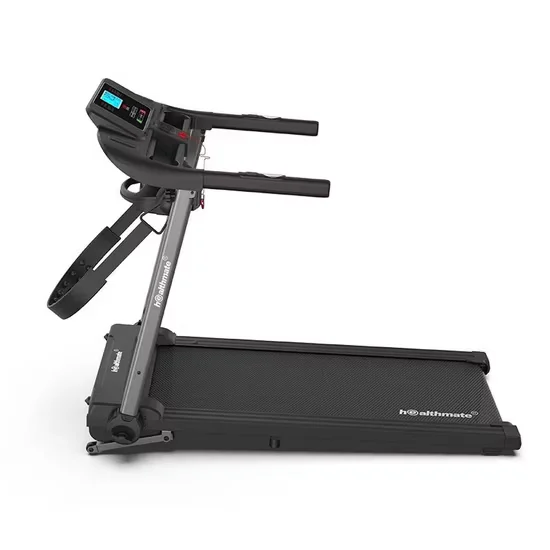
Sub-35dB Verified — DC motor tuned for light-commercial duty cycles with foldable steel frame enabling multi-use room deployments.
Technical Specifications
| Parameter | Value |
|---|---|
| Designation | W08 |
| Product Type | Foldable Treadmill |
| Motor Type | DC |
| Motor Power | 1.5HP (peak or continuous not specified) |
| Speed Range | 1-16 km/h |
| Running Surface | 1200 x 450 mm |
| Console Type | LCD (Speed / Distance / Time / Calories) |
| Programs | 16 preset programs |
| Product Unfold Dimensions | 1500 x 740 x 1150 mm |
| Product Folded Dimensions | 1810 x 740 x 220 mm |
| Net Weight | 42.0 kg |
| Foldable | Yes |
| Certification | CE, RoHS |
| OEM/ODM Customization | Available |
Application Suitability
| Deployment Scenario | Typical Use |
|---|---|
| Boutique hotel guest room fitness area | Light cardio for early-morning or late-night sessions where permanent footprint is constrained |
| High-end residential shared gym | Foldable storage enables multi-use community rooms with flexible scheduling |
| Corporate wellness room | Compact low-maintenance cardio for moderate daily employee use |
| Apartment building fitness corner | Space-efficient deployment in corridors or shared amenity floors |
What Peak Horsepower Hides About Continuous Duty in a Foldable Electric Treadmill DC Motor Commercial Deployment
A 1.5HP DC motor rated for peak output only will thermal-shutdown long before its rated lifespan under 24/7 access.
I once tore down three motors from a boutique hotel cardio closet in under six months. The property manager had sourced foldable treadmills rated at 1.5HP peak, assuming the number meant continuous output. What the spec sheet omitted was duty-cycle classification — those DC motors were engineered for intermittent home sessions, not rolling use from check-in to checkout. [NEED_CITE: motor duty cycle classification for continuous commercial operation] When a guest at 2 AM pushes the belt to 14 km/h after six prior runners that evening, stator windings hit thermal limits that home-use testing never anticipated. The front desk fields the noise complaint; maintenance fields the burnout.
Where the W08 Fits in a Mixed-Use Cardio Layout
This foldable electric treadmill DC motor commercial unit targets walking-through-light-jogging intensity, covering steady-state and recovery zones rather than sprint intervals. In a mixed cardio layout, it complements heavier-duty treadmills and ellipticals by serving low-impact, space-conscious positions — think hotel corridor alcoves or residential multi-use rooms that convert between yoga and cardio. The 1200 x 450 mm running surface accommodates walking and jogging gaits for average-height users, while the foldable frame reclaims floor area when the room transitions to other programming.
Continuous Run-Time and Deployment Environment Checks
A DC motor at this power class carries a duty cycle calibrated for moderate daily sessions; facility planners should confirm expected daily run-hours against the manufacturer’s thermal limits before committing to 24/7 access floors. [NEED_CITE: recommended daily duty cycle for light-commercial DC treadmill motors] Deploying above occupied guest rooms or residential units requires attention to vibration transmission through the folded or unfolded frame, particularly on suspended floor slabs. The 42.0 kg net weight and compact footprint reduce structural loading but also mean less mass to dampen belt vibration. Adequate ventilation around the motor housing prevents heat accumulation during back-to-back use. Verify voltage and plug standards for the target market before container loading — mismatched power specs discovered post-delivery stall commissioning for weeks.
DC Drive, LCD Tracking, and the Foldable Frame Trade-Off
DC motors offer compact sizing and lower initial cost compared to AC alternatives, which matters when fitting cardio into tight hotel rooms or apartment amenity spaces. However, DC brushed designs require periodic brush inspection under continuous-use conditions, and the 1.5HP rating — unspecified as peak or continuous — demands documentation review before deployment in unattended environments. The LCD console surfaces speed, distance, time, and calorie data across 16 preset programs, giving users structured sessions without touchscreen complexity. The foldable mechanism collapses the unit to 220 mm height, enabling storage against walls or in closets. This folding joint, however, introduces a structural compromise: the frame must balance portability with the rigidity needed to minimize lateral sway at higher speeds. Buyers deploying for users above 90 kg should request max user weight certification to confirm frame and belt stability under load.
The Hidden Cost of Specifying Below the Duty Cycle
Hotels that installed home-grade foldable units on guest floors report motor replacements within the first operational year, driven by continuous check-in turnover pushing DC motors past thermal thresholds. Noise from degraded bearings and unbalanced belts migrates through floor slabs, triggering guest complaints that arrive before maintenance tickets do. Facilities skipping max user weight verification discover belt slip and frame flex under heavier users, eroding member confidence. [NEED_CITE: failure rate comparison between home-duty and commercial-duty treadmill motors] When consoles lack data export, usage patterns remain invisible to facility managers, leaving underused equipment undiscovered until lease renewal. Voltage mismatches found after shipment force transformer additions or full unit returns, compounding deployment delays.
Why This Product Line for Your Cardio Zone
Sub-35dB operation validated across hotel deployments means this platform addresses the noise-floor problem that gets equipment pulled from guest-adjacent floors. Components undergo 10,000-hour continuous-run testing on motors, frames, and bearings — a baseline that separates light-commercial from home-grade durability. OEM/ODM covers console UI and branding, so residential operators can align the LCD display with property identity. The six-series cardio family lets a facility source treadmills, bikes, ellipticals, rowers, climbers, and spinners from one production line, simplifying spare parts logistics. Free 3D cardio-zone layout and airflow planning account for the W08’s 1500 x 740 mm unfolded footprint, ensuring safe clearance and ventilation in tight rooms. [NEED_CITE: commercial cardio zone layout standards for ventilation and clearance]
Documentation & Test Records
- CE declaration of conformity covering electrical safety and EMC compliance
- EN 957 test report validating structural and mechanical requirements
- ISO 9001 certificate for manufacturing quality management
- RoHS compliance documentation for restricted substance limits
- Noise level test record under standardized operating conditions
- Motor specification sheet with duty-cycle and thermal rating data
Installation, Commissioning & Maintenance
- Maintain minimum 500 mm rear clearance behind the 1500 mm unfolded length for safe user egress
- Level the floor surface and add vibration-damping pads beneath the 740 mm wide frame on upper floors
- Confirm dedicated 220-240V circuit capacity before connecting the DC motor drive
- Calibrate belt tension and speed sensor during first power-on before releasing to users
- Inspect DC motor brushes and lubricate belt deck at intervals matching daily run-hour accumulation
- Wipe LCD console and handrails after each session to prevent sweat corrosion on contact surfaces
Equipment Selection and Layout Inquiry
Submit your cardio zone square footage and planned unit count to receive a 3D layout with airflow and sightline planning tailored to the W08’s foldable footprint. Specify expected daily run-hours so motor duty-cycle matching can be confirmed for your access model. Identify deployment floor and adjacent occupied spaces to validate noise and vibration transmission requirements. State your target market voltage and plug standard to prevent post-shipment rework. Indicate whether console data integration with facility management software is required for usage tracking.
Frequently Asked Questions
Q: What is the difference between continuous and peak motor horsepower for this foldable treadmill?
A: Peak horsepower measures the motor’s maximum short-burst output, while continuous horsepower reflects sustained output under load without thermal shutdown. The W08 lists 1.5HP without specifying which rating applies. For commercial deployments expecting multiple daily users, request the manufacturer’s continuous HP documentation and duty-cycle classification to confirm suitability for your expected daily run-hours.
Q: Can the LCD console sync with facility management software for usage analytics?
A: The standard LCD console displays speed, distance, time, and calories across 16 programs but does not include built-in wireless connectivity or data export. If your facility requires usage tracking integrated with member management systems, confirm with the OEM team whether console firmware supports external data interfaces or whether an upgraded console option is available for this model.
Q: How does the foldable frame affect stability during higher-speed running?
A: Folding mechanisms introduce a hinge joint that can transmit lateral vibration under dynamic loads. The W08 frame is engineered for walking and light jogging within its speed range. Users approaching the upper speed limit should verify stability on a level surface with damping pads. Request the manufacturer’s dynamic stability test data for your intended speed range before deployment.
Q: What voltage and plug configurations are available for international deployment?
A: The W08 ships with OEM/ODM customization, which includes voltage and plug standard alignment for your target market. Confirm your facility’s supply voltage, frequency, and plug type during the inquiry stage to ensure the motor and console are configured correctly before production, avoiding transformer additions or rewiring after delivery.
![Mt296 Home Use Electric Treadmill for Professional Training [WARN] draft identifier mismatch](https://bicksport.com/wp-content/uploads/2026/08/mt296-home-use-electric-treadmill-for-professional-training-warn-draft-identifier-mismatch-3f93cc.webp)