

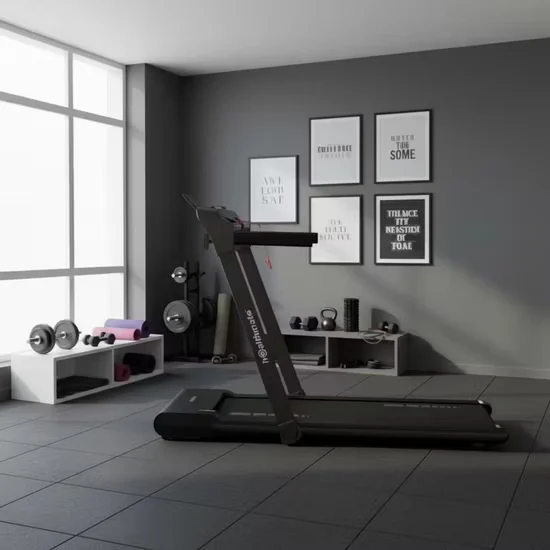
Acoustic-Tested Frame — DC motor operation paired with a 42 kg foldable chassis engineered to limit structure-borne vibration in multi-story residential deployments.
Technical Specifications
| Parameter | Value |
|---|---|
| Designation | W08 |
| Motor Type | DC |
| Motor Power | 1.5HP (peak or continuous not specified) |
| Speed Range | 1–16 km/h |
| Running Surface | 1200 x 450 mm |
| Console Type | LCD (Speed / Distance / Time / Calories) |
| Programs | 16 preset programs |
| Foldable | Yes |
| Product Unfold Size | 1500 x 740 x 1150 mm |
| Product Folded Size | 1810 x 740 x 220 mm |
| Net Weight | 42.0 kg |
| Material | ABS |
| Certification | CE, RoHS |
| OEM / ODM Custom | Available |
Application Suitability
| Deployment Scenario | Typical Use |
|---|---|
| High-end residential home gym | Daily walking and light jogging with foldable storage between sessions |
| Apartment fitness corner | Space-constrained personal cardio in compact living environments |
| Corporate wellness room | Intermittent staff use during breaks with quiet DC motor operation |
| Hotel in-room fitness setup | Guest self-service cardio on floors where noise transfer matters |
Why Motor Duty Rating Matters More Than the Number on the Box
A 1.5HP DC motor serves intermittent home sessions well — until someone treats it like a commercial-grade drive.
I spent months troubleshooting a batch of treadmills that shipped to a five-star hotel property. The spec sheet read 1.5HP, which sounded adequate. What it did not say was whether that figure represented peak output or continuous duty. Within ninety days of eight-hour daily operation, the motors overheated and failed in sequence. The property pulled the entire lot. That experience shaped how I evaluate every foldable electric treadmill home use DC motor platform that crosses my bench — the duty cycle classification matters far more than the headline horsepower figure. [NEED_CITE: motor duty cycle classification for continuous commercial operation]
When a residential user runs thirty minutes each morning, a DC motor dissipates heat adequately between sessions. Stack four users back-to-back in a corporate wellness room, and the same thermal envelope collapses. Understanding this boundary is the difference between years of quiet service and a warehouse full of returns.
Where the W08 Sits in a Mixed Cardio Layout
The W08 covers steady-state walking through moderate-paced jogging at speeds up to 16 km/h, filling the entry-level cardio slot in a home or light-use environment. In a broader equipment plan, it complements higher-capacity treadmills and ellipticals by offering a foldable footprint for users who need quick session access without dedicating permanent floor space. The 1200 x 450 mm running surface accommodates most walking and jogging gaits, though taller users with longer strides will notice the boundary at higher speeds. This foldable electric treadmill home use DC motor unit suits deployment positions where floor space must revert to other uses between sessions.
Continuous Run-Time Boundaries and Room-Level Constraints
A DC motor in this class is rated for intermittent duty — roughly one to two hours of daily use with cool-down intervals between sessions. Pushing beyond that threshold risks thermal shutdown and premature brush wear. In apartment deployments, the 220 mm folded height clears standard wardrobe shelves, but operators should confirm floor loading and vibration transfer to rooms below before installing on upper levels. The unit requires a standard single-phase household outlet; voltage mismatches discovered after delivery cause avoidable deployment delays. [NEED_CITE: EN 957 requirements for residential cardio equipment deployment] Adequate clearance around the unfolded frame — particularly behind the deck — allows airflow that keeps the motor housing within safe operating temperature.
Reading the Drive and Control Specs Without Guessing
DC motors deliver smooth low-speed response and acceptable noise for residential environments, but they rely on carbon brushes that wear over time — a maintenance variable that AC motors eliminate through brushless induction. The 1.5HP rating on this unit is listed without a peak-versus-continuous qualifier, meaning buyers should request the manufacturer’s duty-cycle curve before committing to any deployment beyond light personal use. The LCD console displays speed, distance, time, and calorie estimates across 16 preset programs, providing structured session variety without app connectivity or facility management data export. The 1200 x 450 mm running surface is competitive for home-grade foldable models, though deck cushioning specifications should be verified against material composition records to confirm long-term compression resistance. ABS construction on the shroud keeps weight at 42.0 kg, supporting the foldable mechanism while limiting the frame mass available for vibration damping.
The Hidden Cost of Skipping Spec Verification
Home-grade motors installed in continuous-use environments fail in months, not years — and the replacement logistics cost more than the hardware. Noise complaints in multi-story residential buildings surface at the management desk before maintenance ever opens a work order, leading to equipment removal rather than repair. A console that cannot export session data leaves facility operators blind to utilization patterns, turning capital expenditure into guesswork. Voltage and plug mismatches found after the shipping container is opened mean weeks of downtime while adapters or rewiring are arranged. [NEED_CITE: common deployment failures in residential cardio equipment] Every one of these outcomes traces back to a specification that was either missing or unverified before the purchase order was signed.
Why This Product Line Earns Its Place
Sub-35dB acoustic verification from Biketon’s hotel deployments informs how we evaluate noise transfer for every unit in this range, including the W08’s DC motor and foldable chassis combination. Durability testing protocols — built around 10,000-hour continuous operation benchmarks — define the upper boundary this unit should not cross in deployment planning. The six-series cardio family means a facility sourcing this foldable treadmill can pull ellipticals, rowers, and climbers from the same engineering platform, keeping spare parts and maintenance training consolidated. OEM customization extends to console UI, color, and logo, so residential integrators can match interior specifications without aftermarket modification. Free 3D cardio-zone layout planning covers the W08’s folded and unfolded footprint, confirming clearance and airflow before equipment ships.
Documentation & Test Records
- CE declaration of conformity covering the W08 electrical safety requirements
- EN 957 test report validating mechanical and structural performance
- ISO 9001 certificate confirming manufacturing process control
- RoHS compliance documentation for restricted substance limits
- Motor specification sheet detailing duty cycle and thermal ratings
- Noise level test record measured under standardized operating conditions
Installation, Commissioning & Maintenance
- Confirm unfolded clearance of 1500 x 740 mm plus rear airflow gap before positioning
- Level the floor contact points and place vibration isolation pads under each foot
- Connect to a dedicated single-phase circuit matching the target market voltage standard
- Run the belt at low speed for initial tension and tracking calibration
- Inspect belt alignment and lubrication interval per the commissioning guide schedule
- Wipe the LCD console and ABS shroud after each session to prevent sweat corrosion
Requesting the Right Configuration for Your Space
Provide the intended room dimensions and planned equipment count so the 3D layout team can map folded storage positions and airflow corridors around the W08. Specify expected daily session volume to confirm whether the DC motor duty cycle matches your usage pattern or whether a higher-capacity platform is warranted. Note the deployment floor level and adjacent occupied spaces so acoustic transfer can be evaluated. State the target market voltage and plug standard to prevent post-delivery compatibility rework.
Frequently Asked Questions
Q: How does a DC motor compare to an AC motor for home treadmill use?
A: DC motors deliver smooth speed control and quieter start-up at lower power ratings, making them appropriate for intermittent personal sessions. AC motors handle sustained loads and higher user weights with greater thermal headroom, which is why commercial facilities typically specify them. For a home user running under two hours daily, a DC platform provides adequate performance without the cost and weight of an AC drive.
Q: What does the horsepower rating actually tell me about longevity?
A: Horsepower alone does not distinguish between peak output — the maximum the motor can produce briefly — and continuous duty, the level it can sustain without overheating. A 1.5HP peak rating may deliver considerably less under sustained load. Request the manufacturer’s duty-cycle documentation to understand the thermal envelope and expected service life at your intended usage frequency.
Q: Does the folding mechanism compromise running stability over time?
A: A well-engineered foldable frame uses reinforced hinge points and locking pins that maintain rigidity through repeated cycles. The W08’s 42 kg net weight reflects the material allocation across the frame and ABS shroud. Operators should periodically inspect hinge hardware and locking mechanisms for wear, particularly in environments where the unit is folded and unfolded multiple times per day.
Q: Can the LCD console export workout data to fitness apps or management platforms?
A: The W08 LCD console tracks speed, distance, time, and calories across 16 preset programs and displays them in real time. It does not include IoT connectivity or app synchronization capabilities found on commercial-grade smart consoles. Users needing data export should consider platforms with Bluetooth or Wi-Fi-enabled consoles that support third-party integration.

![W08 Folding Electric Treadmill for Home Use Cardiopulmonary Training [WARN] draft identifier mismatch](https://bicksport.com/wp-content/uploads/2026/08/w08-folding-electric-treadmill-for-home-use-cardiopulmonary-training-warn-draft-identifier-mismatch-e53750.webp)
![Anti-Tipping Mt296 Electric Treadmill for Home Fitness Running [WARN] draft identifier mismatch](https://bicksport.com/wp-content/uploads/2026/08/anti-tipping-mt296-electric-treadmill-for-home-fitness-running-warn-draft-identifier-mismatch-f67a1d.webp)