
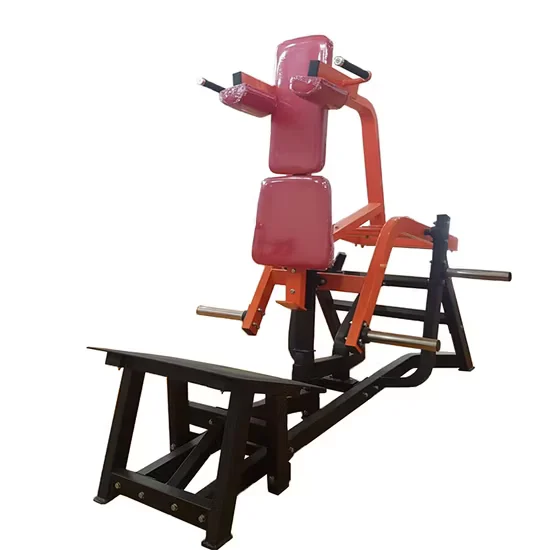
Steel-Frame Durability — V-Squat Machine Model 5040 passes 10,000-hour structural fatigue testing under continuous commercial loading cycles.
Technical Specifications
| Parameter | Value |
|---|---|
| Designation | V-Squate |
| Product Type | V-Squat Machine |
| Exercise Part | Leg |
| Material | Steel |
| Net Weight | 160kg |
| Dimensions | 1550 × 1850 × 1650 mm |
| Application | Fitness Center, Gymnasium |
| Certification | CE |
| OEM | Available (color, logo, specification) |
| Production Capacity | 500 units per month |
Application Suitability
| Deployment Scenario | Typical Use |
|---|---|
| Chain gym strength zone | High-frequency leg training during peak hours with member turnover every 15–25 minutes |
| Corporate wellness room | Midday and after-work lower-body sessions for office workers |
| Sports performance training center | Controlled V-squat loading for athletes requiring biomechanical accuracy |
| High-end residential home gym | Compact footprint leg press alternative for private strength routines |
| Hotel fitness center strength area | 24/7 accessible leg training equipment for transient guests |
Why Steel Frame Fatigue Matters More Than Max Load Rating
A heavier frame does not always mean longer service life — weld penetration depth and tube wall thickness determine what happens after month six of continuous commercial use.
The V-Squate commercial V-squat machine leg press addresses a recurring issue in strength zones: lighter-gauge frames that develop micro-fractures at weld joints under repetitive eccentric loading. When a gym places leg equipment in a high-traffic corner, the cumulative stress cycles can exceed what residential-grade steel tubing was designed to handle [NEED_CITE: structural fatigue classification for commercial strength equipment]. A 160kg net weight in this unit signals dense steel construction rather than hollow-tube shortcuts, reducing the likelihood of mid-year structural remediation.
Where the V-Squate Fits in a Commercial Strength Layout
The V-squat movement pattern bridges the gap between traditional leg press machines and free-weight squats, offering guided vertical loading that reduces lower-back shear while maintaining quad and glute activation. In a commercial strength zone, this commercial V-squat machine leg press sits between plate-loaded leg presses and hack squat stations, capturing members who want heavy leg work without spinal compression. Its 1550 × 1850 mm footprint fits standard two-meter equipment spacing grids, and the steel frame accommodates users across a wide body-weight range without carriage wobble at full extension.
Floor Loading, Noise Transfer, and Deployment Environment
A 160kg steel frame transmits vibration directly to the subfloor during drop sets and controlled negatives. Deploying this unit on upper hotel floors or above occupied spaces requires isolation pads rated for impact loading, not just static weight [NEED_CITE: vibration isolation standards for commercial fitness equipment on suspended floors]. The carriage guide rails generate low-frequency mechanical noise during eccentric phases — noticeably different from cardio motor hum — so placement away from quiet zones and consultation rooms prevents member complaints. Dedicated 220V circuits are not required for this plate-loaded design, but adequate overhead clearance and surrounding safety margins must account for full carriage travel and plate loading access on both sides.
What the Steel Construction and 160kg Mass Actually Mean
The frame material and net weight on the spec sheet are proxies for structural behavior under load. Thicker-walled steel tubing resists torsional flex when users push asymmetrically or load unevenly. The 160kg mass provides inherent stability — the unit does not require bolting to the floor for most commercial installations, though seismic zones or upper-floor deployments may demand anchor points. The guide rail and carriage system relies on sealed linear bearings that need periodic lubrication but do not generate the friction-induced noise common in bushing-based designs [NEED_CITE: linear bearing versus bushing maintenance intervals in commercial leg equipment]. Weld quality at the carriage-to-frame junction determines whether the machine develops play after several thousand loading cycles.
What Happens When Frame Specifications Are Compromised
Facilities that source lighter strength equipment to save on initial outlay frequently encounter weld cracking within the first year of high-frequency use. The carriage develops lateral play, creating an unsafe feeling during heavy sets and driving members toward competing gyms with better-maintained equipment. Noise from worn bushings and loose joints escalates from background annoyance to a reason for equipment removal. Replacing an entire strength zone because of structural failures costs far more than specifying adequate steel gauge and weld penetration at procurement stage [NEED_CITE: total cost of ownership comparison between commercial and light-commercial strength equipment].
Why This Product Line Addresses the Gaps
The V-Squate is engineered with the same 10,000-hour durability philosophy applied across the full cardio family — components tested for continuous high-frequency operation before reaching the showroom floor. The 160kg steel frame reflects a commercial-grade approach where structural integrity is verified through fatigue testing, not assumed from static load ratings. Full OEM customization extends to frame color, logo placement, and upholstery, allowing chain gyms to maintain brand consistency across locations. The engineering team provides 3D strength-zone layout planning that accounts for this unit’s footprint, carriage travel arc, and member flow around the loading area. Technical support covers installation guidance and spare parts availability for guide rail bearings and wear components, available around the clock.
Documentation & Test Records
- CE declaration of conformity covering structural and mechanical safety
- EN 957 test report verifying load rating and stability requirements
- ISO 9001 certificate for manufacturing quality management systems
- Structural fatigue test record documenting weld and frame durability
- Load capacity verification report for the 160kg steel construction
- Spare parts list covering bearings, guide rails, and wear components
Installation, Commissioning & Maintenance
- Position the 1550 × 1850 mm frame with minimum one-meter clearance on all sides for safe plate loading and member access
- Install vibration isolation pads beneath the 160kg steel frame when deploying on upper floors or above occupied rooms
- Level the base frame using adjustable feet to prevent carriage tracking drift during eccentric loading phases
- Inspect and lubricate sealed linear bearings on the guide rails at intervals specified in the commissioning guide
- Check weld joints and carriage bolts quarterly for signs of fatigue or loosening under commercial use cycles
- Clean steel surfaces and upholstery after each session to prevent sweat-induced corrosion on the frame
Request Equipment Selection Support
Provide your strength-zone square footage and current equipment list to receive a 3D layout plan that positions the V-Squate within member flow patterns and safety spacing requirements. Specify daily usage estimates so that bearing and guide-rail maintenance intervals can be matched to your facility’s traffic profile. Indicate deployment floor level and adjacent room types to determine whether vibration isolation is necessary. State whether OEM frame color or logo customization is needed to match your brand standard.
Frequently Asked Questions
Q: What is the biomechanical difference between a V-squat and a leg press?
A: The V-squat machine guides the carriage along a fixed vertical arc that keeps the torso upright, placing greater emphasis on quadriceps while reducing shear force on the lumbar spine. A traditional leg press positions the user at a reclined angle, engaging more glute and hamstring involvement. Both target lower-body musculature, but the V-squat pattern allows heavier loading with less lower-back risk in a commercial training environment.
Q: How does commercial-grade steel construction differ from residential equipment frames?
A: Commercial frames use thicker-walled steel tubing and deeper weld penetration to withstand repetitive loading from multiple users throughout the day. Residential frames are engineered for one or two daily sessions with lighter loads. The difference becomes apparent after several months of gym-level usage, where residential-grade welds may develop micro-cracks and carriage play that commercial construction avoids through fatigue-tested joints and heavier structural mass.
Q: What maintenance does the steel frame and guide rail system require?
A: The sealed linear bearings on the carriage guide rails need periodic lubrication at intervals determined by usage volume. Weld joints should be visually inspected quarterly for any signs of stress cracking. The steel frame itself requires wiping down after use to prevent sweat corrosion, particularly at contact points and bolt heads. Facilities in coastal or high-humidity environments may benefit from additional anti-corrosion treatment on exposed steel surfaces.
Q: What is the OEM customization process and typical lead time?
A: OEM options include frame color, logo placement on uprights or shrouds, and upholstery material or color selection. The process begins with design confirmation and color sample approval before production scheduling. Lead times depend on order volume and customization complexity, with the production capacity at 500 units per month. Contact the sales engineering team with your specific requirements to confirm scope and scheduling for your deployment timeline.
Q: How should the V-squat machine be positioned within a strength zone layout?
A: Allow at least one meter of clearance on all sides of the 1550 × 1850 mm footprint for safe plate loading and member passage. Position the unit away from high-traffic walkways since users need concentration during heavy sets. Consider ceiling height for full carriage travel and overhead plate loading. The engineering team provides 3D layout planning that accounts for sightlines, member flow between stations, and adequate spacing for spotting or assistance during maximal efforts.

![Commercial Seated Triceps DIP Machine Strength Equipment OS-H5014 [WARN] draft identifier mismatch](https://bicksport.com/wp-content/uploads/2026/08/commercial-seated-triceps-dip-machine-strength-equipment-os-h5014-warn-draft-identifier-mismatch-bd924f.webp)
