
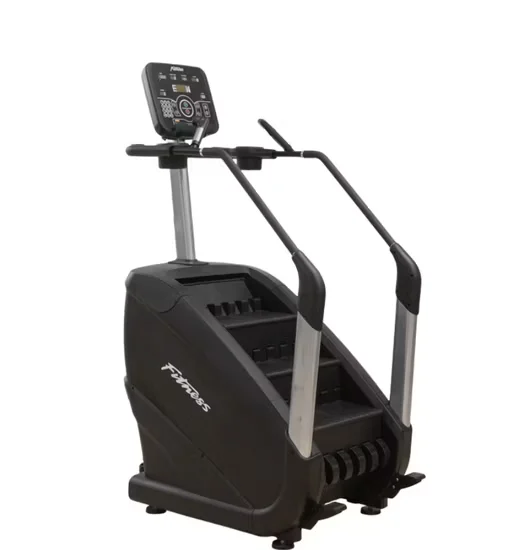
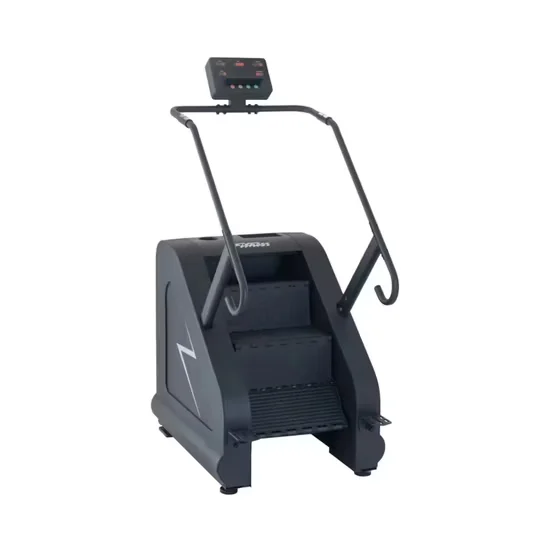
![SQ1017 Commercial Stair Machine for Gym Workouts [WARN] draft identifier mismatch](https://bicksport.com/wp-content/uploads/2026/08/sq1017-commercial-stair-machine-for-gym-workouts-warn-draft-identifier-mismatch-41df59.webp)
Acoustic-Optimized Motor Drive — Engineered for hotel guest-floor fitness centers and 24/7 gym deployments where continuous stair climbing duty cycles meet strict noise thresholds.
Technical Specifications
| Parameter | Value |
|---|---|
| Designation | SQ1017 |
| Product Type | Stair Climber |
| Drive Type | Motor Drive |
| Running Velocity | 15–164 steps/minute |
| Max User Weight | 180 kg |
| Step Area | 560 × 235 × 220 mm |
| Console Display (OSD) | Time, Climb, Calories, Steps, Heart Rate |
| Connectivity | IoT-enabled with app sync capability |
| Mains Input | AC220V±10% / AC110V±10% |
| Material | Steel Pipe + PP Plastic |
| Product Dimensions | 1450 × 820 × 2080 mm |
| Net Weight | 148 kg |
| Foldable | Unfolded |
| Color | Black (customization available) |
| Certification | CE |
| Customization | Logo, color, console UI |
Application Suitability
| Deployment Scenario | Typical Use |
|---|---|
| Hotel fitness center on guest room floors | 24-hour self-service cardio with whisper-quiet motor drive preventing noise migration to adjacent rooms |
| Chain gym cardio zone | High-frequency stepmill stations supporting HIIT and steady-state climbing programs across peak hours |
| Corporate wellness room | Compact vertical footprint fitting limited square footage while delivering full-range climbing intensity |
| High-end residential home gym | Motor-driven climbing for daily conditioning without belt-driven vibration transferring through floor structures |
| Sports performance training center | Precise step velocity control from 15 to 164 steps/minute for athlete interval protocols and lactate threshold work |
Why Noise Complaints Reach the Front Desk Before Maintenance Does
Motor-driven stair climbers transmit low-frequency vibration through floor slabs long before the motor itself fails.
I spent years troubleshooting cardio deployments in five-star hotels, and the pattern was always the same: a guest on the floor below calls reception at 11 PM because the ceiling hums every time someone climbs. By the time maintenance gets involved, the reputation damage is done. The SQ1017 addresses this at the source with a commercial stair climber motor drive gym operators can deploy on occupied floors. The motor drive system eliminates the belt slap and chain rattle that plague older stepmill designs, while the steel pipe frame and reinforced bearings absorb harmonic resonance before it reaches the structure [NEED_CITE: acoustic transmission paths for cardio equipment on suspended floor slabs].
Where This Stepmill Fits in a Multi-Discipline Cardio Layout
The SQ1017 occupies a distinct intensity band in any cardio zone. Unlike treadmills that serve walking through sprinting, or ellipticals that emphasize low-impact steady-state, this stair climber targets sustained vertical loading — the movement pattern that drives glute activation and cardiovascular demand simultaneously. In a facility layout, it complements treadmill rows and elliptical banks by offering an alternative modality that attracts members who find flat-ground cardio monotonous. The 1450 × 820 mm footprint is narrower than most commercial treadmills, allowing deployment in cardio zones where lateral spacing is constrained. The 180 kg max user weight capacity ensures the equipment accommodates diverse member demographics without structural compromise. For facilities planning member flow, the vertical climbing motion creates a natural visual anchor that draws traffic deeper into the cardio area.
Continuous Duty Cycles and the Environments That Demand Them
A stair climber in a hotel fitness center may see 18 hours of intermittent use daily, while a chain gym unit can face near-continuous operation during peak periods. The motor drive system in the SQ1017 is validated through 10,000-hour durability testing on motors and sealed bearings, which translates to years of service under commercial load profiles [NEED_CITE: motor duty cycle classification for continuous commercial cardio operation]. Noise propagation matters equally: when a stepmill sits above occupied guest rooms or office spaces, low-frequency vibration travels through concrete slabs regardless of how quiet the motor sounds at ear level. Deploying on upper floors requires attention to subfloor isolation and leveling to prevent resonance amplification. The dual-voltage input (AC220V±10% / AC110V±10%) accommodates international markets, but confirming local plug standards and dedicated circuit requirements before shipment prevents commissioning delays. Facilities integrating usage analytics should verify console data interface documentation against their management software specifications during the selection phase.
Reading the Motor Drive and Step Velocity Specifications
Motor drive systems in stair climbers differ fundamentally from belt-driven or hydraulic alternatives. A motor-driven stepmill uses an electric motor to control step descent speed, meaning the user’s foot is met with consistent resistance regardless of cadence — this is what makes the 15–164 steps/minute range genuinely usable rather than a marketing spread. At the low end, 15 steps/minute supports rehabilitation protocols and warm-up progressions; at 164 steps/minute, trained athletes can push into high-intensity intervals. The motor must absorb and redirect kinetic energy on every step, which is why continuous duty rating matters far more than peak power claims [NEED_CITE: continuous vs peak motor rating standards for commercial stepping equipment]. The console tracks Time, Climb, Calories, Steps, and Heart Rate, with IoT connectivity enabling app sync and virtual coaching integration. Heart rate data collected through the console supports facility-level programming when the data interface connects to member tracking systems. The steel pipe and PP plastic construction balances structural rigidity with weight distribution across the 148 kg net weight.
What Happens When Specifications Are Treated as Suggestions
Facilities that spec cardio equipment based on price-per-unit without examining duty cycle ratings encounter a predictable sequence of failures. Light-commercial motors in stair climbers begin overheating within months when subjected to continuous gym traffic, and the replacement cycle creates equipment downtime that members notice immediately. Noise issues compound differently: a stepmill that measures acceptably in a showroom can generate structure-borne vibration once installed on a suspended floor, triggering guest complaints or tenant disputes that force emergency equipment relocation. Console systems lacking data interface documentation leave usage analytics stranded — operators cannot track utilization rates, identify underused units, or justify expansion budgets with actual evidence. Voltage mismatches discovered after container arrival mean weeks of idle inventory while adapters or transformers are sourced. These are not hypothetical failures; they follow directly from skipping the verification steps that separate commercial-grade procurement from consumer-grade purchasing [NEED_CITE: EN 957 requirements for commercial cardio equipment durability and safety].
Why This Product Line Supports Facility-Wide Cardio Procurement
The SQ1017 is one of six cardio series engineered under the same acoustic and durability standards, meaning a facility can source treadmills, bikes, ellipticals, rowers, and climbers from a single product family with consistent noise performance. The sub-35dB operation verified in hotel deployments means this stair climber meets the same acoustic threshold as the rest of the lineup. The 10,000-hour durability testing protocol applies across all motor and bearing specifications, so procurement teams evaluate one reliability standard rather than reconciling different vendor claims. OEM customization extends to console UI, allowing gym chains to brand the interface or integrate specific workout programming without managing separate software contracts. The free 3D cardio-zone layout and airflow planning service addresses this equipment’s specific footprint and vertical clearance requirements — the 2080 mm height demands ceiling clearance verification that generic floor plans overlook. Technical support available around the clock covers commissioning, firmware configuration, and parts replacement.
Documentation & Test Records
- CE declaration of conformity confirming SQ1017 compliance with European machinery and low-voltage directives
- EN 957 test report validating structural integrity and safety under repeated 180 kg loading cycles
- ISO 9001 certificate covering manufacturing quality management for motor drive assembly and frame fabrication
- Noise level test report documenting sub-35dB acoustic performance under continuous stepping operation
- 10,000-hour durability test record for motor, sealed bearings, and step mechanism components
- Console technical documentation with data interface specifications for facility management software integration
Installation, Commissioning & Maintenance
- Maintain minimum 600 mm clearance behind and 400 mm on each side of the 1450 × 820 mm footprint for safe mounting and dismounting
- Verify floor levelness within 3 mm across the installation area; apply vibration isolation pads to prevent structure-borne noise transmission
- Connect to a dedicated circuit matching the specified AC220V±10% or AC110V±10% input; confirm plug standard matches local market before energizing
- Run initial calibration sequence through the console OSD to verify step velocity accuracy across the 15–164 steps/minute range
- Inspect step mechanism bearings and motor drive coupling quarterly; lubricate pivot points per the maintenance schedule in the commissioning guide
- Configure IoT console connectivity and test data sync with facility management software during first-week commissioning
Equipment Selection and Deployment Planning
Provide your cardio zone square footage and target unit count to receive a 3D layout with airflow planning that accounts for this stepmill’s 2080 mm height and ventilation requirements. Specify anticipated daily operating hours so the motor duty cycle can be matched to your traffic profile — a 24-hour hotel fitness center demands different validation than a corporate wellness room open during business hours. Confirm the deployment floor and what occupies the space directly below to determine whether additional subfloor isolation is necessary. State your target market voltage and plug standard to ensure the unit ships with the correct power configuration. Indicate whether console data must integrate with existing facility management software so interface documentation is reviewed before production.
Frequently Asked Questions
Q: What is the difference between continuous duty and peak motor power for stair climbers?
A: Peak power measures the motor’s maximum output during brief bursts, while continuous duty reflects sustained thermal capacity under ongoing load. A stair climber in a commercial gym may run for hours without stopping, so the motor must dissipate heat continuously without degradation. Specifying only by peak rating risks selecting a unit that overheats during peak traffic, causing automatic shutdowns or premature winding failure. Always request the continuous duty rating alongside peak figures.
Q: How does motor drive compare to manual or belt-driven systems in noise and maintenance?
A: Motor drive systems use an electric motor to control step speed, producing consistent resistance with fewer mechanical wear points than belt-driven alternatives that rely on friction and tension. Belt systems require periodic adjustment and replacement as the belt stretches or wears, while motor-driven units concentrate maintenance on bearings and the motor itself. Noise profiles differ as well: motor drive eliminates the rhythmic belt slap that contributes to structure-borne vibration in occupied buildings.
Q: Can the console sync with our gym management software or member apps?
A: The SQ1017 console features IoT connectivity designed for app sync and data integration. However, compatibility depends on the data interface protocol your management software supports. Request the console technical documentation during the selection phase and have your IT team verify that the communication protocol matches your existing infrastructure. Custom console UI configuration is available for facilities requiring branded interfaces or specific data field mappings.
Q: What voltage and plug standards are available for different markets?
A: The unit supports AC220V±10% and AC110V±10% mains input, covering the primary commercial voltage standards across most international markets. Plug configuration is determined during the order scoping phase based on your deployment country. Specifying the target market early in the procurement process ensures the unit ships with the correct power cord and avoids the need for adapters or transformers during installation.
Q: How does the 180 kg max user weight capacity support diverse facility demographics?
A: The 180 kg rating reflects structural testing of the steel pipe frame, step mechanism, and motor drive under sustained loading. This capacity accommodates a wide range of user body types without compromising step velocity accuracy or motor performance. For facilities serving athletic populations, the rating also accounts for the dynamic forces generated during high-cadence interval climbing, where peak loads momentarily exceed static body weight.
![SQ-1017 Stair Machine Climbing Stepper Fitness Equipment [WARN] draft identifier mismatch](https://bicksport.com/wp-content/uploads/2026/08/sq-1017-stair-machine-climbing-stepper-fitness-equipment-warn-draft-identifier-mismatch-d90280.webp)
![Heavy-Duty Stair Climber Machine for Commercial Fitness Centers and Gyms [WARN] draft identifier mismatch](https://bicksport.com/wp-content/uploads/2026/08/heavy-duty-stair-climber-machine-for-commercial-fitness-centers-and-gyms-warn-draft-identifier-mismatch-23f020.webp)