
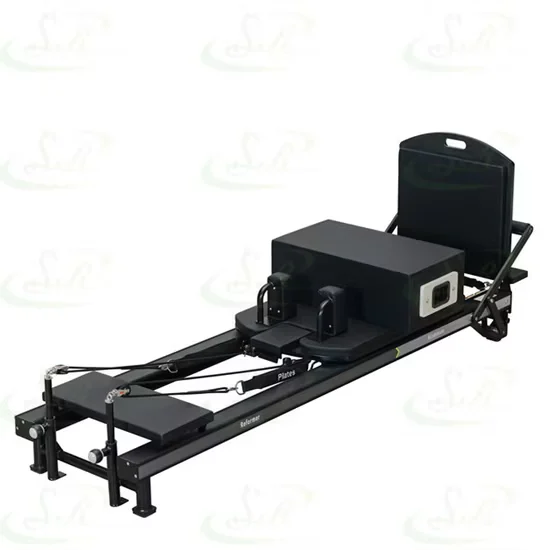
Whisper-Quiet Precision — Magnetic resistance and aluminium alloy construction deliver sub-35dB operation verified in hotel deployments.
Technical Specifications
| Parameter | Value |
|---|---|
| Designation | SRY-27 |
| Product Type | Pilates Reformer |
| Material | Aluminium Alloy |
| Color | Black |
| Accessory | Long Box / Jump Board / Platform |
| Product Dimensions | 2570730890mm |
| Net Weight | 90kgs |
| Max User Weight | 180kg |
| Resistance Type | Magnetic |
| Noise Level | Sub-35dB |
| Warranty | 3 Years |
| Certification | ISO 9001, CE |
Application Suitability
| Deployment Scenario | Typical Use |
|---|---|
| Hotel fitness center on guest room floors | 24-hour access Pilates programming requiring silent resistance engagement |
| Chain Pilates studio network | Multi-session daily scheduling with continuous high-frequency carriage travel |
| Corporate wellness room | Lunch-break and post-work reformer classes with minimal acoustic disruption |
| High-end residential home gym | Shared-space deployment where noise transfers through floor assemblies |
| Rehabilitation center | Controlled resistance progression for clinical movement therapy |
Why Acoustic Complaints Reach the Front Desk Before Maintenance Does
Magnetic resistance eliminates the mechanical friction that generates mid-session noise.
Traditional spring-based reformers produce audible twang and carriage rumble that travels through concrete floor slabs into occupied guest rooms below. When hotel operators install equipment on upper floors, the vibration transmits directly through structural elements, triggering noise complaints that accumulate before facility managers recognize the pattern [NEED_CITE: acoustic transmission through floor assemblies in commercial hospitality environments]. The commercial aluminium Pilates reformer addresses this with a non-contact magnetic system that removes metal-on-metal friction entirely. In facilities where cardio and reformer zones share walls with guest corridors, the difference between spring-loaded and magnetically resisted carriages becomes the determining factor for deployment approval.
Where the SRY-27 Fits Within a Studio Equipment Matrix
This reformer covers full-range movement patterns from supine footwork through standing platform sequences, accommodating both beginner introductory sessions and advanced athletic conditioning. In a mixed-equipment studio layout, it pairs with cadillac towers for vertical resistance work and mat zones for bodyweight transitions. The 2570mm length provides adequate carriage travel for tall users, while the aluminium alloy frame maintains dimensional stability under repeated loading cycles. Facilities typically position these units along perimeter walls with mirror sightlines, reserving center-floor space for mat-based group formats. The commercial aluminium Pilates reformer serves users across a wide anthropometric range without requiring carriage length adjustments between sessions.
Continuous Scheduling Demands and Spatial Requirements
Studios running six or more sessions daily subject the carriage rail and resistance mechanism to near-constant engagement cycles throughout operating hours. The magnetic system requires no periodic spring replacement or tension recalibration, reducing scheduled maintenance windows that pull equipment offline [NEED_CITE: maintenance intervals for magnetic versus spring-based resistance systems in commercial Pilates]. The aluminium alloy frame resists the humidity accumulation common in basement-level studios and coastal hotel properties. Adequate lateral clearance between adjacent reformers allows instructors to circulate and provide manual cueing without disrupting neighboring participants. Floor-mounted units require level substrate to prevent carriage drift during unilateral exercises, and vibration isolation pads further decouple the frame from structural elements when deployed on suspended floor assemblies.
Magnetic Engagement and Frame Rigidity Under Load
The magnetic resistance system generates force through electromagnetic field interaction rather than physical contact, producing smooth resistance curves across the full carriage travel without the progressive stiffness characteristic of coil springs. This allows practitioners to maintain consistent muscular tension through end-range positions where spring-based systems would either unload or stack resistance abruptly. The aluminium alloy frame achieves the necessary torsional rigidity for loaded standing sequences while remaining repositionable by a single technician during studio reconfiguration. Long Box and Jump Board accessories expand the exercise catalog without requiring separate dedicated equipment footprint. The 90kg net weight provides sufficient mass for stability during explosive Jump Board sequences while allowing relocation for cleaning and floor maintenance access [NEED_CITE: frame material fatigue characteristics under cyclic loading in commercial fitness equipment].
The Accumulated Cost of Specification Compromises
Spring-based reformers in high-scheduling studios require quarterly spring replacement as coils lose elastic memory and develop inconsistent resistance profiles across the set. Facilities that deploy lighter-gauge frames experience progressive rail misalignment that manifests as carriage wobble and user discomfort during supine sequences. When resistance mechanisms generate audible noise, instructors unconsciously avoid programming sequences that emphasize slow controlled carriage returns, limiting the movement vocabulary available to clients. Data-isolated equipment prevents studio operators from tracking utilization rates, leaving scheduling decisions based on anecdotal impressions rather than measured throughput [NEED_CITE: equipment utilization tracking methodologies in commercial fitness operations]. These compounding degradations surface as declining rebooking rates before operators identify the equipment specification as the root variable.
Why This Line Addresses the Identified Failure Points
The sub-35dB operation has been verified in hotel fitness center deployments where equipment operates above occupied guest rooms without triggering acoustic complaints. Core components undergo 10,000-hour continuous operation testing that simulates multi-year high-scheduling studio conditions. The complete six-series cardio family allows facilities to source reformers alongside treadmills, ellipticals, and rowing units from a single product line with matched warranty terms. OEM customization extends to logo application, frame color specification, and accessory configuration at flexible minimum order quantities. Facility operators receive complimentary 3D cardio-zone layouts that account for reformer footprint, lateral instructor circulation space, and HVAC airflow patterns across the movement studio envelope. Technical support responds around the clock to address deployment questions during installation and commissioning phases.
Documentation & Test Records
- CE declaration of conformity for European market deployment
- EN 957 test report validating commercial equipment safety requirements
- ISO 9001 certificate confirming quality management system compliance
- Noise level test report documenting sub-35dB operation verification
- Durability test record from 10,000-hour continuous operation protocol
- Accessory specification sheets for Long Box, Jump Board, and Platform components
Installation, Commissioning & Maintenance
- Position with minimum 800mm lateral clearance for instructor circulation and adjacent reformer access
- Verify floor levelness within tolerance before frame placement to prevent carriage drift during use
- Conduct full carriage travel test across all resistance settings before releasing for client scheduling
- Inspect magnetic resistance engagement smoothness quarterly and recalibrate if carriage return tension changes
- Clean aluminium alloy frame surfaces with non-abrasive solutions to prevent sweat salt accumulation
- Confirm Jump Board attachment security before each plyometric programming session
Equipment Selection and Deployment Inquiry
Provide studio floor dimensions and target reformer count to receive a 3D layout addressing equipment spacing, instructor sightlines, and airflow distribution across the movement zone. Specify daily session volume and operating hours so resistance mechanism duty cycle aligns with your scheduling intensity. Identify deployment floor level and adjacent occupied spaces to confirm acoustic isolation requirements are matched. Indicate destination market voltage standards and whether console data integration with existing facility management software is required for utilization tracking.
Frequently Asked Questions
Q: How does aluminium alloy frame durability compare to steel construction in commercial environments?
A: Aluminium alloy achieves comparable structural rigidity to steel at reduced mass, allowing single-technician repositioning during studio reconfiguration. The material resists corrosion from humidity and sweat salt accumulation that degrades painted steel surfaces over time. Frame fatigue characteristics under cyclic loading remain stable across the expected commercial service life, maintaining rail alignment and carriage travel precision throughout high-frequency deployment.
Q: What maintenance distinguishes magnetic resistance from spring-based systems?
A: Magnetic resistance operates without physical contact between resistance-generating components, eliminating the spring replacement cycles required as coils lose elastic memory in high-scheduling studios. There is no periodic lubrication requirement, and resistance calibration remains stable across thousands of carriage travel cycles. Facilities avoid the quarterly maintenance windows that pull spring-based reformers offline for coil inspection and tension adjustment procedures.
Q: Can the reformer integrate with existing studio management software for utilization tracking?
A: Console data integration capability depends on the facility management platform’s API specifications and data protocol requirements. Operators should provide their current software documentation during the inquiry phase so compatibility can be assessed before equipment specification is finalized. Integration scoping occurs alongside equipment selection to ensure utilization data flows to existing reporting dashboards without requiring parallel tracking systems.
Q: What noise control measures accompany deployment on hotel guest room floors?
A: The sub-35dB magnetic resistance operation eliminates the primary acoustic signature that triggers guest complaints in upper-floor fitness centers. Supplemental vibration isolation pads decouple the aluminium frame from structural floor assemblies, preventing low-frequency transmission through concrete slabs. Deployment layouts account for equipment positioning relative to guest room boundaries, and installation procedures include occupied-space acoustic verification during commissioning.
Q: What is the recommended maintenance cycle for high-frequency studio deployment?
A: Quarterly inspection should verify carriage rail alignment, magnetic resistance engagement smoothness, and accessory attachment hardware security. Annual service includes comprehensive frame fastener torque verification and bearing surface condition assessment. The aluminium alloy construction and non-contact resistance system eliminate the consumable replacement cycles associated with spring-based equipment, concentrating maintenance resources on inspection rather than component exchange.


![Discount Cheap Yoga Reformer Bed Machine Aluminum Alloy Pulley&Push Pilates Reformer Folding Foldable Aluminum Alloy Pilates Reformer for Studio and Home Use [WARN] draft identifier mismatch](https://bicksport.com/wp-content/uploads/2026/08/discount-cheap-yoga-reformer-bed-machine-aluminum-alloy-pulleypush-pilates-reformer-folding-foldable-aluminum-alloy-pilates-reformer-for-studio-and-home-use-warn-draft-identifier-mismatch-fea7f3.webp)