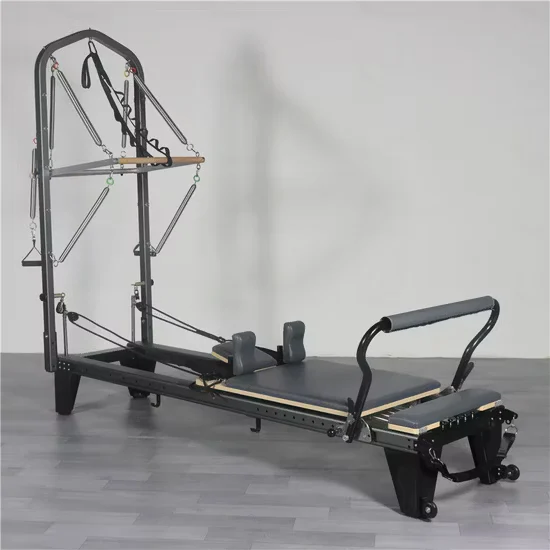
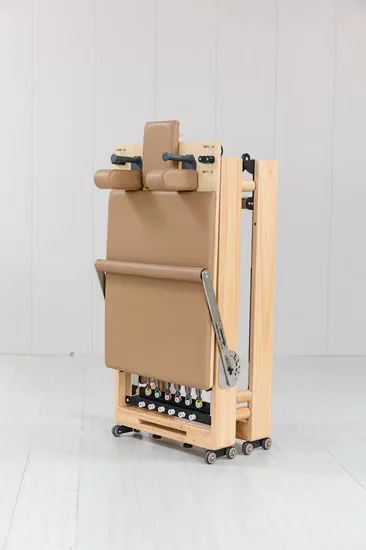
Natural Vibration Damping — Solid wood frame absorbs spring-loaded transitions at the source, eliminating metallic resonance in shared-wall wellness floors.
Technical Specifications
| Parameter | Value |
|---|---|
| Product Type | Pilates Reformer |
| Designation | SRY-24 |
| Frame Material | Solid Wood |
| Resistance Type | Spring-based |
| Accessories Included | Long Box, Jump Board, Platform |
| Product Dimensions | 2460 × 730 × 680 mm |
| Net Weight | 100 kg |
| Color | Solid Color (OEM options available) |
| Customization | Logo and color customization available |
| Age Group | Adult |
| Gender | Unisex |
| Warranty | 3 Years |
Application Suitability
| Deployment Scenario | Typical Use |
|---|---|
| Boutique Pilates studio in multi-tenant building | Group reformer classes requiring quiet carriage travel between sessions |
| Five-star hotel wellness floor | One-on-one and small group sessions where noise must not reach adjacent guest suites |
| High-end residential private gym | Daily personal practice in open-plan or shared-wall home environments |
| Rehabilitation and physiotherapy center | Controlled spring-resistance therapy with smooth, predictable load transitions |
Why Noise Complaints Reach the Front Desk Before Maintenance Does
Wood absorbs what metal amplifies.
I have watched metal-frame reformers turn a quiet hotel spa into a liability. The carriage wheels transmit spring clatter straight through the steel rail into the floor slab, and by the third week guests in the room below start calling reception. A commercial wood Pilates reformer solves this at the material level — hardwood naturally dampens vibration before it reaches the structure, keeping carriage travel quiet even during jump board sequences [NEED_CITE: acoustic transmission class for fitness equipment on suspended floors]. The spring-based resistance system adds to this: progressive load without the mechanical scrape of friction pads. For facilities where treatment rooms or guest suites share a wall with the studio, that difference determines whether the equipment stays or gets replaced.
Where This Reformer Fits in a Mixed-Modal Studio Layout
This full-size reformer covers the complete classical and contemporary Pilates repertoire — footwork, long stretch, coordination, and jump board cardio intervals. In a studio that pairs reformer work with mat and apparatus stations, the SRY-24 occupies the primary apparatus slot, complemented by Cadillac or Wunda Chair units for advanced programming. The 2460 mm length requires generous clearance front and back for long box and jump board use. It accommodates the full adult anthropometric range, and the included accessory set means a facility can run comprehensive group classes without purchasing add-on modules separately.
Continuous Session Scheduling and Floor-Level Deployment
Back-to-back group classes mean the carriage rolls for six or more hours daily, and every transition loads the springs and wheels. The solid wood frame handles this duty cycle without the fatigue cracking that bonded metal joints develop over repeated high-frequency use [NEED_CITE: fatigue testing standards for commercial Pilates apparatus]. Deploying on upper hotel floors demands attention to subfloor rigidity — a flexible suspended slab amplifies any residual vibration, while a concrete podium level provides the mass needed for the wood frame’s damping to work fully. Standard single-phase power is not required since the system is entirely mechanical, eliminating voltage compatibility concerns for international shipments. Leveling feet must contact a flat, hard surface; carpeted wellness rooms require a rigid sub-board beneath the unit.
Spring Tension, Wheel Bearings, and Rail Geometry
The spring-based resistance delivers a progressive load curve that increases as the carriage travels away from the anchor point, matching the natural strength curve of most muscle groups. This differs from rope-pulley systems where load remains constant regardless of position. Spring selection should match the studio’s programming style — heavier springs for athletic populations, lighter gauges for rehabilitation work. Carriage wheel material and bearing type determine long-term smoothness: sealed bearings prevent dust and chalk ingress that causes grinding over months of use. The wood rail surface, when properly finished, provides low-friction travel without the metallic rattle of steel-on-steel contact. Net weight of 100 kg gives the frame sufficient mass to resist walking during aggressive jump board sets without requiring floor anchoring.
The Hidden Cost of Specifying Below Commercial Grade
Reformers built for home use enter the commercial market at a lower price point, and the failure pattern is predictable. Light-duty springs lose tension within months of group class loading, creating uneven resistance that instructors notice before owners do. Carriage wheels on consumer-grade units develop flat spots from continuous lateral forces, generating a rhythmic thump that carries through floor structures [NEED_CITE: wheel durometer requirements for commercial Pilates carriage systems]. When a hotel wellness center replaces an entire row of under-specced reformers after eighteen months, the procurement savings vanish against the cost of guest complaints and operational downtime. Data from facilities that upgraded to commercial-specification equipment consistently shows extended replacement intervals and reduced maintenance call-outs.
Why This Product Line Covers the Deployment Gaps
Every SRY-24 unit ships with the full accessory ecosystem — long box, jump board, and platform — so a studio does not face lead-time delays sourcing add-ons after the initial install. The solid wood frame and solid color finish accept OEM logo placement without compromising acoustic properties, letting hotel brands maintain visual identity across their wellness floors. The 2460 × 730 mm footprint fits standard studio bay widths, and our team provides 3D layout planning that accounts for instructor sightlines, participant spacing, and airflow between units. Spring tension documentation and carriage noise test records ship with each order, giving facility managers the verification they need before opening day. Technical support remains available around the clock for commissioning questions or adjustment guidance [NEED_CITE: commercial equipment warranty and support response standards].
Documentation & Test Records
- CE declaration of conformity for commercial Pilates apparatus
- Noise level test report covering full carriage travel under spring load
- Spring tension and progressive resistance curve specification sheet
- Solid wood frame material grade and joint integrity documentation
- Installation, leveling, and commissioning guide with accessory fitting instructions
- Spare parts list covering springs, wheels, bearings, and accessory hardware
Installation, Commissioning & Maintenance
- Maintain minimum 900 mm clearance at head and foot ends for long box and jump board travel
- Install on level hard flooring; use rigid sub-board under carpeted wellness room surfaces
- Verify all spring anchor points and carriage wheel seating before first loaded session
- Inspect spring tension and wheel bearing smoothness monthly under group class frequency
- Wipe wood rail surfaces daily with damp cloth to remove chalk and sweat residue
- Check accessory mounting hardware quarterly for tightness under repeated jump board loading
Planning Your Reformer Deployment
Share your studio floor plan and unit count to receive a 3D layout covering spacing, sightlines, and ventilation paths. Specify your typical daily session schedule so we can confirm spring gauge recommendations match your class intensity profile. Identify the deployment floor and adjacent room types to verify that the wood frame’s acoustic performance meets your building’s requirements. Let us know if OEM branding or color matching is needed for your facility’s design standard.
Frequently Asked Questions
Q: How does a solid wood frame compare to metal for noise control in a hotel wellness floor?
A: Wood naturally dampens vibration at the material level, absorbing the energy from spring transitions and carriage travel before it reaches the floor structure. Metal frames transmit that energy through the rail into the slab, where it travels to rooms below. In deployments above guest suites or treatment spaces, the wood frame noticeably reduces structure-borne noise without requiring additional isolation mats.
Q: What maintenance does the spring-based resistance system require under daily class scheduling?
A: Springs should be inspected monthly for tension consistency and visible fatigue marks, especially on units running multiple group sessions per day. Individual springs can be replaced without dismantling the carriage, keeping maintenance downtime short. Sealed wheel bearings require no lubrication but should be checked quarterly for smooth rotation and chalk dust accumulation around the housing.
Q: Does adding the jump board or platform affect carriage smoothness or noise levels?
A: The included accessories mount directly to the frame without aftermarket adapters, preserving the original rail geometry and wheel alignment. The solid wood frame’s mass — 100 kg net — provides sufficient stability to absorb jump board impact without frame deflection or rail chatter, maintaining quiet carriage travel across the full exercise repertoire.
Q: What OEM customization is available without compromising the wood frame’s acoustic performance?
A: Logo placement and solid color matching are applied to the wood substrate using finishes that do not fill the natural grain structure responsible for vibration damping. Custom branding integrates with the facility’s design standard while preserving the acoustic properties that make a commercial wood Pilates reformer suitable for noise-sensitive deployment environments.