![Senrui SRY-20B Maple Oak Wood Folding Pilates Reformer for Studio Use [WARN] draft identifier mismatch](https://bicksport.com/wp-content/uploads/2026/08/senrui-sry-20b-maple-oak-wood-folding-pilates-reformer-for-studio-use-warn-draft-identifier-mismatch-4e68a8.webp)
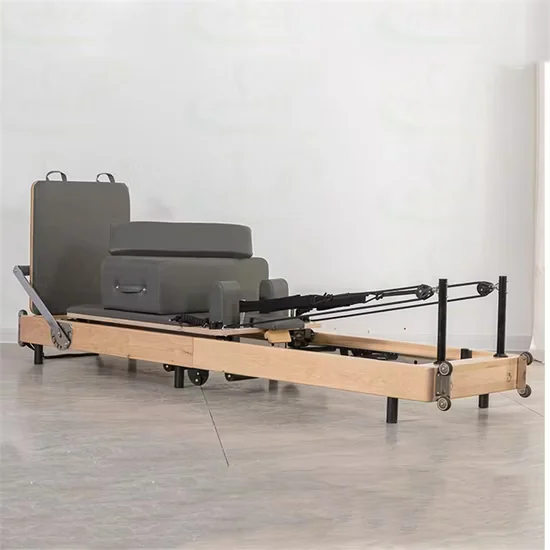
Acoustic Frame Damping — Solid maple oak wood construction absorbs carriage vibration at the source, eliminating resonance in shared studio environments.
Technical Specifications
| Parameter | Value |
|---|---|
| Product Type | Foldable Pilates Reformer |
| Model NO. | SRY-20B |
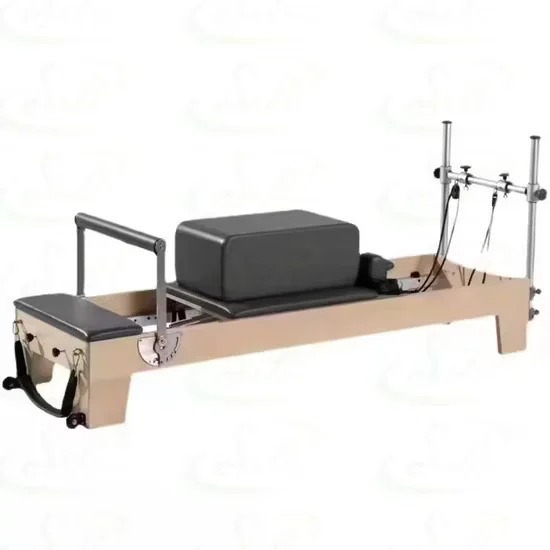
| Frame Material | Solid Maple Oak Wood |
| Specification | 2400 x 600 x 350 mm |
| Net Weight | 100 kg |
| Accessories | Long Box / Jump Board / Platform |
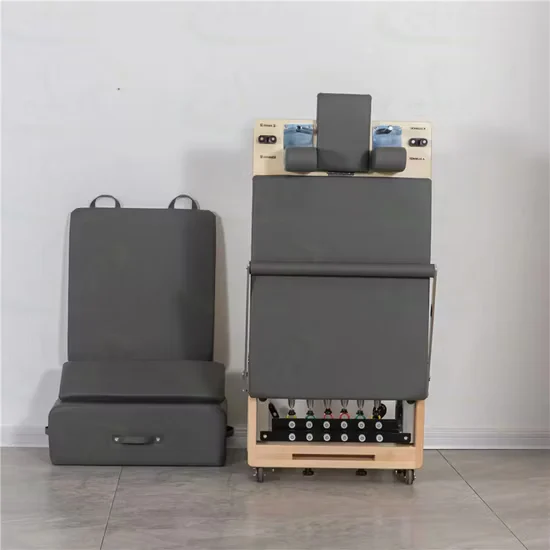
| Foldable | Yes |
| Color | Solid Color |
| Logo | Customized Is Allowed |
| Target User | Adult, Unisex |
| Warranty Time | 3 Years |
| Production Capacity | 80 Pieces/Month |
| HS Code | 9506911900 |
Application Suitability
| Deployment Scenario | Typical Use |
|---|---|
| Boutique Pilates studio | Group reformer classes with high daily cycle frequency and multi-instructor programming |
| Hotel guest wellness suite | In-room or shared floor deployment where acoustic performance prevents noise migration to adjacent suites |
| High-end residential private gym | Dedicated home training space requiring foldable storage when the room serves multiple purposes |
| Corporate wellness facility | Employee fitness room with variable usage density throughout the workday |
| Rehabilitation clinic | Controlled therapeutic movement requiring stable spring resistance progression |
Why Carriage Rattle Reaches the Studio Owner Before the Technician Does
Wood density and joint tolerance determine whether a reformer stays quiet through its third year of group classes.
Laminated and plywood frames compress unevenly under repetitive carriage loading. The adhesive layers degrade at different rates than the wood substrate, creating micro-gaps at the rail mounting points. Once those gaps open, the carriage generates a low-frequency knock on every return stroke — and members notice it during supine footwork long before maintenance schedules catch it [NEED_CITE: wood fatigue cycle testing for commercial Pilates equipment]. A commercial foldable Pilates reformer maple oak wood frame resists this compression set because solid hardwood maintains uniform density through the fastener zones.
Where This Reformer Sits in a Multi-Apparatus Studio Layout
The SRY-20B covers full-range reformer programming from spinal articulation through the long box to plyometric loading on the jump board. In a studio configured with cadillacs and chairs, this unit handles the high-volume foundational work that fills the class schedule between apparatus-specific sessions. Its foldable footprint allows deployment in rooms that convert between group reformer classes and mat-based programming. User weight capacity accommodates the full membership roster without requiring a separate heavy-duty unit.
Continuous Use Cycles and Room Environment Requirements
A studio running four to six group classes daily subjects each reformer to sustained carriage travel across the full rail length, demanding consistent glide performance without mid-session maintenance. Room ventilation must manage the humidity that solid maple oak wood naturally exchanges with surrounding air — excessive dry conditions cause the frame to contract at the joints, while high humidity swells the rail surfaces [NEED_CITE: hardwood dimensional stability in climate-controlled fitness environments]. Floor leveling is critical: the 100 kg unit weight provides stability during jump board exercises, but an uneven subfloor introduces lateral drift during high-resistance footwork. Studios deploying above occupied floors benefit from the inherent vibration damping of solid wood, which transmits less structure-borne noise than metal-framed alternatives.
How Frame Material and Spring Configuration Shape the Training Experience
Solid maple oak wood delivers natural vibration damping that laminated construction cannot replicate. When the carriage reverses direction under heavy spring tension, the frame absorbs the transient energy rather than reflecting it back as audible resonance. The accessory ecosystem — long box for seated and prone work, jump board for plyometric intervals, platform for standing exercises — means a single chassis supports programming that would otherwise require three separate apparatus units. Spring resistance progression must be verified against the studio’s class templates: too steep a gradient between tension levels forces instructors to skip intermediate progressions, while too flat a curve leaves advanced members under-loaded during peak effort sequences. The foldable mechanism must be evaluated under loaded conditions; hinge integrity directly affects carriage tracking after repeated open-close cycles in multi-use room configurations [NEED_CITE: foldable mechanism cycle durability under commercial load].
What Spec Compromise Costs After Six Months of Studio Operation
Veneer-over-composite frames look identical in showroom photography. By month six of group class use, the substrate compresses at the spring anchor points, altering the tension calibration across the full resistance range. Instructors compensate by adjusting verbal cues rather than addressing the mechanical drift, and advanced members migrate to competing studios with properly maintained equipment. Foldable mechanisms rated for residential duty cycles develop play in the hinge after several hundred open-close sequences, introducing lateral carriage wobble that compromises alignment during single-leg work. Studios replacing entire fleets due to frame degradation absorb procurement and installation costs that proper material specification would have avoided [NEED_CITE: reformer replacement frequency in commercial Pilates studios].
Why This Product Line Holds Up Under Studio Conditions
The SRY-20B is engineered around the noise and durability realities of commercial deployment. Solid maple oak wood construction eliminates the delamination failure mode that ends the service life of composite-framed reformers. The foldable mechanism is rated for daily open-close cycles in multi-use studio spaces without carriage tracking degradation. Each unit ships with the full accessory ecosystem — long box, jump board, platform — so studios standardize programming across their entire reformer fleet rather than mixing apparatus from different manufacturers. The 3-year warranty reflects confidence in frame and component durability under continuous commercial duty cycles [NEED_CITE: commercial Pilates equipment warranty standards]. OEM customization covers logo application and color options to match studio branding without compromising structural specifications.
Documentation & Test Records
- Frame material certification confirming solid maple oak wood species and moisture content at time of assembly
- Load rating test for foldable mechanism under repeated open-close cycles with carriage in place
- Spring resistance gradient verification across full tension range with calibration certificate
- Accessory attachment interface compatibility and swap cycle time documentation
- Assembly guide with floor clearance and wall-adjacent storage positioning dimensions
Installation, Commissioning & Maintenance
- Verify floor levelness within tolerance before positioning; 100 kg unit weight requires shimming rather than adjustable feet on uneven surfaces
- Confirm ceiling height clearance for vertical storage position when folded against wall in multi-use room configurations
- Inspect carriage wheel alignment and rail contact pattern after first 50 hours of use to establish baseline tracking
- Lubricate spring anchor points and carriage wheels on schedule defined by studio class volume and ambient humidity levels
- Check foldable hinge bolt torque quarterly; vibration from jump board exercises can loosen fasteners over time
- Clean maple oak wood frame with pH-neutral wood cleaner; avoid solvent-based products that strip the protective finish
Request Equipment Layout and Deployment Specification
Provide your studio floor plan and class schedule density to receive a 3D reformer zone layout covering unit spacing, instructor sightlines, and ventilation requirements. Specify whether the deployment floor sits above occupied space so acoustic isolation requirements can be matched to the maple oak wood frame’s inherent damping characteristics. Confirm target market and facility type for warranty and customization scoping.
Frequently Asked Questions
Q: How does solid maple oak wood differ from laminated frame construction in daily studio use?
A: Solid hardwood maintains uniform density at the rail mounting points and spring anchors, so the frame does not compress unevenly under repetitive carriage loading. Laminated construction uses adhesive layers that degrade at different rates than the wood substrate, eventually creating micro-gaps that generate carriage knock during return strokes. The acoustic difference becomes apparent within the first year of group class volume.
Q: Does the foldable mechanism affect carriage tracking accuracy over time?
A: The hinge system is engineered for daily open-close cycles without introducing lateral play into the rail alignment. Carriage tracking depends on the rigidity of the frame sections on either side of the fold point. If the hinge develops play, the carriage will drift during single-leg and standing exercises. Verify mechanism load rating and cycle test records before committing to a foldable configuration for commercial deployment.
Q: How do I verify spring resistance calibration matches my studio’s class programming?
A: Request the spring tension gradient specification showing resistance at each hook position across the full travel range. Compare this against your class templates to confirm intermediate progressions exist between your most-used tension levels. Springs that degrade lose tension unevenly across the set, so periodic recalibration checks prevent the entire fleet from drifting out of sync with instructor cueing.
Q: What floor loading and clearance does this reformer require in a group class layout?
A: The 100 kg unit weight combined with dynamic forces during jump board exercises requires a subfloor rated for concentrated static and impact loads. Side clearance must accommodate the full arm span of users performing supine arm work. End clearance allows carriage travel beyond the frame during advanced exercises. Wall-adjacent storage positioning requires ceiling height confirmation for the vertical folded orientation.
Q: Can accessories be swapped mid-class without disrupting the session flow?
A: The long box, jump board, and platform attach to standardized interface points on the frame. Swap time depends on whether the attachment uses quick-release pins or threaded fasteners. Studios running back-to-back classes with different programming templates should verify that a single instructor can complete the accessory change within the transition window between sessions without tools.