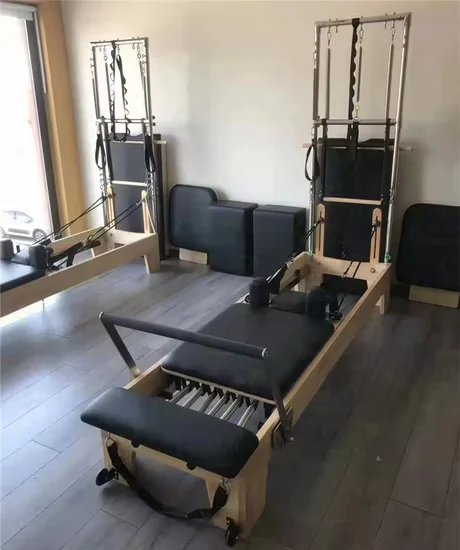
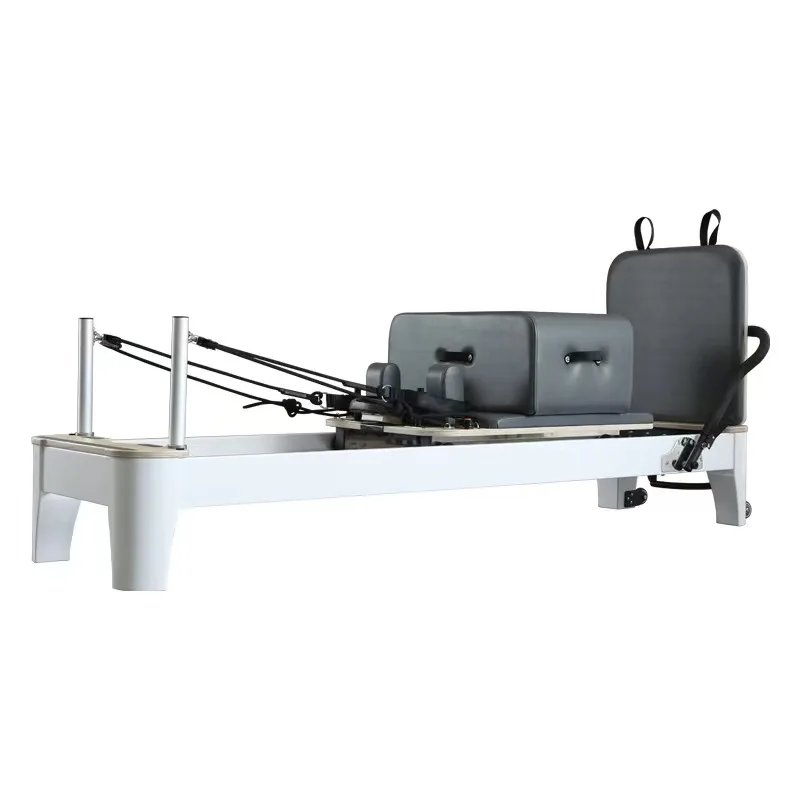
Whisper-Quiet Precision — An aluminum alloy chassis and tolerance-machined carriage rail system eliminate the resonance and friction noise that plague steel-frame reformers in multi-floor deployments.
Technical Specifications
| Parameter | Value |
|---|---|
| Product Type | Pilates Reformer |
| Frame Material | Aluminum Alloy |
| Product Dimensions | 2570 × 730 × 270 mm |
| Net Weight | 90 kg |
| Color | White |
| Accessories | Long Box, Jump Board, Platform |
| Warranty | 3 Years |
| Logo | Customization Available |
| Age Group | Adult |
| Gender | Unisex |
| Production Capacity | 80 Pieces per Month |
Application Suitability
| Deployment Scenario | Typical Use |
|---|---|
| Hotel fitness center on guest room floors | Low-noise individual and group Pilates sessions during early morning and late evening hours |
| Boutique Pilates studio | Classical and contemporary reformer classes with multiple units running simultaneously |
| High-end residential home gym | Private daily practice in shared-wall or upper-floor environments |
| Rehabilitation and physiotherapy center | Controlled spring-resistance protocols for post-injury recovery and mobility training |
| Corporate wellness room | Lunchtime and after-work group sessions with minimal acoustic disruption to adjacent offices |
Why Aluminum Eliminates the Noise Complaints That Reach the Front Desk First
Structure-borne vibration travels through concrete slabs faster than airborne sound — and the frame material is where it starts.
Steel-frame reformers generate low-frequency resonance every time the carriage reverses direction under spring tension. That vibration transmits directly through the frame feet into the floor structure, reaching occupied rooms below as a rhythmic rumble. In hotel deployments, these complaints arrive at the front desk long before maintenance is consulted [NEED_CITE: structure-borne noise transmission in multi-floor fitness deployments].
The aluminum alloy frame on the SRY-12 changes the equation at the material level. Aluminum’s natural damping coefficient absorbs vibrational energy rather than transmitting it, and the reduced frame mass lowers the total kinetic energy available to couple into the floor structure. For facilities operating on guest room floors or above shared spaces, this material choice directly determines whether the commercial aluminum Pilates reformer super silent claim holds up in practice.
Where the SRY-12 Fits Within a Studio or Hotel Cardio and Conditioning Zone
The SRY-12 Pilates Reformer covers the low-velocity, high-control end of the conditioning spectrum. It complements the high-intensity output of treadmills and rowers by offering a controlled spring-resistance environment where members work through full range-of-motion patterns under variable load. In a mixed-use cardio and conditioning zone, reformers typically occupy the perimeter — positioned along walls or in dedicated alcoves where the 2570 mm length fits within standard bay spacing.
The frame geometry accommodates adult users across a broad height and weight range, and the included Long Box, Jump Board, and Platform expand the movement library from supine and seated classical work to standing plyometric and balance protocols. The commercial aluminum Pilates reformer super silent performance means this unit can anchor a conditioning bay adjacent to quiet zones — treatment rooms, lounge areas, or corridors — without generating the mechanical noise that forces operational compromises.
Continuous Session Scheduling and Environmental Deployment Requirements
A reformer in a busy studio or hotel fitness center may see six to ten consecutive class sessions per day, with each session involving hundreds of carriage cycles under varying spring loads. The SRY-12 is built for this duty cycle: the aluminum alloy frame maintains dimensional stability through thousands of load cycles without developing the joint loosening and squeaking that plague lighter constructions.
Noise transmission is a primary deployment variable. On upper floors or above occupied spaces, the combination of the aluminum frame’s inherent damping and the precision rail system keeps structure-borne vibration within acceptable limits. However, proper deployment still requires attention to floor leveling, vibration-isolating mat placement, and adequate clearance around each unit [NEED_CITE: EN 957 safety clearance requirements for commercial Pilates equipment]. Facilities planning multiple units should allow sufficient lateral spacing for full-range arm and leg movements while maintaining clear sightlines for instructor supervision. The 3-year warranty covers frame and mechanical components under continuous commercial scheduling.
Reading the Aluminum Alloy Frame and Carriage Specifications
The aluminum alloy frame is the defining engineering choice on this reformer. Compared to traditional mild steel, aluminum alloy offers a superior strength-to-weight ratio and inherent vibration damping — two properties that directly affect both the user experience and the acoustic environment. The 90 kg net weight provides sufficient mass for stability during dynamic exercises including Jump Board work, while remaining manageable for repositioning during studio layout changes.
The 2570 × 730 mm footprint accommodates the full range of classical and contemporary reformer exercises, including overhead reaches and full-body supine positions. The carriage rail system is precision-machined to maintain consistent friction characteristics across the full travel length — this is what prevents the scraping and chattering sounds that develop as cheaper rail systems wear unevenly. The included accessory ecosystem — Long Box for seated and prone work, Jump Board for plyometric conditioning, Platform for standing balance work — means a facility can program diverse class formats without sourcing additional equipment. The commercial aluminum Pilates reformer super silent operation depends on all three elements working together: frame material, rail tolerance, and accessory fit.
What Cutting Corners on Frame Material and Rail Tolerance Costs a Facility Down the Line
Facilities that select reformers based on purchase price alone often encounter the real cost months after deployment. Steel frames that transmit vibration into the floor structure generate complaints from neighboring tenants or hotel guests, leading to operational restrictions — limited hours, reduced class sizes, or complete relocation of the Pilates zone. Replacing an entire batch of reformers with aluminum-frame units after noise complaints is far more expensive than specifying correctly from the start [NEED_CITE: equipment replacement costs due to acoustic non-compliance in commercial facilities].
Rail systems that lack precision machining develop uneven wear patterns within the first year of continuous use, introducing friction noise and inconsistent carriage travel that instructors immediately notice. Accessories that don’t fit securely — Jump Boards that rattle, Platforms that shift — create both a safety concern and an acoustic problem. These are not cosmetic issues; they directly affect member retention and class attendance.
Why This Product Line Addresses the Deployment Problems Facilities Actually Face
Biketon Sport engineers cardio and conditioning equipment from a dedicated noise and durability testing facility in Shandong, and that testing discipline carries directly into the SRY-12 platform. The aluminum alloy frame specification is not an aesthetic choice — it is an acoustic engineering decision validated through deployment in five-star hotel fitness centers where noise complaints carry immediate financial consequences.
The full OEM and ODM capability extends to the SRY-12: frame color, logo placement, and accessory bundling are all configurable to match facility branding. Every unit ships with the documentation a commercial buyer needs — test records, material certifications, and installation guides. The Biketon team provides 3D studio layout planning that accounts for reformer spacing, instructor sightlines, and member flow patterns specific to the SRY-12’s 2570 × 730 mm footprint. Technical support is available around the clock for commissioning questions and post-installation adjustments. The commercial aluminum Pilates reformer super silent specification is backed by the same 10,000-hour continuous operation testing protocol applied across Biketon’s full cardio range.
Documentation & Test Records
- CE declaration of conformity covering the SRY-12 aluminum frame and mechanical assembly
- EN 957 test report validating structural integrity under continuous spring-loaded carriage cycling
- ISO 9001 certificate covering manufacturing and quality management processes
- Noise level test report documenting dB readings under repetitive carriage operation
- Durability test record for rail system, spring assemblies, and frame joints
- Installation and commissioning guide with accessory fitting instructions and spare parts list
Installation, Commissioning & Maintenance
- Maintain minimum clearance on all sides of the 2570 × 730 mm footprint for full-range user movement and instructor access
- Level the aluminum alloy frame on vibration-isolating pads to prevent structure-borne transmission to the floor below
- Verify spring tension calibration and carriage travel smoothness during initial commissioning before opening to members
- Inspect rail contact surfaces and lubricate per schedule to maintain consistent friction and silent carriage operation
- Check all accessory mounting points — Long Box, Jump Board, Platform — for secure fit and replace worn attachment hardware promptly
- Wipe down aluminum frame and carriage components after each class to prevent sweat-induced corrosion on exposed surfaces
Scoping Your Reformer Deployment
Provide the total conditioning area square footage and planned unit count to receive a 3D layout that optimizes SRY-12 spacing, sightlines, and member circulation flow. Specify whether the deployment floor sits above occupied rooms or adjacent to quiet zones so acoustic requirements can be confirmed against the aluminum frame’s measured performance. Indicate whether OEM customization — logo, frame color, or accessory bundle — is needed for your facility rollout. Clarify your target market and any facility management system integration requirements to ensure full compatibility from day one.
Frequently Asked Questions
Q: How does an aluminum alloy frame reduce noise compared to a steel frame on a Pilates reformer?
A: Aluminum alloy has a higher inherent damping coefficient than mild steel, meaning it absorbs vibrational energy from carriage movement rather than transmitting it into the floor structure. This reduces the low-frequency resonance that reaches rooms below as audible rumble. Combined with precision-machined rails, the aluminum frame keeps the reformer’s acoustic signature well within the limits acceptable for hotel guest floors and shared-wall environments.
Q: What accessories are included with the SRY-12, and what training formats do they support?
A: The SRY-12 ships with a Long Box for seated and prone exercises, a Jump Board for plyometric and cardiovascular conditioning, and a Platform for standing balance and alignment work. This accessory set supports classical Pilates repertoire, contemporary group class formats, and athletic conditioning protocols — allowing a studio to program diverse offerings without purchasing additional standalone equipment.
Q: What OEM customization options are available for facility-branded deployments?
A: Frame color, logo placement, and accessory configuration can all be customized to match facility branding. This supports multi-location gym chains and hotel groups that require consistent visual identity across properties. Customization scoping is confirmed during the quotation stage, and production lead times are adjusted based on the scope of modifications requested.
Q: What noise verification documentation should a buyer request before deploying reformers in shared spaces?
A: Request a noise level test report that documents decibel readings under repetitive carriage cycling at representative spring loads. This report should reflect continuous operation conditions rather than single-cycle measurements. Additionally, ask for the EN 957 structural test report and frame material certification to verify that the aluminum alloy construction meets commercial deployment standards for the intended environment.
Q: How does the 3D studio layout service help with reformer deployment planning?
A: The layout service takes your floor plan and planned unit count, then generates a three-dimensional model that accounts for the SRY-12’s specific dimensions, required user clearance zones, instructor sightlines, and member flow patterns. This prevents the common problem of installing reformers too close together for safe full-range movement or positioning them in ways that create acoustic hot spots near quiet zones.