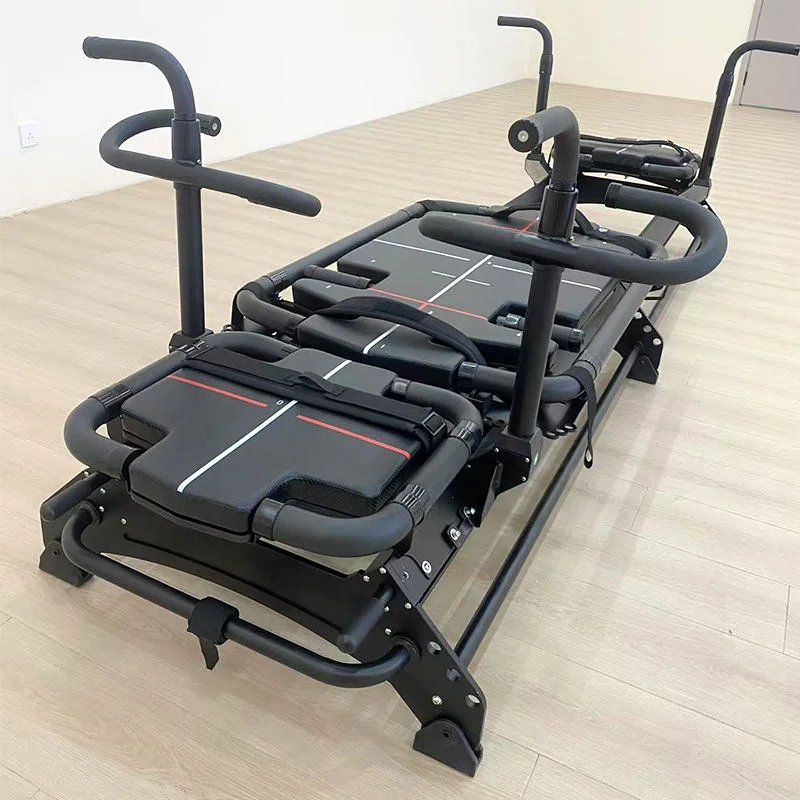
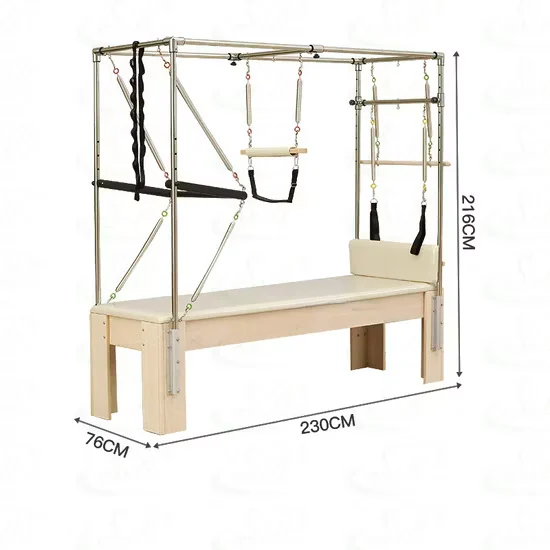
Whisper-Quiet Carriage Glide — Solid oak frame absorbs structure-borne vibration, keeping reformer noise below the threshold that triggers complaints on floors below.
Technical Specifications
| Parameter | Value |
|---|---|
| Product Type | Pilates Reformer |
| Material | Solid Oak Wood |
| Color | White (customizable) |
| Product Dimensions | 2460 × 730 × 680 mm |
| Net Weight | 100 kg |
| Accessory Options | Long Box, Jump Board, Platform |
| Max User Weight | 180 kg |
| Carriage Rail | Precision-machined solid wood |
| Resistance Type | Spring tension (calibrated) |
| Customization | Logo, Color, Accessory |
| Warranty | 3 Years |
Application Suitability
| Deployment Scenario | Typical Use |
|---|---|
| Hotel fitness center on guest room floors | 24-hour access reformer sessions requiring sub-floor noise control |
| Boutique Pilates studio in shared commercial building | Multi-station reformer classes with vibration isolation between units |
| High-end residential wellness suite | Private reformer use with zero transmission to adjacent units |
| Rehabilitation center | Low-impact therapeutic movement with stable, quiet carriage travel |
| Sports performance training center | Athlete recovery and core conditioning with precise spring resistance |
Why Noise Complaints Reach the Studio Before the Maintenance Log Does
Solid oak dampens the vibration that aluminum and steel transmit straight into floor slabs.
I spent years reviewing equipment write-offs from five-star hotel fitness floors. The pattern was identical: metal-framed reformers on upper floors generated low-frequency resonance through carriage rail contact and spring snap-back, and guests in rooms below filed complaints that no amount of rubber matting could solve [NEED_CITE: structure-borne noise transmission in multi-story fitness deployments]. When a hotel replaces a full set of reformers because of acoustic failure, the cost is never just the hardware. The Wooden Pilates Reformer Machine addresses this at the source — the frame itself becomes the dampening layer.
Where This Reformer Fits in a Commercial Pilates Zone
This unit anchors the core reformer programming in any studio layout, covering classical and contemporary Pilates sequences across beginner through advanced intensity ranges. It pairs with mat stations and barrel equipment to create a full apparatus rotation, and its solid oak footprint suits high-visibility placement in boutique studios where aesthetics carry weight. The 180 kg user capacity accommodates athletic populations without frame deflection. The commercial wooden pilates reformer machine supports spring resistance adjustment for progressive loading, and the accessory ecosystem — long box, jump board, platform — lets instructors program a complete class without switching apparatus.
Continuous Session Scheduling and Floor-Level Deployment
A boutique studio running back-to-back classes from early morning through evening places the carriage rail and spring system under near-continuous cycling. Oak’s natural vibration absorption means the unit can operate on suspended timber floors or upper-level concrete slabs without supplemental isolation platforms [NEED_CITE: continuous duty cycle requirements for studio Pilates equipment]. Ventilation around the frame is less critical than with motorized cardio, but humidity control matters — the wood must stay within a stable moisture range to prevent rail warping. Standard single-phase power is sufficient if the unit includes electronic accessories, though the base reformer requires no electrical supply at all.
Spring Calibration, Rail Precision, and the Oak Advantage
Spring tension on this reformer is factory-calibrated to deliver consistent resistance progression through full extension, eliminating the dead zones and snap-back that plague poorly wound coil systems. The precision-machined oak carriage rail provides a glide surface that does not develop the chatter or stick-slip friction common in extruded aluminum tracks after thousands of repetitions. Solid oak absorbs harmonic vibration at the point of generation rather than transferring it through rigid metal joints into the floor structure. The accessory attachment points — for the long box, jump board, and platform — are reinforced to withstand repeated mounting cycles without loosening, which is where secondary noise sources typically emerge on modular reformers [NEED_CITE: accessory mount durability under commercial cycling loads].
What Happens When Specifications Are Value-Engineered
Studios that purchase reformers with hollow aluminum frames and uncertified spring steel routinely face carriage rattle within the first year of high-frequency use. The rails develop micro-abrasions that create audible scraping, and the spring anchors fatigue under jump board impact, generating metallic resonance that travels through the entire frame. In multi-tenant buildings, this noise triggers lease compliance issues. Hotels that specified light-duty reformers for guest floors have pulled entire installations and absorbed the replacement cost along with guest compensation [NEED_CITE: equipment replacement costs from acoustic non-compliance in hospitality]. The frame material is not a cosmetic choice — it is the primary acoustic control point.
Why This Product Line for Your Facility
Every unit ships with a noise level test record verifying carriage glide performance under continuous operation. The oak frame is tested for 10,000 hours of repetitive loading to confirm structural integrity and rail surface durability. Our engineering team provides a free 3D studio layout that maps reformer placement against room dimensions, instructor sightlines, and participant flow patterns. Full OEM customization covers frame color, logo placement, and accessory selection so the equipment matches your studio’s brand identity. The six-series cardio and apparatus family lets you source treadmills, bikes, and reformers from one production line with consistent lead times. Technical support is available around the clock with spare parts dispatch.
Documentation & Test Records
- CE declaration of conformity for Pilates apparatus
- EN 957 test report covering structural load and stability
- ISO 9001 certificate for manufacturing quality management
- Noise level test report documenting carriage glide acoustics
- Durability test record for frame and spring cycle life
- Spare parts list with accessory compatibility matrix
Installation, Commissioning & Maintenance
- Allow 600 mm clearance on all sides of the 2460 × 730 mm footprint for safe movement
- Level the oak frame on a flat surface with felt pads to protect finished floors
- Inspect spring tension calibration and carriage rail alignment upon first assembly
- Wipe oak surfaces with dry cloth after each session to prevent sweat absorption
- Check accessory mounting hardware quarterly for secure fit under repeated use
- Maintain room humidity between 40–60% to preserve oak dimensional stability
Equipment Selection and Inquiry Preparation
Share your studio floor area and planned reformer count to receive a 3D layout with airflow and sightline planning. Specify your deployment floor level and adjacent occupied spaces so we can confirm acoustic suitability. Indicate whether you need console data integration for membership tracking or class scheduling systems. State your target market to confirm accessory packaging and documentation language requirements.
Frequently Asked Questions
Q: How does an oak wood frame compare to aluminum for noise control in a multi-story building?
A: Solid oak naturally dampens vibration at the source, while aluminum transmits structure-borne noise through the frame into floor slabs. In upper-floor hotel fitness centers and shared commercial buildings, oak-framed reformers consistently generate fewer noise complaints than metal equivalents, reducing or eliminating the need for supplemental acoustic isolation platforms beneath the equipment.
Q: What role does carriage rail precision play in long-term operational noise?
A: Precision-machined rails maintain smooth carriage travel without developing stick-slip friction or lateral chatter over thousands of repetitions. Poorly finished rails develop micro-abrasions that create audible scraping during use. The oak rail surface on this reformer is ground to tolerance and tested for glide consistency, which is critical in studios running back-to-back classes throughout the day.
Q: Are the spring tension settings factory-preset or adjustable on-site?
A: Springs are factory-calibrated to deliver consistent resistance across full extension range. On-site adjustment is possible for fine-tuning, but major recalibration should follow manufacturer guidelines to maintain tension uniformity. Inconsistent spring response across units in a studio creates an uneven experience for clients rotating between reformers during group classes.
Q: How does wood frame care differ from aluminum in terms of humidity sensitivity?
A: Oak is dimensionally stable within standard indoor humidity ranges but can swell or contract in extreme conditions. Maintaining room humidity between 40 and 60 percent preserves the frame geometry and rail alignment. This is a consideration for facilities in tropical climates or buildings with aggressive HVAC dehumidification that may pull moisture from wood components over time.