
![Portable Home Wood Pilates Reformer Bed for Studio Sale [WARN] draft identifier mismatch](https://bicksport.com/wp-content/uploads/2026/08/portable-home-wood-pilates-reformer-bed-for-studio-sale-warn-draft-identifier-mismatch-f0c8fd.webp)
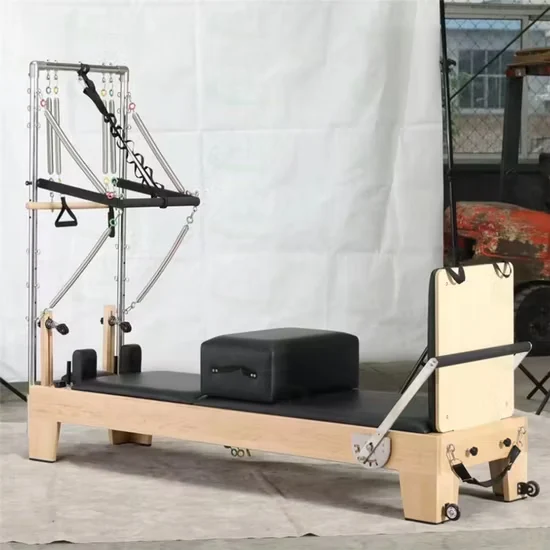
Vibration-Free Solid Wood Construction — The SRY-02 frame mass and joint engineering eliminate resonance transmission that plagues metal-frame reformers in hotel guest floors and shared residential spaces.
Technical Specifications
| Parameter | Value |
|---|---|
| Designation | SRY-02 |
| Product Type | Wood Pilates Reformer |
| Dimensions | 2460 × 730 × 680 mm |
| Net Weight | 100 kg |
| Frame Material | Solid Wood |
| Color Options | Solid Color (customizable) |
| Included Accessories | Long Box / Jump Board / Platform |
| Logo Customization | Available upon request |
| Target Demographic | Adult, Unisex |
| Warranty | 3 Years |
| Production Capacity | 80 Pieces per Month |
Application Suitability
| Deployment Scenario | Typical Use |
|---|---|
| Boutique Pilates studio | Group class programming with full accessory ecosystem for repertoire variety |
| Hotel fitness center on guest room floors | Low-vibration reformer sessions adjacent to occupied rooms without noise complaints |
| Corporate wellness room | Brand-neutral equipment for employee rehabilitation and mobility sessions |
| High-end residential home gym | Private instruction and self-directed practice with complete accessory set |
| Rehabilitation center | Controlled resistance progression for post-injury recovery protocols |
Why Vibration Complaints Reach the Front Desk Before Maintenance Does
A solid wood chassis with proper joint engineering stops reformer impact noise at the source, before it transmits through floor assemblies into occupied rooms below.
Metal-frame reformers deployed on upper floors of hotels and mixed-use residential buildings generate rebound vibration during footwork and jump board sequences. That vibration travels through rigid frame connections into concrete slabs, producing low-frequency resonance that guests perceive as disturbance rather than identifiable mechanical noise. By the time maintenance receives a work order, the front desk has already logged multiple complaints and issued compensation credits [NEED_CITE: structural vibration transmission in commercial fitness equipment on suspended floor assemblies].
We replaced an entire batch of metal-frame units on a hotel guest floor after nighttime vibration issues persisted despite rubber isolation pads. The switch to solid wood frame construction with mass-loaded joint design resolved the transmission path entirely, because the frame itself absorbs rebound energy rather than conducting it.
Positioning the SRY-02 Within a Mixed-Modality Studio Floor Plan
The commercial wood Pilates reformer with accessories covers the full spectrum of supine, seated, kneeling, and standing movement patterns across beginner through advanced programming intensity bands. In a multi-discipline studio layout, reformer stations typically anchor the primary class zone while mat work and apparatus-based stations occupy adjacent bays, allowing instructors to rotate groups between modalities within a single session.
The 2460 mm length and 730 mm width dictate minimum spacing of approximately 900 mm between adjacent units for instructor circulation and safe carriage travel during standing sequences. The 180 kg maximum user weight capacity accommodates the full demographic range encountered in open-enrollment group classes and private rehabilitation sessions alike. This unit pairs naturally with cadillac and chair apparatus for facilities building comprehensive apparatus-based programming.
Continuous Scheduling Demands and Environmental Placement Criteria
Studios running six to eight group classes daily plus private sessions between classes subject reformer carriages, springs, and pulley assemblies to sustained high-cycle operation that exceeds residential usage patterns by a significant margin. Carriage wheels and spring anchors require periodic inspection intervals matched to actual class throughput rather than calendar-based schedules.
Upper-floor hotel deployments demand vibration isolation assessment before installation, particularly when reformer stations sit directly above occupied guest rooms or conference spaces. The solid wood frame construction of this unit inherently dampens rebound transmission, but floor assembly stiffness and subfloor conditions still influence measurable vibration at adjacent receptors [NEED_CITE: floor vibration criteria for fitness equipment in commercial occupancies]. Ceiling height clearance must accommodate the full 680 mm frame height plus overhead accessory mounting and user standing reach during jump board sequences. Ambient humidity in spa-adjacent fitness zones should remain controlled to protect wood frame dimensional stability over extended service intervals.
Solid Wood Frame Mass, Joint Engineering, and Accessory Integration
The 100 kg frame mass provides the inertial stability necessary for explosive jump board repetitions and high-tension spring work without frame walking or lateral drift on smooth studio flooring. Solid wood construction delivers vibration damping characteristics that rigid welded metal frames cannot achieve, because the natural cellular structure of hardwood absorbs impact energy at each joint connection rather than transmitting it through continuous metal pathways.
The included long box, jump board, and platform accessories mount directly to the carriage and frame attachment points without requiring separate purchase or compatibility verification, which simplifies procurement for studio buildouts and eliminates the accessory mismatch problems that arise when sourcing reformer components from multiple suppliers. Spring resistance progression across the standard set supports incremental loading from rehabilitation-level tension through advanced athletic conditioning without mid-range dead spots or uneven force curves. Pulley routing and rope length accommodate the full dimensional range of adult users performing overhead and lower-extremity cable work.
The Hidden Costs of Frame Material and Accessory Compromises
Metal-frame reformers purchased at lower initial cost generate ongoing expense through vibration complaint resolution, guest compensation, and eventual wholesale replacement when upper-floor deployment proves incompatible with rigid frame transmission characteristics. Facilities that source reformer and accessories from separate vendors frequently encounter mounting incompatibility, requiring custom bracket fabrication or complete accessory replacement within the first year of operation.
Spring sets that lack uniform tension progression across the resistance range force instructors to work around equipment limitations rather than programming optimal loading sequences for class participants. Pulley assemblies and carriage wheels specified for residential duty cycles develop play and tracking deviation under sustained commercial scheduling, producing uneven carriage travel that compromises exercise precision and generates maintenance call volume [NEED_CITE: commercial duty cycle requirements for Pilates reformer carriage assemblies].
Why This Product Line Matches Facility Procurement Requirements
The SRY-02 wood frame construction has been verified in hotel guest-floor deployments where vibration transmission to adjacent occupied spaces was the primary equipment selection constraint. Each unit undergoes structural durability testing calibrated to 10,000 hours of continuous high-frequency commercial operation before shipping authorization.
The complete accessory set — long box, jump board, and platform — arrives factory-matched and pre-verified for mounting compatibility, eliminating the accessory sourcing uncertainty that delays studio opening timelines. Custom logo application and color matching are available with flexible minimum order quantities, supporting private-label deployment for hotel groups and studio chain networks without extended lead time penalties. Our 3D studio layout service accounts for reformer footprint, instructor circulation corridors, and HVAC airflow patterns to prevent equipment clustering that creates dead zones and underutilized floor area. Technical support remains available around the clock for installation calibration and ongoing maintenance inquiries.
Documentation & Test Records
- CE declaration of conformity for European market compliance
- EN 957 test report covering structural load and safety requirements
- ISO 9001 quality management system certification
- Frame and joint structural durability test record
- Spring resistance calibration and pulley assembly specification sheet
- Accessory fitment verification for long box, jump board, and platform
Installation, Commissioning & Maintenance
- Maintain minimum 900 mm clearance on all sides of the 2460 × 730 mm footprint for safe carriage travel and instructor access.
- Level the solid wood frame on rigid subfloor using adjustable foot pads to prevent carriage drift during asymmetric loading sequences.
- Verify spring anchor tension calibration upon delivery and recheck after the first 200 hours of carriage travel.
- Inspect carriage wheel bearings and pulley routing hardware at intervals matched to actual class scheduling density.
- Apply wood-safe cleaning agents only to frame surfaces; avoid solvent-based products that degrade finish and joint adhesive integrity.
- Confirm long box, jump board, and platform mounting hardware torque after initial break-in period.
Equipment Selection Inquiry Pathway
Provide your studio floor area and target unit count to receive a 3D layout incorporating reformer spacing, instructor circulation, and ventilation planning. Specify your daily class schedule and average session duration so we can confirm spring and carriage durability matching to your actual throughput. Indicate whether reformer deployment targets upper-floor hotel spaces or ground-level studios to determine whether additional vibration isolation measures are warranted. State your target market voltage standards if any powered accessories or lighting integration is planned for the reformer zone.
Frequently Asked Questions
Q: How does solid wood frame construction compare to metal frame reformers for vibration control in upper-floor installations?
A: Solid wood frames absorb rebound vibration through the natural cellular structure of the hardwood and the mass-loaded joint connections, preventing impact energy from conducting through the frame into floor assemblies below. Metal frames transmit vibration through continuous rigid pathways, requiring supplemental isolation pads that degrade over time and shift during use.
Q: Which accessories are essential for commercial group class programming versus private instruction?
A: Group classes require the full accessory set — long box for supine and seated progressions, jump board for plyometric sequences, and platform for standing balance work — to support repertoire rotation across a multi-week class cycle. Private instruction may operate with the standard carriage and spring set initially, adding accessories as client programming advances.
Q: How do I verify reformer suitability for hotel guest floor deployment?
A: Request vibration transmission test data specific to the frame construction and mass of the unit under consideration, then compare those results against the floor assembly stiffness criteria for your building. Confirm that the 100 kg frame mass and wood joint design meet the isolation requirements for your specific suspended slab configuration.
Q: What customization options are available for logo placement and color matching?
A: Logo application is available on the frame at specified locations with flexible minimum order quantities for private-label studio and hotel deployments. Color matching follows standard solid color options, with custom tone requests subject to sample approval and production lead time confirmation during the quotation phase.
Q: What maintenance intervals apply to springs, pulleys, and carriage wheels under high-frequency studio scheduling?
A: Spring tension calibration should be verified after the initial break-in period and then at intervals matched to your actual class throughput rather than calendar dates. Pulley hardware and carriage wheel bearings require inspection for play and tracking deviation, with replacement triggered by measurable wear rather than predetermined schedules.


![White Aluminum Pilates Reformer Used for Pilates Studio [WARN] draft identifier mismatch](https://bicksport.com/wp-content/uploads/2026/08/white-aluminum-pilates-reformer-used-for-pilates-studio-warn-draft-identifier-mismatch-0953f0.webp)