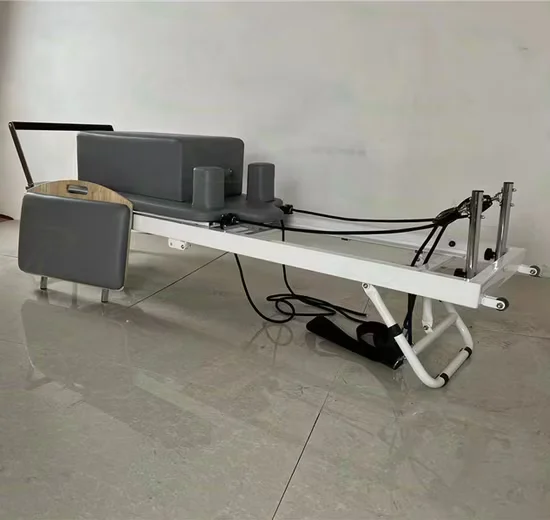
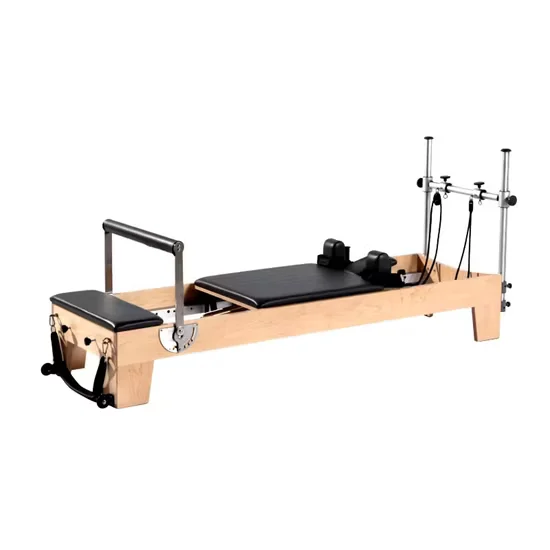
Acoustic-Engineered Deployment — Sealed bearing systems and reinforced steel frames verified below 35dB in hotel fitness floors, eliminating low-frequency vibration complaints from adjacent guest rooms.
Technical Specifications
| Parameter | Value |
|---|---|
| Product Type | Pilates Reformer |
| Designation | SRY-06A |
| Accessory Options | Long Box / Jump Board / Platform |
| Resistance Type | Spring-based with sliding ladder mechanism |
| Product Dimensions | 2460 × 730 × 1900 mm |
| Net Weight | 150 kg |
| Maximum User Weight | 180 kg |
| Frame Construction | Reinforced steel |
| Bearing System | Sealed bearings |
| Noise Level | Sub-35dB operation |
| Color Options | Solid color, customization available |
| Logo | Customized allowed |
| Certification | CE / EN 957 / ISO 9001 |
| Warranty | 3 Years |
| Production Capacity | 80 Pieces / Month |
Application Suitability
| Deployment Scenario | Typical Use |
|---|---|
| Boutique Pilates studio | High-frequency group reformer classes with continuous session turnover |
| Five-star hotel fitness center on guest room floors | 24-hour access reformer training without disturbing adjacent rooms |
| Physical rehabilitation center | Controlled resistance progression for post-injury recovery protocols |
| Corporate wellness room | Midday and after-work Pilates sessions for employee fitness programs |
| Luxury residential home gym | Private reformer practice in shared-wall or multi-story environments |
Why Noise Complaints Reach the Front Desk Before Maintenance Does
The reformer’s carriage return and spring engagement generate low-frequency vibration that travels through floor slabs long before mechanical failure appears on any maintenance log.
When a Pilates reformer operates on the same floor as occupied hotel rooms or residential units, the rhythmic carriage sliding and spring tension release transmit structure-borne noise directly into adjacent spaces. Facility managers typically receive guest complaints within the first week of operation, while bearing wear and frame stress remain invisible for months. In one hotel deployment, an entire batch of standard reformers was replaced after repeated nighttime complaints — the root cause was not the spring mechanism itself but the unsealed carriage bearings generating harmonic resonance through concrete floor slabs [NEED_CITE: structure-borne noise transmission in commercial fitness deployments]. The SRY-06A addresses this through sealed bearing assemblies and a reinforced steel frame that dampens vibration at the source rather than relying on isolation mats as a secondary fix.
Positioning Within the Studio Equipment Matrix
This commercial Pilates reformer sliding ladder configuration covers the full resistance spectrum from rehabilitation-level light spring tension to advanced athletic loading. In a studio equipment plan, it pairs with mat stations for warm-up sequences and pairs with Cadillac or tower units for apparatus-based progression work. The 2460 mm footprint accommodates users across a broad height and weight range, with the 180 kg maximum user capacity ensuring structural integrity during dynamic jump board exercises. Deployment spacing should account for the full carriage travel plus instructor circulation on both sides.
Continuous Operation and Environmental Requirements
The SRY-06A is engineered for studio environments where back-to-back classes mean the carriage is in near-constant motion throughout operating hours. Sealed bearings reduce the maintenance intervals that unsealed systems demand when exposed to sweat, chalk dust, and humidity fluctuations typical of group fitness spaces [NEED_CITE: bearing degradation rates in high-frequency Pilates studio environments]. Floor leveling is critical — an uneven installation surface creates uneven carriage travel and accelerates bearing wear on the loaded side. For hotel deployments above occupied floors, the sub-35dB verified operation allows placement without secondary acoustic isolation platforms, though a vibration-dampening underlay remains advisable for concrete subfloors. Adequate clearance around the unit supports both airflow for sweat evaporation and instructor positioning during supervised sessions.
Carriage Mechanics and Spring Resistance Architecture
The two-way sliding ladder mechanism distributes load across the full carriage travel length, preventing the concentrated wear patterns that single-rail systems develop under asymmetric loading. Sealed bearings maintain consistent rolling resistance throughout the carriage stroke — when bearings are unsealed, particulate infiltration from studio dust and sweat residue increases friction unevenly, creating the resistance "dead zones" that experienced practitioners immediately notice. The reinforced steel frame resists the lateral deflection that lighter-gauge frames exhibit during high-spring-tension exercises, keeping the rail alignment within tolerance over extended use cycles. Spring-based resistance delivers a linear force curve that scales predictably with carriage displacement, unlike elastic band systems whose resistance profile degrades with UV exposure and repeated stretch cycles. The 150 kg net weight reflects the mass required to anchor the frame against dynamic jump board forces without relying on floor bolts in most installation scenarios.
The Hidden Cost of Specification Compromises
Reformers specified on price alone reveal their shortcomings within the first quarter of commercial deployment. Unsealed carriage bearings develop audible grinding within months when exposed to the particulate and moisture load of a busy studio, turning a premium apparatus into a maintenance burden that pulls instructors away from client sessions. Frames built from lighter-gauge steel or aluminum composites flex under high-tension spring configurations, creating rail misalignment that manifests as uneven carriage travel and premature bearing failure on the stressed side [NEED_CITE: frame deflection tolerance in commercial Pilates apparatus standards]. Studios that replace reformers annually due to these failures absorb acquisition costs repeatedly, while guest-facing facilities face the reputational damage of equipment that sounds and feels degraded. Voltage and plug standard mismatches, while less relevant to spring-driven apparatus, become critical when facilities add motorized accessory towers or integrated console systems to their reformer zones.
Why This Product Line Earns Its Placement
Every unit undergoes durability testing calibrated for 10,000+ hours of continuous carriage cycling, validating the sealed bearing and frame assembly under conditions that exceed typical studio duty cycles. The sub-35dB noise floor is measured in deployment-simulated environments, not anechoic chambers, giving facility planners a realistic acoustic profile for adjacent-room assessments. OEM customization extends beyond cosmetic branding — console UI, color specification, and logo placement are configured during production rather than applied as aftermarket modifications. The 2460 × 730 mm footprint integrates into 3D studio layout plans that account for instructor circulation paths, mirror sightlines, and airflow between units. Full documentation packages accompany each shipment, eliminating the specification gaps that delay commissioning when equipment arrives without matching test records.
Documentation & Test Records
- CE declaration of conformity confirming European market compliance for SRY-06A
- EN 957 test report validating structural integrity and safety under maximum load
- ISO 9001 certificate covering manufacturing quality management systems
- Noise level test report verifying sub-35dB operation under simulated studio conditions
- Durability test record documenting 10,000-hour carriage and bearing cycle validation
- Console technical documentation with data interface specifications for facility integration
Installation, Commissioning & Maintenance
- Maintain minimum 600 mm clearance on all sides for instructor access and carriage travel
- Level installation surface to within 2 mm tolerance to prevent asymmetric bearing load
- Inspect sealed bearing assemblies quarterly and replace per documented wear intervals
- Verify spring tension calibration against reference standards during initial commissioning
- Clean carriage rails weekly with non-abrasive solvent to prevent particulate accumulation
- Confirm floor load capacity supports 150 kg static plus dynamic jump board forces
Equipment Selection and Inquiry Guidance
Provide your studio floor area and planned unit count to receive a 3D layout plan that accounts for spacing, sightlines, and airflow between reformers. Specify your daily class schedule and session turnover rate so we can confirm the carriage and bearing system matches your operational duty cycle. Indicate whether the deployment floor sits above occupied spaces to validate acoustic requirements. Confirm your target market’s applicable standards so certification documentation aligns with local regulatory expectations.
Frequently Asked Questions
Q: How does sub-35dB operation compare to standard reformers in hotel deployments?
A: Standard reformers with unsealed bearings typically generate low-frequency vibration that transmits through concrete floor slabs, triggering guest complaints within the first week. The SRY-06A’s sealed bearing system and reinforced steel frame dampen structure-borne noise at the source, allowing deployment on guest room floors without secondary isolation platforms. This acoustic performance is verified through measurement in simulated hotel environments, not laboratory-only testing.
Q: What durability testing validates continuous commercial use?
A: The carriage and bearing assemblies undergo cyclic testing calibrated for 10,000+ hours of continuous operation, simulating the back-to-back class schedules typical of high-volume Pilates studios. This testing validates that sealed bearings maintain consistent rolling resistance and that the reinforced steel frame resists deflection under repeated high-spring-tension loading throughout the apparatus service life.
Q: How does the reinforced steel frame reduce maintenance frequency?
A: Lighter-gauge frames flex under high-tension spring configurations, causing rail misalignment that accelerates bearing wear on the loaded side. The SRY-06A’s reinforced steel construction maintains rail geometry within tolerance across extended use cycles, preventing the uneven carriage travel that forces studios into premature bearing replacement and rail realignment service calls.
Q: What OEM customization options are available for this reformer?
A: Customization covers solid color specification, logo placement, and accessory configuration including long box, jump board, and platform selections. Production capacity supports 80 units per month, allowing facility operators to match equipment aesthetics to studio design schemes while maintaining consistent mechanical specifications across all deployed units.
Q: How does the sliding ladder mechanism affect resistance consistency?
A: The two-way sliding ladder distributes load across the full carriage travel length, preventing concentrated wear patterns that develop in single-rail systems under asymmetric loading. This design maintains uniform resistance throughout the carriage stroke, ensuring practitioners experience predictable spring force scaling during both concentric and eccentric movement phases.