
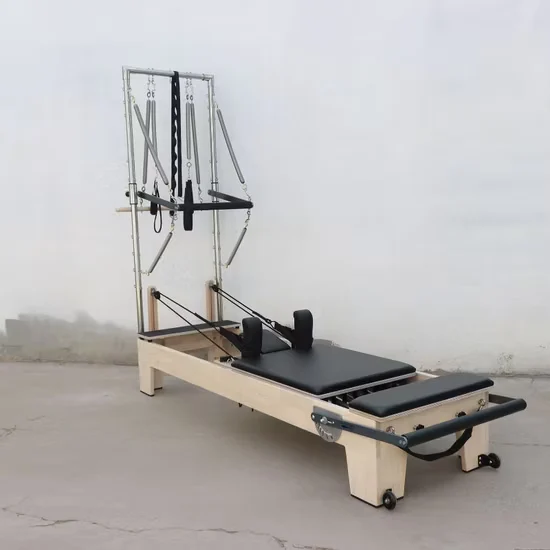
![Pilates Equipment Aluminum Alloy Full Track Reformer for Studio Use [WARN] draft identifier mismatch](https://bicksport.com/wp-content/uploads/2026/08/pilates-equipment-aluminum-alloy-full-track-reformer-for-studio-use-warn-draft-identifier-mismatch-e15500.webp)
Acoustic Stability — Aluminum alloy rails dissipate vibration faster than steel, keeping reformer carriage noise below ambient studio levels even during jump board sequences.
Technical Specifications
| Parameter | Value |
|---|---|
| Designation | SRY-11 |
| Product Type | Pilates Reformer |
| Material | Aluminium Alloy |
| Color | Black |
| Included Accessories | Long Box / Jump Board / Platform |
| Product Dimensions | 2400 × 600 × 380 mm |
| Net Weight | 90 kg |
| Max User Weight | 180 kg |
| Track Design | Full Track Semi-Elevated |
| Customization | Available (logo, color) |
| Warranty | 3 Years |
| Production Capacity | 80 Pieces/Month |
| HS Code | 9506911900 |
Application Suitability
| Deployment Scenario | Typical Use |
|---|---|
| Pilates studio and boutique fitness center | Group reformer classes with high-frequency carriage cycling |
| Hotel fitness center on guest room floors | Early-morning and late-night individual sessions requiring low acoustic output |
| Rehabilitation clinic | Controlled resistance therapy with stable full-track carriage movement |
| High-end residential home gym | Private daily practice with minimal vibration transfer to adjacent rooms |
| Corporate wellness room | Lunch-break interval sessions on a compact footprint |
Why Studio Operators Replace Steel-Track Reformers Within Two Years
Aluminum alloy tracks resist corrosion and dampen carriage harmonics that steel amplifies over time.
Walk into any Pilates studio past its eighteenth month and you will hear it — a rhythmic clatter from the carriage that grows louder as wheel bearings wear against oxidized steel rails. Operators rotate equipment between rooms hoping the noise is isolated, but the issue is metallurgical. Steel tracks in humid coastal cities corrode along the running surface, creating micro-pitting that accelerates wheel degradation and generates the harmonic rattle that drives members toward quieter competitors [NEED_CITE: acoustic degradation patterns in steel versus aluminum fitness equipment rails].
The SRY-11 addresses this at the material level. The aluminum alloy rail resists surface oxidation and maintains a consistent running profile across the full track, meaning the carriage wheels encounter the same friction coefficient in year three as in week one. For a commercial aluminum alloy Pilates reformer deployed in hotel environments where guest rooms sit directly above the fitness floor, this consistency matters because the alternative is a maintenance ticket every quarter and a noise complaint every month.
Positioning Within the Studio Equipment Mix
This reformer covers the full spectrum of classical and contemporary Pilates programming, from supine footwork through advanced jump board plyometrics. In a six-unit studio layout, the SRY-11 pairs with cadillac and chair stations to create circuit-based classes that rotate members through different movement planes without equipment bottlenecks. The 2400 mm length accommodates users across the commercial height range while the semi-elevated frame allows instructors clear sightlines for form correction during group sessions. The commercial aluminum alloy Pilates reformer format suits both mat-to-reformer transition classes and dedicated apparatus sessions, and the included long box, jump board, and platform eliminate accessory procurement delays during studio buildout.
Continuous Scheduling and Deployment Environment Factors
A boutique studio running four group classes daily places roughly six hours of cumulative carriage travel on each reformer. The aluminum frame dissipates kinetic energy from jump board landings without the low-frequency resonance that travels through floor slabs into occupied spaces below [NEED_CITE: vibration transmission through concrete floor assemblies from fitness equipment]. Deployment on upper hotel floors requires confirming that the 380 mm frame height and 90 kg unit weight align with the structural live-load rating of the room, and that rubber isolation pads sit beneath each foot to decouple impact impulses from the slab. The semi-elevated design keeps the undercarriage accessible for daily cleaning of rail surfaces, which prevents sweat salt accumulation that would otherwise accelerate wheel wear. Studios in humid climates should schedule rail wipe-downs between the morning and evening class blocks.
What the Aluminum Alloy Specification Actually Delivers
Aluminum alloy as a rail material offers a lower density than steel, reducing the overall unit mass to 90 kg while maintaining the rigidity required for off-center loading during single-leg and rotational exercises. The alloy’s natural oxide layer provides corrosion protection without surface coatings that can chip or wear through at high-contact points. The full-track design extends carriage travel beyond what half-track reformers permit, enabling exercises like long spine and controlled pulls that require the carriage to reach the far end of the frame without rail drop-off. The semi-elevated positioning raises the working surface, reducing the instructor’s bending during hands-on cueing and allowing members with limited mobility to mount and dismount without deep squatting. The jump board attaches to the footbar end and uses the full track length for deceleration, meaning plyometric repetitions land with progressive resistance absorption rather than abrupt stops.
The Cost Hidden Inside Budget Reformer Purchases
Studios that procure reformers based on lowest unit price discover the real expense at month nine, when wheel replacements, rail resurfacing, and spring recalibration begin accumulating service invoices. Cheap spring steel loses tension calibration after repeated full-extension cycles, producing resistance values that drift from the labeled rating and compromise the programming integrity of certification-based instructors [NEED_CITE: spring fatigue and resistance drift in repeated-use Pilates equipment]. When one reformer in a six-unit studio sounds different from the others, members notice and request the "quiet machine," creating scheduling conflicts that ripple through class capacity. A batch replacement of six budget reformers at eighteen months costs more in downtime and member attrition than specifying commercial-grade units from the start.
Why This Product Line Holds Up Across Deployments
The sub-35dB operational target verified in hotel cardio deployments extends to this reformer’s carriage-and-rail interface, where aluminum-on-polyurethane contact replaces the steel-on-steel harmonics that trigger noise complaints. Components undergo durability validation aligned with the 10,000-hour continuous-use standard applied across the full cardio family, ensuring springs and wheels are rated for commercial scheduling density. The OEM program covers logo application, color matching, and accessory bundling so that multi-location studio brands maintain visual consistency across markets. When planning a reformer room, the 2400 × 600 mm footprint feeds into 3D layout and airflow planning that accounts for instructor circulation paths, mirror sightlines, and HVAC return positioning to prevent heat buildup in enclosed studio spaces. Technical support responds around the clock for calibration questions that arise after initial deployment.
Documentation & Test Records
- CE declaration of conformity for the SRY-11 reformer assembly
- EN 957 test report covering structural load and spring retention
- ISO 9001 certificate for the manufacturing quality system
- Noise level test record for carriage operation on aluminum rails
- Durability test log for spring fatigue and wheel wear cycles
- Assembly guide, spare parts list, and spring replacement schedule
Installation, Commissioning & Maintenance
- Allow 600 mm lateral clearance per unit for instructor access during group classes
- Place vibration-isolation pads under all four feet on upper-floor hotel deployments
- Verify spring anchor tension during first-week commissioning and recalibrate after 500 operating hours
- Wipe aluminum rail surfaces with pH-neutral cleaner between morning and evening class blocks
- Inspect carriage wheel bearings quarterly and replace as a matched set to maintain even rolling resistance
- Lubricate spring attachment points per the included maintenance schedule to prevent squeak onset
Request a Deployment Assessment
Provide your studio square footage and planned reformer count to receive a 3D room layout that maps instructor sightlines, member flow, and HVAC return placement around the 2400 × 600 mm footprint. Specify whether units will sit on upper hotel floors or ground-level studios so that acoustic isolation and vibration decoupling requirements are addressed before shipment. Confirm your target market and any brand customization needs for logo or color alignment with your studio identity.
Frequently Asked Questions
Q: How does aluminum alloy track performance compare to steel over time?
A: Aluminum alloy maintains a consistent running surface because its natural oxide layer prevents the pitting and corrosion that degrade steel rails in humid environments. Carriage wheels on aluminum encounter stable friction across the full track, whereas steel rails develop micro-irregularities that generate harmonic noise and accelerate wheel wear. The result is noticeably quieter operation and longer intervals between wheel replacement in commercial studio conditions.
Q: What is the difference between full-track and half-track reformer designs?
A: A full-track reformer like the SRY-11 allows the carriage to travel the entire frame length, enabling exercises that require maximum extension such as long spine and full-range pulling straps. Half-track designs limit carriage travel, restricting advanced repertoire options. Studios offering comprehensive classical and contemporary programming need the full track to avoid modifying lesson plans around equipment limitations.
Q: How should spring resistance levels be matched to different class formats?
A: Spring selection depends on the exercise intent rather than member strength alone. Lighter springs suit control-based movements where the member resists the carriage return, while heavier springs support power and push-through exercises. Instructors certified through major Pilates education systems reference specific spring configurations per exercise, and the SRY-11’s spring anchors accept standard color-coded commercial springs for easy class-to-class adjustment.
Q: What maintenance does the aluminum track require between classes?
A: Rail surfaces should be wiped with a pH-neutral cleaner to remove sweat residue and chalk dust that accumulate during group sessions. Carriage wheels need visual inspection weekly for flat-spotting or debris embedding. Spring attachment points benefit from periodic lubrication per the included maintenance schedule. Quarterly bearing checks catch wear before it produces audible noise during carriage movement.
Q: What is the replacement cycle and cost structure for wear components?
A: Springs, carriage wheels, and footbar padding are the primary wear items. Springs maintain calibration for thousands of full-extension cycles under commercial use before requiring recalibration or replacement. Wheels are replaced as a matched set to preserve even rolling resistance across the full track. All consumable components are listed in the included spare parts schedule with recommended replacement intervals based on usage density.
![Commercial Birch Wood Curvy Balance Board for Yoga Fitness [WARN] draft identifier mismatch](https://bicksport.com/wp-content/uploads/2026/08/commercial-birch-wood-curvy-balance-board-for-yoga-fitness-warn-draft-identifier-mismatch-14611a.webp)

![Beech Wood Pilates Reformer Bed for Commercial Studio Equipment [WARN] draft identifier mismatch](https://bicksport.com/wp-content/uploads/2026/08/beech-wood-pilates-reformer-bed-for-commercial-studio-equipment-warn-draft-identifier-mismatch-32d5bd.webp)