

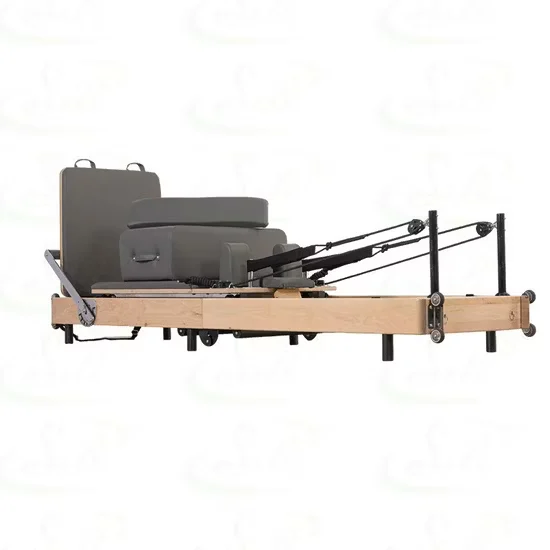
Aluminum Alloy Rail Glide — Machined rail surface maintains consistent carriage travel under repeated high-force loading without wobble or binding.
Technical Specifications
| Parameter | Value |
|---|---|
| Designation | SRY-12 |
| Product Type | Pilates Reformer |
| Frame Material | Aluminum Alloy |
| Product Dimensions | 2570 × 730 × 270 mm |
| Net Weight | 90 kg |
| Accessory Included | Long Box / Jump Board / Platform |
| Color | White |
| Target User | Adult, Unisex |
| Logo | Customized Is Allowed |
| Warranty | 3 Years |
Application Suitability
| Deployment Scenario | Typical Use |
|---|---|
| Pilates studio | Group class reformer stations with daily high-frequency scheduling |
| Boutique fitness center | Semi-private sessions requiring accessory versatility |
| Rehabilitation and physiotherapy clinic | Controlled eccentric loading for post-injury protocols |
| Private home gym | Full-discipline programming within a single footprint |
Why Studios Replace Reformers Within Months of Opening
Carriage wobble and spring fatigue are the first failures guests notice — and they notice them quickly.
Consumer-grade reformers look acceptable on day one. By month three, carriage wheels develop lateral play on steel rails, springs lose their progressive tension curve, and accessory mounting points no longer align. Studio owners end up sourcing replacement units or individual components from incompatible suppliers, creating maintenance overhead that was never in the operating budget [NEED_CITE: typical failure modes in commercial Pilates reformer carriage systems]. The SRY-12 aluminum alloy frame addresses this at the structural level: the rail surface resists corrosion in humid studio environments and maintains tighter glide tolerances than painted steel alternatives, reducing routine wheel adjustment intervals.
Where This Reformer Fits in a Studio Equipment Layout
The commercial Pilates reformer aluminum alloy frame supports full-range exercise programming from foundational footwork through advanced jump board plyometrics, covering low-intensity rehabilitation progressions and high-force athletic conditioning within one unit. In a studio equipment plan, it pairs with Cadillac and Wunda Chair stations for comprehensive apparatus-based sessions. The 2570 mm length accommodates tall users during supine and standing exercises, while the 90 kg net weight provides frame rigidity during explosive push-off sequences without flex or drift.
Continuous Scheduling and Studio Environment Considerations
A fully booked Pilates studio runs back-to-back sessions from early morning through evening, meaning each reformer sees repeated loading cycles with minimal idle time between users. The aluminum alloy construction resists surface oxidation from perspiration and humidity, which is a common degradation path for powder-coated steel frames in climate-controlled but moisture-dense group class environments [NEED_CITE: corrosion resistance of aluminum alloy in fitness facility environments]. Adequate clearance of at least 600 mm on each side allows instructor access for hands-on cueing, and the 270 mm bed height keeps the carriage accessible for clients with limited mobility during rehabilitation sessions.
Rail Construction, Spring Tension and Accessory Modularity
The aluminum alloy rail delivers lower rolling resistance than steel equivalents, meaning the carriage glides with less friction and produces less wheel wear over thousands of repetitions. The spring tension system provides a progressive resistance curve — heavier springs engage during the initial push-off phase while lighter springs maintain tension through the eccentric return, which supports controlled muscle loading throughout each movement pattern. Replaceable springs extend the equipment service life compared to elastic cord systems that stretch and degrade unpredictably. The included long box, jump board and platform attach to standardized mounting points, expanding the exercise repertoire without requiring additional floor space or separate equipment purchases.
What Happens When Frame and Rail Specifications Are Undersized
A reformer frame that flexes under high-force jump board loading creates inconsistent carriage travel, forcing instructors to modify or eliminate entire exercise categories from class programming. Springs that lose calibration within weeks generate uneven resistance between units in a group class setting, meaning clients on adjacent reformers experience different loading despite following identical choreography [NEED_CITE: spring tension consistency requirements in group Pilates instruction]. Studios that purchased lightweight or underspecified reformers report replacing units within twelve to eighteen months, turning a capital equipment decision into a recurring procurement problem.
Why This Product Line Was Engineered for Facility Deployment
The SRY-12 was developed from field observations where studios cycled through multiple reformer brands before finding equipment that survived daily commercial scheduling. The aluminum alloy rail and reinforced frame address the two most common failure points: carriage drift and structural flex under dynamic loading. The three-year warranty covers frame, carriage and spring components for commercial use. Accessory compatibility across the product line means studios can standardize mounting interfaces when adding units later. The 3D layout planning service covers reformer spacing, instructor circulation paths and ventilation requirements for the full studio footprint, so the commercial Pilates reformer aluminum alloy deployment accounts for airflow and sightlines before equipment arrives on site.
Documentation & Test Records
- CE declaration of conformity for Pilates reformer structural and mechanical safety
- EN 957 test report covering frame load and carriage travel tolerances
- ISO 9001 certificate for manufacturing quality management
- Spring tension rating and replacement interval documentation
- Accessory attachment interface compatibility confirmation
- Installation and commissioning guide with spare parts list
Installation, Commissioning & Maintenance
- Position with 600 mm side clearance for instructor access and 1200 mm end clearance for jump board exercises
- Level the 2570 × 730 mm frame on solid flooring using adjustable feet to prevent carriage drift
- Inspect carriage wheels quarterly for lateral play and replace per maintenance schedule
- Verify spring tension calibration every six months using load testing protocol
- Clean aluminum alloy rail surface with non-abrasive solution after each session to maintain glide tolerance
- Confirm accessory mounting point alignment during initial commissioning before client use
Request a Deployment-Focused Equipment Assessment
Provide your studio floor plan and target class capacity to receive a 3D layout covering reformer spacing, instructor flow and ventilation requirements. Specify daily session volume per unit so spring and carriage durability can be matched to scheduling density. Indicate whether units will serve rehabilitation clients, group classes or both, so accessory configuration is scoped correctly. Confirm destination market for shipping documentation and any OEM branding requirements.
Frequently Asked Questions
Q: How does an aluminum alloy frame compare to steel for commercial reformer use?
A: Aluminum alloy offers lower rolling resistance on the carriage rail, reducing wheel wear over repeated sessions. It also resists surface corrosion from perspiration and humidity in studio environments, which is a common degradation path for painted or powder-coated steel frames. The weight difference makes units easier to reposition during studio reconfiguration while maintaining frame rigidity during high-force exercises.
Q: What is the advantage of spring-based resistance over elastic cords?
A: Springs deliver a predictable progressive resistance curve that remains consistent across thousands of compression cycles. Elastic cords stretch and degrade unpredictably, requiring replacement at irregular intervals. Replaceable springs allow studios to maintain precise tension calibration across all units in a group class environment, ensuring clients experience uniform resistance regardless of which reformer they use.
Q: Are the included accessories compatible with other reformer models in the product line?
A: The long box, jump board and platform attach to standardized mounting interfaces shared across the product line. This means studios can standardize accessory inventory when expanding their reformer fleet. Compatibility confirmation documentation is provided with each unit, specifying attachment points and load ratings for each accessory component.
Q: What is the recommended maintenance interval for carriage wheels?
A: Carriage wheels should be inspected quarterly for lateral play and surface wear. On the aluminum alloy rail, wheels typically show less friction-induced degradation compared to steel rail operation. Replacement criteria include audible rolling noise, visible flat spots or measurable lateral movement beyond specified tolerance. A maintenance log template is included in the commissioning documentation.


![New Design Body Exercise Machine Zen Yoga Equipment Pilates MachineCommercial Wood Pilates Reformer Machine for Studio Use [WARN] draft identifier mismatch](https://bicksport.com/wp-content/uploads/2026/08/new-design-body-exercise-machine-zen-yoga-equipment-pilates-machinecommercial-wood-pilates-reformer-machine-for-studio-use-warn-draft-identifier-mismatch-76b32b.webp)