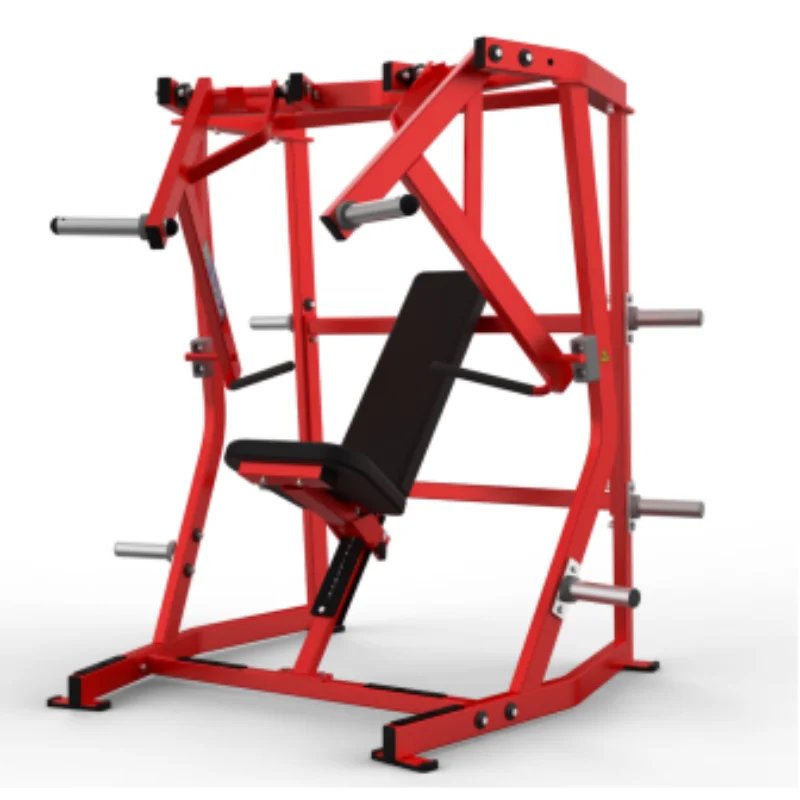
![OS-H5081 Commercial Half Rack Steel Frame Gym Equipment for Professional Gym [WARN] draft identifier mismatch](https://bicksport.com/wp-content/uploads/2026/08/os-h5081-commercial-half-rack-steel-frame-gym-equipment-for-professional-gym-warn-draft-identifier-mismatch-46a436.webp)
Whisper-Quiet Engineering — Manual resistance eliminates motor noise entirely, delivering a true zero-decibel mechanical training platform for multi-story facilities.
Technical Specifications
| Parameter | Value |
|---|---|
| Designation | os-h5081 |
| Product Type | Half Rack |
| Material | Steel |
| Product Dimensions | 1434×1675×2296mm |
| Net Weight | 152kg |
| Max User Weight | 180kg |
| Resistance Type | Manual |
| Power Source | Manual |
| Foldable | Unfolded |
| Certification | ISO 9001, CE |
| OEM/ODM | Available |
Application Suitability
| Deployment Scenario | Typical Use |
|---|---|
| Chain gym free-weight zone | Compound lifts, rack pulls, and functional barbell work under high-frequency member rotation |
| Corporate wellness room | Supervised strength sessions with compact footprint fitting limited square footage |
| Community fitness center | Open-access strength training with durable steel construction handling daily public use |
| Sports performance training center | Athlete testing and periodized loading in dedicated strength rooms |
| Hotel fitness center on guest room floors | Low-noise manual resistance avoiding vibration transfer to occupied rooms below |
Why Steel Frame Rigidity Dictates Noise Transfer Through the Floor Slab
Heavier gauge steel with full-perimeter welding absorbs barbell impact energy before it reaches the subfloor.
When a loaded barbell drops onto safety arms, the kinetic energy has to go somewhere. Lighter frames flex and transmit that impulse through the feet into the concrete or timber deck, creating low-frequency thuds that travel vertically through building structures [NEED_CITE: vibration transmission paths in multi-story fitness facilities]. I have inspected hotel fitness rooms on upper floors where members could feel each repetition through the ceiling below. A 152kg commercial half rack steel frame gym equipment unit with reinforced steel construction spreads that load across a wider base, reducing point-load transfer. The manual resistance design also removes motor vibration entirely, meaning the only acoustic event during use is plate contact with steel — a sound that stays contained within the weight room footprint rather than humming through HVAC ducts.
Positioning This Unit Within the Free-Weight Training Zone
The os-h5081 covers the core compound movement patterns — squats, presses, rack pulls, and rack-mounted accessory work — occupying the middle ground between a full power cage and a standalone squat stand. In a commercial strength zone, it pairs naturally with flat and adjustable benches, platform-mounted Olympic lifting stations, and plate-loaded machines to create a complete training circuit. Its 1434×1675mm footprint allows two units to face each other across a shared loading aisle without blocking member circulation paths. The 180kg maximum user weight rating accommodates the vast majority of commercial gym members, from general-fitness participants loading moderate weights to experienced lifters moving serious tonnage. This commercial half rack steel frame gym equipment serves as the anchor station where members spend the longest continuous time blocks in any free-weight area.
Continuous Deployment and Floor-Level Noise Considerations
A half rack in a commercial facility sees repetitive loading and unloading cycles throughout operating hours, often exceeding ten hours of daily use. Because this unit relies on manual resistance with no motor or electronic components, the mechanical duty cycle is effectively unlimited — there are no thermal limits, no cool-down intervals, and no electronic failure points to manage [NEED_CITE: continuous duty classification standards for manual resistance gym equipment]. The critical deployment variable becomes structural: which floor, what subfloor composition, and whether adjacent rooms house noise-sensitive functions such as hotel guest rooms, spa treatment areas, or conference spaces. On upper floors, anti-vibration mats beneath the 1434×1675mm base footprint become essential rather than optional, decoupling steel frame contact from the deck surface. Ground-level installations on poured concrete slabs present fewer constraints, though level flooring remains important to prevent frame racking under asymmetric loads.
Reading the Frame Gauge and Weld Pattern Specifications
The os-h5081 is constructed from steel with a 152kg net weight, a figure that directly reflects the material volume in the uprights, cross-members, and base frame. Heavier net weight in a half rack generally correlates with thicker wall thickness in the steel tubing, which resists lateral deflection when a barbell is racked off-center or when a member performs dynamic movements like kipping pull-ups on the top crossbar. The full-perimeter weld pattern at every joint intersection determines whether the frame behaves as a single rigid body or as a collection of loosely connected segments that can develop play over thousands of loading cycles. Manual resistance operation means the frame absorbs all training forces — there is no belt drive, no magnetic brake, and no electronic governor to smooth the load path. Every Newton of force the athlete generates transfers directly through the barbell, the safety arms, and the uprights into the floor, making structural integrity the single most important specification on the data sheet.
The Hidden Cost of Underspecifying Frame Mass
Facilities that select lighter half racks based on lower unit cost often face a predictable sequence of operational problems. Frame flex under heavy loading creates audible creaking that disturbs adjacent training zones and spa areas. Upright deflection causes J-cup alignment drift, making barbell re-racking imprecise and potentially unsafe during solo training sessions [NEED_CITE: structural fatigue patterns in undersized commercial strength equipment]. Over months of high-frequency use, bolted connections in lighter frames loosen progressively, requiring maintenance staff to schedule regular torque-check rounds that consume labor hours. In hotel deployments, the vibration signature of an undersized rack transmitted through floor structures has triggered guest complaints that lead to entire free-weight zones being relocated to basement levels — a capital project far exceeding the original equipment savings.
Why This Product Line Addresses Those Failure Modes
The os-h5081 is engineered around a 152kg all-steel frame tested for continuous commercial loading cycles, with manufacturing backed by ISO 9001 process controls across a vertically integrated facility. The manual resistance architecture eliminates every electrical failure point — no motor bearings to replace, no console boards to troubleshoot, no firmware updates to schedule — which directly reduces lifetime maintenance cost in unattended or semi-attended deployment scenarios. OEM and ODM customization extends to frame color, logo placement, and attachment configuration, allowing gym chains to maintain visual branding across multiple locations from a single sourcing line. The 3D layout service maps this 1434×1675mm footprint against adjacent equipment spacing, member flow corridors, and overhead clearance for pull-up and press movements, ensuring the commercial half rack steel frame gym equipment lands in a position that supports both training function and operational safety. Technical support covers commissioning and spare parts availability on a 24/7 basis.
Documentation & Test Records
- CE declaration of conformity for strength equipment safety compliance
- EN 957 test report covering static and dynamic load verification
- ISO 9001 certificate for manufacturing quality management systems
- Structural load test record documenting maximum static and dynamic capacity
- Dimensional inspection report confirming frame tolerances and attachment compatibility
- OEM customization specification sheet for color, logo, and accessory configuration
Installation, Commissioning & Maintenance
- Maintain minimum 600mm clearance on all sides of the 1434×1675mm base for safe loading and member passage
- Install on verified level flooring with anti-vibration mats to decouple frame contact from subfloor
- Anchor base feet to floor slab using manufacturer-specified hardware to prevent lateral migration
- Inspect all bolted connections and safety arm locking pins during initial commissioning and monthly thereafter
- Wipe down steel surfaces daily with pH-neutral cleaner to prevent sweat corrosion on welded joints
- Verify J-cup and safety arm alignment quarterly to ensure consistent barbell seating geometry
Planning Your Strength Zone Layout and Equipment Specification
Share your free-weight zone floor plan and expected daily member volume to receive a 3D layout mapping the os-h5081 footprint against barbell storage, bench placement, and member circulation paths. Specify the deployment floor level and adjacent room functions so noise transfer requirements can be matched to appropriate vibration isolation solutions. Confirm your target market voltage standards if the rack will be installed alongside electronic cardio equipment requiring dedicated circuits. Indicate whether OEM branding, custom color, or specific attachment configuration is needed so customization scope is defined before production begins.
Frequently Asked Questions
Q: What are the space and functional differences between a half rack and a full power cage?
A: A half rack like the os-h5081 provides uprights and safety arms for barbell training while leaving the front open, requiring less depth than an enclosed cage. This suits facilities where floor area is limited and visual openness matters for member engagement. Full cages offer overhead pull-up bars and more attachment points but demand a larger footprint and can feel enclosed in compact training zones.
Q: How does steel frame thickness affect training stability under heavy loads?
A: Thicker steel tubing in the uprights and cross-members resists lateral flex when a loaded barbell is racked asymmetrically or when dynamic movements generate side forces. The 152kg net weight of this unit reflects substantial material volume distributed through the frame structure, reducing perceptible sway and maintaining J-cup alignment even under maximum user weight conditions.
Q: How do manual resistance half racks compare to motorized equipment in long-term maintenance?
A: Manual resistance systems contain no motors, circuit boards, or electronic sensors, eliminating the primary failure points found in powered equipment. Maintenance reduces to periodic bolt torque checks and surface cleaning rather than motor bearing replacement, firmware updates, or console repair. This makes manual half racks well-suited for facilities with limited on-site technical staff.
Q: How should a free-weight zone be laid out to prevent traffic conflicts and safety hazards?
A: Position half racks along perimeter walls with barbell storage immediately adjacent to minimize carrying distances across active training lanes. Maintain clear sightlines between rack stations so members loading plates can see approaching traffic. The 3D layout service maps these spatial relationships against your specific room dimensions and member volume projections.
Q: What customization options are available and what minimum order quantities apply?
A: OEM and ODM customization covers frame color, logo application, and attachment configuration such as specialty J-cups or pull-up bar geometry. Minimum order quantities are flexible and determined during the quotation phase based on customization scope. Specify your branding requirements during the inquiry stage so tooling and lead time can be confirmed before production.

![China Commercial ISO-Lateral Kneeling Leg Curl Equipment H5028 [WARN] draft identifier mismatch](https://bicksport.com/wp-content/uploads/2026/08/china-commercial-iso-lateral-kneeling-leg-curl-equipment-h5028-warn-draft-identifier-mismatch-19d309.webp)