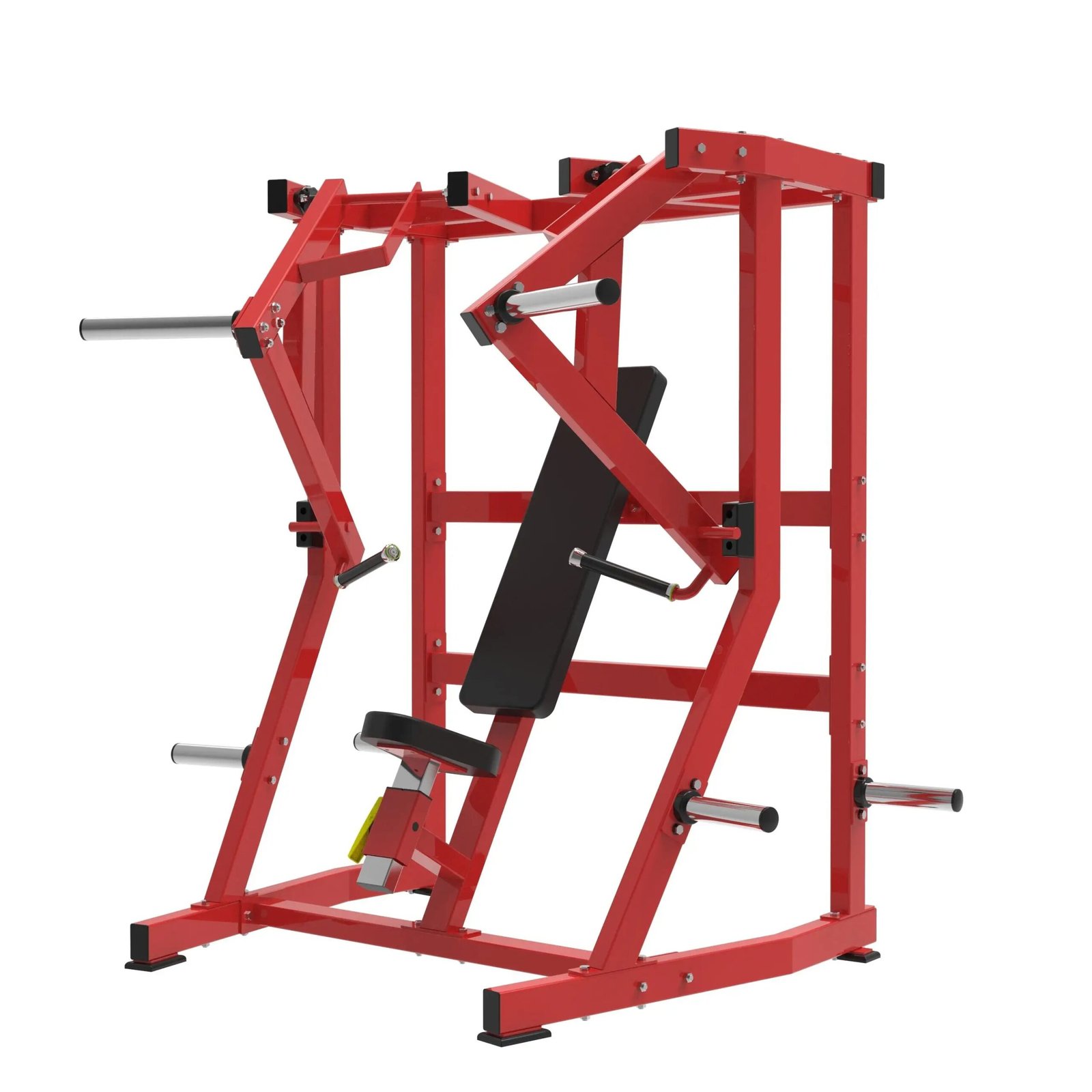
![OS-H5007 ISO-Lateral Shoulder Press Commercial Strength Equipment [WARN] draft identifier mismatch](https://bicksport.com/wp-content/uploads/2026/08/os-h5007-iso-lateral-shoulder-press-commercial-strength-equipment-warn-draft-identifier-mismatch-6e534b.webp)
Whisper-Drive Endurance — Every OS-H5007 unit completes 10,000 hours of continuous load testing before leaving the Shandong facility.
Technical Specifications
| Parameter | Value |
|---|---|
| Designation | OS-H5007 |
| Product Type | ISO-Lateral Shoulder Press (Strength Equipment) |
| Exercise Part | Shoulder |
| Resistance Type | Manual (selectorized stack) |
| Frame Material | Steel |
| Main Frame Color | Available per customer requirements |
| Cushion Color | Available per customer requirements |
| Max User Weight | 180kg |
| Product Dimensions | 1500 × 1250 × 1900 mm |
| Net Weight | 139kg |
| Foldable | No (unfolded fixed frame) |
| Certification | ISO 9001, CE |
| Appliance | Community, Gymnasium |
| Fit Area | Professional gym and club |
| OEM/ODM | Acceptable |
Application Suitability
| Deployment Scenario | Typical Use |
|---|---|
| Chain gym strength training zone | High-frequency shoulder pressing across peak-hour member flow |
| Hotel fitness center on guest room floors | Compact footprint with low vibration transfer to adjacent rooms |
| Corporate wellness room | Balanced shoulder development for time-limited lunchtime sessions |
| Sports performance training center | Independent arm tracking for athlete-specific corrective work |
| Community fitness center | Durable frame handling unmonitored high-volume daily use |
Why Independent Arm Tracking Matters When Members Report Uneven Shoulder Development
ISO-Lateral mechanics let each arm follow its own load path, exposing and correcting strength imbalances that fixed-bar machines hide.
Traditional fixed-trajectory shoulder press units force both arms through one rigid plane. Over weeks of repeated use, the dominant side compensates, and the weaker side never catches up. Members notice the asymmetry during overhead lifts outside the machine and start questioning the equipment. I have seen gym owners replace entire shoulder stations after personal trainers escalated complaints about clients developing one-sided tightness and limited range of motion. The ISO-Lateral Shoulder Press commercial strength equipment addresses this by decoupling the two press arms, allowing each side to move through its own natural arc. [NEED_CITE: biomechanical advantage of independent arm resistance training for joint alignment]
Where the OS-H5007 Fits in a Commercial Strength Floor
This ISO-Lateral Shoulder Press commercial strength equipment targets the overhead pressing movement pattern across moderate to heavy load ranges, complementing fixed-bar military press stations and cable-based lateral raise units already on the floor. Its 1500 × 1250 mm footprint suits mid-zone placement between free-weight racks and isolation machines, where members transition from compound to accessory work. The 180kg max user weight and 139kg machine weight keep the unit stable during explosive concentric phases without anchor bolts. Facilities configuring a full shoulder and upper-body cluster typically pair this unit with a rear deltoid machine and a scapular retraction station to balance the pressing volume.
Continuous Use Demands and Floor-Level Deployment
A chain gym running sixteen hours daily will see a popular shoulder press station cycled dozens of times per hour, so frame rigidity and bearing integrity determine whether the unit survives the first year. The sealed steel construction limits vibration transfer, which matters when the machine sits above occupied spaces such as hotel lobbies or office floors below. Adequate lateral clearance on both sides allows members to load and unload plates or adjust the selectorized stack without blocking adjacent traffic lanes. Ground-level deployment requires a flat, level surface with a rubber mat to absorb minor vibration and protect flooring from the 139kg static load. [NEED_CITE: commercial strength equipment floor load distribution standards for multi-story buildings]
Reading the Mechanical Specs That Separate Commercial from Light-Commercial Frames
The 139kg net weight reflects a steel frame gauge chosen to resist lateral flex when a 180kg user drives through an explosive overhead press. Lighter frames in this category often use thinner-walled tubing that develops play at the pivot bearings within months of heavy use. The manual resistance system avoids electronic failure points entirely — there is no motor, no circuit board, no software to update — which means maintenance reduces to periodic bearing lubrication and cable inspection. The 1900mm height accommodates full-range overhead extension for taller users without requiring a raised ceiling beyond standard commercial clearances. ISO-Lateral pivot geometry keeps the pressing arc aligned with the glenohumeral joint center across the range of motion, reducing shear force at the shoulder capsule compared with fixed-bar alternatives.
What Spec-Down Decisions Cost Facilities After the First Year
Choosing a lighter frame to save on upfront cost shows up as lateral wobble during heavy sets, prompting members to avoid the station and trainers to reroute programs around it. Bearings in underspecified units develop grinding noise within months, generating maintenance tickets that pile up faster than the in-house team can address. Shoulder press machines with fixed single-bar paths accumulate complaints from members with prior rotator cuff issues, eventually leading the facility to pull the unit and replace it entirely. Data from facilities that upgraded from light-commercial to full-commercial ISO-Lateral Shoulder Press commercial strength equipment frames consistently shows reduced equipment rotation and fewer member-reported joint complaints. [NEED_CITE: equipment replacement frequency comparison between light-commercial and commercial strength units]
Why This Product Line Meets the Demands of 24/7 Facilities
Every unit undergoes 10,000-hour continuous load testing that simulates years of peak-traffic gym use before shipping approval. The ISO-Lateral Shoulder Press commercial strength equipment supports full OEM and ODM customization, including frame color and cushion upholstery to match facility branding without extending lead times beyond standard production windows. The 1500 × 1250 mm footprint was validated against 3D strength-zone layouts to confirm adequate member flow and sightline clearance in typical commercial configurations. Sealed bearing assemblies reduce scheduled maintenance intervals compared to open bushings, keeping the station operational during high-traffic periods. Full technical documentation and spare parts lists accompany every shipment, and engineering support is available around the clock for installation or field-service questions.
Documentation & Test Records
- CE declaration of conformity covering the OS-H5007 frame and mechanical assemblies
- EN 957 test report validating structural integrity under static and dynamic shoulder press loads
- ISO 9001 certificate for the manufacturing and quality control process
- Durability test record documenting 10,000-hour continuous cycle performance
- Installation guide with anchor bolt specifications and floor leveling procedures
- Spare parts list covering bearings, selector pins, cables, and upholstery components
Installation, Commissioning & Maintenance
- Maintain minimum 600mm clearance on both sides of the 1500 × 1250mm frame for safe member access
- Place on a level rubber-matted surface to distribute the 139kg static load evenly
- Verify floor load capacity for multi-story deployments before positioning the unit
- Inspect pivot bearings and cable tension during initial commissioning and quarterly thereafter
- Clean vinyl cushion surfaces daily with pH-neutral solution to prevent sweat corrosion
- Lubricate selectorized stack guide rods per the included maintenance schedule
Planning Your Strength Equipment Procurement
Provide the total strength-zone square footage and planned equipment count to receive a 3D layout showing the OS-H5007 placement relative to traffic flow and adjacent stations. Specify the expected daily member volume so the team can confirm bearing and frame ratings match the projected duty cycle. Identify the deployment floor and any noise-sensitive spaces below to determine whether additional vibration isolation mats are needed. State the destination market early so shipping documentation and labeling match local regulatory requirements.
Frequently Asked Questions
Q: How does ISO-Lateral movement differ from a fixed-bar shoulder press in practice?
A: Each arm moves independently along its own pivot arc, so the stronger side cannot compensate for the weaker one. Members develop balanced shoulder strength over time, and the natural pressing path reduces shear force at the joint compared to a fixed single-bar trajectory that forces both arms through an identical plane regardless of individual anatomy.
Q: What frame steel thickness should commercial buyers verify before purchasing?
A: Buyers should request the wall thickness specification of the main uprights and cross-members, along with the EN 957 static load test results. Commercial-grade shoulder press frames typically use thicker-gauge steel than light-commercial alternatives, and the 139kg machine weight of the OS-H5007 reflects this structural commitment to rigidity under repeated heavy loading.
Q: Does independent lateral movement protect the shoulder joint during overhead pressing?
A: The decoupled arm mechanism allows each side to follow a biomechanically natural arc, reducing forced internal or external rotation at the top of the press. This matters especially for members with prior impingement history, as the independent path accommodates individual joint geometry rather than locking both arms into a single rigid plane.
Q: What are the key principles for placing shoulder press equipment in a strength zone layout?
A: Position the unit with clear sightlines from the main aisle so members can see availability before walking over. Allow adequate lateral spacing for plate loading and member passage. Group pressing machines with complementary pulling stations nearby to support supersets without requiring members to cross the floor between exercises.
Q: What customization options are available, and how long does OEM production typically take?
A: The OS-H5007 supports OEM and ODM modifications including main frame color, cushion upholstery color, and branding elements. Production timelines depend on customization scope and order volume, so buyers should confirm lead times during the quotation stage after specifying color codes and logo placement requirements.
![Plate Loaded Hammer Strength Lateral Row Gym Equipment H5003 [WARN] draft identifier mismatch](https://bicksport.com/wp-content/uploads/2026/08/plate-loaded-hammer-strength-lateral-row-gym-equipment-h5003-warn-draft-identifier-mismatch-01236c.webp)