
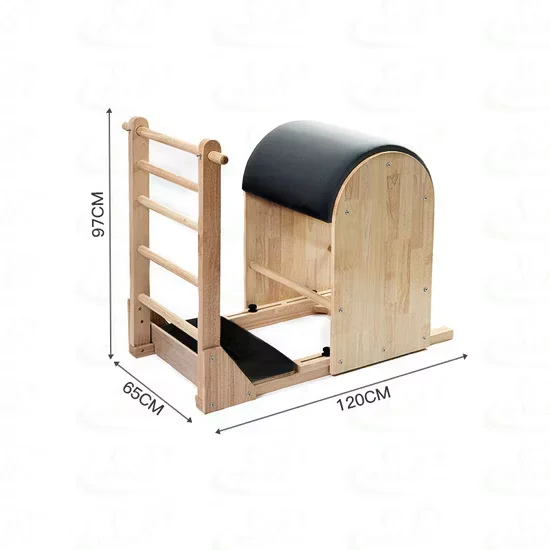
Acoustic Precision — Fixed-arc solid oak geometry eliminates mechanical wear points while delivering whisper-quiet structural performance across thousands of studio class cycles.
Technical Specifications
| Parameter | Value |
|---|---|
| Product Type | Pilates Ladder Barrel |
| Model | SRY-03 |
| Material | Oak Wood |
| Color | Solid Color |
| Specification | 1100×770×980mm |
| Net Weight | 50kgs |
| Maximum User Weight | 180kg |
| Age Group | Adult |
| Gender | Unisex |
| Logo | Customized Is Allowed |
| Warranty | 3 Years |
| Production Capacity | 800 Pieces/Month |
| Origin | China |
Application Suitability
| Deployment Scenario | Typical Use |
|---|---|
| Boutique Pilates and yoga studio | Full apparatus rooms running daily group and private reformer-barrel sequences |
| Professional Pilates training center | Instructor certification programs requiring repeated spinal articulation drills |
| Rehabilitation and physiotherapy facility | Guided flexibility and core stabilization protocols under clinical supervision |
| High-end home gym | Private wellness spaces demanding premium wood finish and zero mechanical maintenance |
| Corporate wellness room | Compact stretching stations for employees between meetings |
Why Composite Barrel Frames Fail Before the Lease Ends
Solid oak eliminates the delamination cycle that plagues high-traffic studios.
Laminated and composite wood ladder barrels look pristine on day one, but daily class rotations expose every glued seam to humidity swings, sweat absorption, and repetitive loading. Within months, rungs loosen, veneer chips, and surface splinters generate member complaints that studio managers trace back to equipment selection [NEED_CITE: wood composite delamination failure rate in commercial fitness environments]. I have walked into studios where the barrel lineup was replaced twice in a single lease term — not because the training methodology changed, but because the material specification never matched the duty cycle. The oak wood Pilates ladder barrel commercial studio buyers choose must survive thousands of articulation sequences without structural degradation or cosmetic failure that drives member attrition.
Where This Barrel Sits in the Studio Apparatus Layout
The SRY-03 occupies the flexibility and spinal articulation station in a full apparatus room, complementing reformers and Cadillac units that handle resisted movement patterns. Its fixed-arc geometry targets extension, flexion, and lateral bending sequences across beginner through advanced class tiers. The 1100×770×980mm footprint slots between reformer rails and wall-mounted tower units without crowding member flow paths. Maximum user weight of 180kg and a 50kg net mass keep the barrel stable during dynamic stretch sequences without requiring floor anchoring. Studios deploying the oak wood Pilates ladder barrel commercial studio planners specify typically allocate one barrel per three reformers to maintain class rotation efficiency.
Continuous Class Cycles and Studio Environment Demands
A barrel in a busy studio endures eight to twelve class sessions daily, with each session loading the arc frame and rung joints through full body-weight articulation sequences. Unlike motorized cardio equipment, the failure mode here is not thermal but structural — humidity fluctuation from adjacent showers, HVAC cycling, and member perspiration all drive wood moisture content changes that test every joint [NEED_CITE: wood moisture equilibrium requirements for fitness equipment in climate-controlled studios]. The solid oak construction resists these cycles without the adhesive breakdown that compromises laminated alternatives. Floor leveling matters: an uneven base concentrates load on two of the four contact points, accelerating joint fatigue. Studios planning deployment should confirm subfloor flatness and allow expansion clearance around the unit perimeter. No electrical supply or data interface is required, which simplifies placement but means usage tracking depends on instructor class logs rather than automated console data.
Fixed-Arc Geometry and Material Specification Breakdown
The fixed-arc design removes every moving part — no hinges, no adjustment pins, no sliding rails — which eliminates the maintenance calendar entirely. Solid oak delivers consistent grain density across the arc frame, meaning load distribution during spinal extension remains predictable across the equipment service life. Rung spacing follows ergonomic grip dimensions calibrated for adult hand sizes, supporting both passive hanging stretches and active pull-through articulation sequences. The 50kg net weight provides sufficient mass to resist tipping during dynamic use without making repositioning impossible during studio floor plan adjustments. Kiln-dried oak stock minimizes post-manufacturing warping that could alter the arc curvature over time [NEED_CITE: kiln-drying moisture content standards for structural hardwood in fitness applications]. Custom color finishes and logo applications are completed at the factory, so branding alignment does not require third-party refinishing that might compromise the wood sealant layer.
What Spec Compromise Actually Costs a Studio
Choosing a barrel built from laminated particleboard or veneer-wrapped MDF saves on the initial invoice but creates a replacement cycle that disrupts class scheduling and erodes member confidence. Loose rungs become a safety liability during advanced extension sequences. Surface splintering generates complaints that receptionists log but maintenance schedules never catch up with [NEED_CITE: member attrition correlation with visible equipment degradation in boutique fitness studios]. Studios that standardize on solid oak across their barrel lineup avoid the scenario where one unit is pulled from rotation every quarter for re-gluing or sanding, which quietly shrinks available apparatus count and forces class size reductions.
Why This Product Line Holds Up Under Studio Duty Cycles
Every SRY-03 barrel undergoes load-bearing verification at the arc frame and rung attachment points before leaving the factory, confirming structural performance under repetitive commercial loading. The 10,000-hour durability testing protocol applied across our cardio range informs the joint construction standards we carry into wood apparatus — mortise-and-tenon joinery replaces adhesive-only methods that fail under cyclic stress. OEM customization covers logo engraving, color matching, and finish specification so the barrel aligns with studio interior design without post-delivery modification. Our 3D layout service maps barrel placement alongside reformers and towers, accounting for member flow sightlines and instructor positioning during group classes. The three-year warranty reflects confidence in material and joint longevity under continuous studio operation. Full documentation accompanies each unit so facility operators have traceable quality records from day one.
Documentation & Test Records
- CE declaration of conformity for Pilates apparatus structural safety
- EN 957 test report covering load-bearing and stability requirements
- ISO 9001 certificate for manufacturing quality management systems
- Wood material treatment and kiln-drying process documentation
- Load-bearing test record for arc frame and rung joints
- OEM customization specification sheet for logo and finish
Installation, Commissioning & Maintenance
- Confirm subfloor flatness within tolerance across the 1100×770mm footprint before placement
- Allow perimeter expansion clearance for oak humidity response in climate-controlled studio spaces
- Inspect all rung joints upon delivery and retighten any fasteners loosened during transit vibration
- Apply recommended wood sealant to high-contact surfaces on a schedule matching studio humidity levels
- Wipe down oak surfaces with pH-neutral cleaner after each class session to prevent sweat absorption
- Reposition barrel periodically to distribute floor contact wear evenly across all base points
Planning Your Studio Apparatus Procurement
Provide your studio floor plan with apparatus count and class rotation volume so we can generate a 3D layout showing barrel placement relative to reformers, towers, and member circulation paths. Specify your climate control parameters so wood moisture equilibrium recommendations align with your HVAC profile. Confirm target market requirements for material certification and finish standards. Indicate whether logo engraving or custom color matching is needed so OEM scoping integrates with your production lead time.
Frequently Asked Questions
Q: Is solid oak necessary for daily studio class use, or does laminated wood perform equally?
A: Laminated wood ladder barrels rely on adhesive bonds between veneer layers that degrade under repeated humidity fluctuation and mechanical loading. Solid oak maintains structural grain continuity throughout the arc frame, resisting delamination and rung loosening across thousands of class cycles. Studios running multiple daily sessions find solid oak eliminates the mid-service replacement cycle that laminated alternatives impose, reducing total equipment cost over a typical lease term.
Q: How should a wood Pilates ladder barrel be maintained over its service life?
A: Regular maintenance involves wiping oak surfaces with pH-neutral cleaner after class sessions to remove perspiration residue that accelerates moisture absorption. Periodic inspection of rung joints catches any loosening before it becomes a safety concern. Reapplication of wood sealant on high-contact arc surfaces should follow a schedule matched to studio humidity levels. Kiln-dried oak requires minimal dimensional maintenance when kept within stable climate parameters.
Q: What customization options exist for studio branding and color matching?
A: Factory-applied customization includes logo engraving or printing on the arc frame, custom color finishes matched to studio interior palettes, and selectable sealant sheen levels from matte to satin. All finishes are applied before shipment, eliminating the need for third-party refinishing that might compromise the protective sealant layer. OEM scoping confirms exact color codes and logo placement during the quotation phase.
Q: What service life can a studio expect from a solid oak ladder barrel under commercial use?
A: Service life depends on class volume, member weight distribution, and climate stability, but solid oak construction with mortise-and-tenon joinery supports continuous daily class rotation well beyond the typical studio lease term. The three-year warranty covers structural defects in the arc frame and rung attachments. Studios maintaining stable humidity and following the sealant reapplication schedule report barrel performance remaining consistent across many years of operation.


![Pilates Reformer Core Training Bed Foldable Home Gym SRY-20B [WARN] draft identifier mismatch](https://bicksport.com/wp-content/uploads/2026/08/pilates-reformer-core-training-bed-foldable-home-gym-sry-20b-warn-draft-identifier-mismatch-715544.webp)