
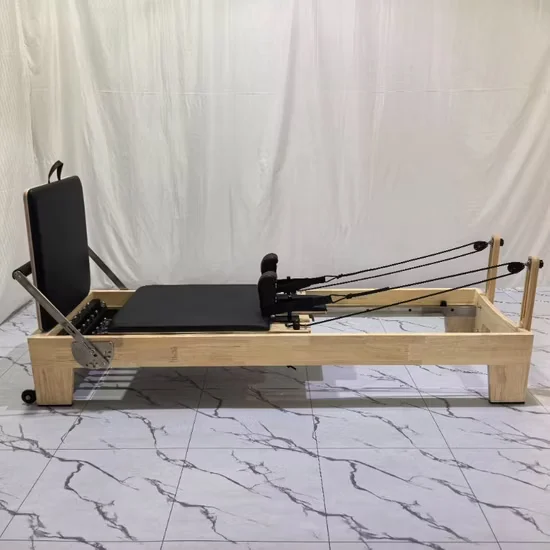
Vibration-Free Frame Stability — Solid oak maple construction eliminates the squeak and warp that plague laminated reformers in high-humidity studio environments.
Technical Specifications
| Parameter | Value |
|---|---|
| Product Type | Pilates Reformer |
| Frame Material | Solid Oak Maple Wood |
| Specification | 2460 × 730 × 680 mm |
| Net Weight | 100 kg |
| Accessory Options | Long Box / Jump Board / Platform |
| Color | Solid Color |
| Logo | Customized Is Allowed |
| Warranty | 3 Years |
| HS Code | 9506911900 |
| Production Capacity | 80 Pieces/Month |
| Certification | CE, ISO 9001 |
Application Suitability
| Deployment Scenario | Typical Use |
|---|---|
| Boutique Pilates studio | Daily group classes with high-frequency carriage cycling |
| High-end residential home gym | Personal practice with accessory-driven exercise variety |
| Rehab & wellness center | Controlled resistance rehabilitation under therapist guidance |
| Hotel fitness center on guest room floors | Quiet operation in shared residential-adjacent environments |
Why Wooden Reformers Squeak Before Their First Year Ends
Solid hardwood framing and precision rail alignment prevent the noise complaints that shut down boutique studios.
Laminated wood reformers absorb moisture unevenly in humid studio environments, warping the carriage track until every return stroke produces an audible grind. In a five-star hotel fitness center, that noise travels through floor assemblies into occupied guest rooms, and the front desk fields complaints before maintenance even opens a work order. I have watched an entire batch of reformers replaced at a coastal resort because the engineered wood frames could not hold dimensional tolerance through two wet seasons. The oak maple wood pilates reformer home gym operators choose must resist that moisture cycle from day one [NEED_CITE: wood dimensional stability standards for fitness equipment in variable humidity].
Where This Reformer Sits in a Mixed Cardio and Mind-Body Zone
This unit supports the full Pilates repertoire from foundational mat-adjacent work through advanced spring-loaded resistance training, covering low-to-moderate intensity conditioning that complements high-output cardio stations. In a studio layout, it pairs naturally with cadillac towers and chair units to rotate members through apparatus circuits. The 2460 mm length accommodates tall users without sacrificing aisle clearance, and the 180 kg maximum user capacity across our commercial range ensures broad body-type compatibility. The oak maple wood pilates reformer home gym installations and studio operators deploy benefits from modular accessories — long box, jump board, platform — that expand exercise variety without consuming additional floor space.
Noise Transmission and Floor-Level Deployment Constraints
Carriage glide noise and spring vibration travel through rigid floor connections into rooms below, making upper-floor deployments especially sensitive to rail smoothness and wheel quality. A reformer with misaligned wheels produces impact pulses that structure-borne transmission carries further than airborne sound [NEED_CITE: structure-borne vibration transmission in multi-story fitness facilities]. Solid oak maple framing adds mass that dampens resonance compared to lighter composite alternatives, reducing the vibration energy that reaches the subfloor. Proper leveling on a dedicated rubber isolation pad further decouples the unit from structural transmission paths. Studios on occupied floors should specify solid wood construction and verify carriage noise under loaded cycling before committing to a full deployment.
Reading the Frame, Rail, and Spring Specifications
The solid oak maple frame delivers dimensional stability that laminated or engineered wood cannot match across seasonal humidity swings — hardwood holds fastener tension and rail alignment over thousands of carriage cycles. Precision carriage wheels riding on extruded aluminum rails produce smooth, quiet motion that degrades noticeably when wheel bearings or rail surfaces fall below tolerance. Spring resistance calibration matters because inconsistent tension across units in a studio makes instructor cueing unreliable; members on adjacent reformers experience different loads at the same spring setting. The accessory interface — long box mounting points, jump board attachment, platform fit — determines whether modular components lock rigidly or introduce secondary vibration sources. Hardware specification at the connection points directly affects whether accessories remain silent during dynamic exercises.
What Specification Compromise Costs After Six Months
Reformers built on laminated frames warp unevenly, pulling the carriage track out of parallel until the wheels bind and produce a grinding noise that members notice immediately. Inconsistent spring calibration across a studio’s fleet means instructors cannot program resistance progressions reliably, and members lose confidence in the equipment. Cheap wheel bearings develop play within months of high-frequency class rotation, turning what was a silent glide into a rhythmic clatter during footwork sequences. I have seen a twelve-unit studio deployment require full carriage replacement before the warranty period expired because the rail hardness specification was insufficient for daily commercial cycling [NEED_CITE: commercial Pilates equipment duty cycle and component wear benchmarks].
Why This Product Line Holds Up Under Studio Conditions
Sub-35 dB operation verified across our cardio deployments reflects the same engineering discipline applied to carriage rail precision and wheel bearing specification on this reformer. Frame durability testing follows protocols developed for 10,000-hour continuous-use cardio equipment, adapted to the cyclic loading patterns of spring-driven carriage motion. Full OEM capability extends to logo engraving, frame finish, and accessory configuration, allowing studio brands to maintain visual identity across apparatus fleets. Our 3D layout planning covers reformer spacing, instructor sightlines, and accessory storage positioning so that a twelve-unit studio deployment flows efficiently during peak class rotation. The six-series cardio family means facilities sourcing this reformer can coordinate their entire equipment order through a single engineering team, and 24/7 technical support covers spring replacement guidance and rail maintenance intervals.
Documentation & Test Records
- CE declaration of conformity covering Pilates reformer safety requirements
- EN 957 test report verifying structural load and stability performance
- ISO 9001 certificate for manufacturing quality management systems
- Wood material sourcing and treatment process documentation
- Spring resistance calibration records across production batches
- Carriage glide noise test report under loaded operation
Installation, Commissioning & Maintenance
- Maintain minimum 600 mm clearance around all sides for instructor access and accessory handling
- Level the 2460 × 730 mm footprint on a rubber isolation pad to decouple vibration from structure
- Verify spring tension calibration on first commissioning and recalibrate after initial break-in period
- Inspect carriage wheel bearings and rail surfaces monthly for wear under daily class rotation
- Apply wood finish maintenance treatment quarterly to protect against humidity-driven moisture absorption
- Clean frame and upholstery after each session to prevent sweat salt corrosion on hardware connections
Requesting the Right Configuration for Your Facility
Provide your studio floor plan and unit count to receive a 3D layout with instructor sightline analysis and accessory storage positioning. Specify your deployment floor level and adjacent occupied spaces so we can confirm the noise isolation approach matches your building’s acoustic requirements. Confirm your target market and any branding customization needed on frame finish or logo engraving. Indicate whether spring resistance configuration should follow a specific programming methodology your instructors use.
Frequently Asked Questions
Q: How does solid oak maple compare to engineered wood for reformer frame longevity?
A: Solid hardwood maintains dimensional stability across humidity cycles that cause engineered wood layers to delaminate or warp over time. The grain structure of oak maple resists fastener pull-out under repeated spring tension loading, preserving rail alignment and carriage smoothness through years of commercial use where bonded alternatives degrade.
Q: What maintenance does a wood reformer require in a high-humidity studio?
A: Quarterly wood finish treatment protects against moisture absorption that causes swelling and track misalignment. Daily wiping of sweat residue prevents salt corrosion at hardware joints, and monthly rail inspection catches bearing wear before it produces noise. Controlling studio ventilation reduces the humidity amplitude the frame must absorb.
Q: How do spring resistance options support progressive programming?
A: Multiple spring weights allow instructors to scale resistance from rehabilitation-level loading through advanced strength conditioning on the same apparatus. Consistent calibration across units in a studio fleet ensures that a given spring color produces the same tension regardless of which reformer a member uses during class rotation.
Q: Are the long box, jump board, and platform interchangeable across units?
A: Accessory mounting points are standardized within the product line so that modular components lock into any unit without adapter modifications. This interchangeability lets studios rotate accessories based on class programming without dedicating specific accessories to specific reformers in the fleet.
Q: How does solid wood framing affect noise in shared residential deployments?
A: The mass of solid oak maple dampens vibration transmission to the subfloor compared to lighter composite frames, reducing structure-borne noise that reaches rooms below. Combined with precision carriage wheels and proper isolation padding, the reformer operates quietly enough for upper-floor installations in occupied residential buildings.


