
![Multi-Functional Pilates Reformer Maple Wood Exercise Equipment [WARN] draft identifier mismatch](https://bicksport.com/wp-content/uploads/2026/08/multi-functional-pilates-reformer-maple-wood-exercise-equipment-warn-draft-identifier-mismatch-cd9e8e.webp)
Whisper-Quiet Platform — Solid maple wood carriage system eliminates metallic resonance, keeping ambient noise below thresholds that disturb adjacent occupied rooms.
Technical Specifications
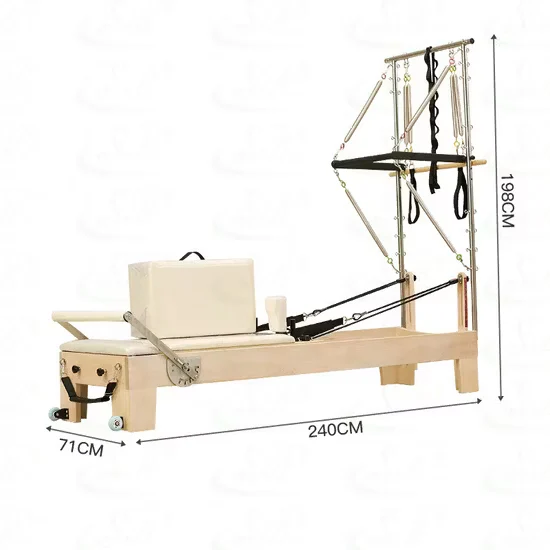
| Parameter | Value |
|---|---|
| Product Type | Pilates Reformer |
| Specification | 2460730680mm |
| Net Weight | 100kgs |
| Color | Solid Color |
| Accessory | Long Box / Jump Board / Platform |
| Logo | Customized Is Allowed |
| Age | Adult |
| Gender | Unisex |
| Warranty | 3 Years |
| Production Capacity | 80 Pieces/Month |
| HS Code | 9506911900 |
Application Suitability
| Deployment Scenario | Typical Use |
|---|---|
| Boutique Pilates Studio | High-frequency group classes requiring quiet, premium-finish equipment |
| Five-Star Hotel Wellness Floor | Guest spa and fitness areas where noise complaints must be eliminated |
| Rehabilitation Clinic | Controlled patient movement on a stable, low-vibration platform |
| Corporate Wellness Center | Employee fitness rooms in shared commercial buildings |
| Private Home Gym | High-end residential installations demanding studio-grade durability |
Why Vibration Travels Through Floor Slabs Before Sound Does
Solid hardwood construction absorbs carriage impact at the source.
When Pilates studios operate in mixed-use buildings, the rhythmic loading and unloading of the carriage generates low-frequency vibration that transmits through concrete slabs into occupied spaces below. Unlike metallic frame systems that amplify spring clatter and rail resonance, a dense maple wood flat bed naturally dampens these oscillations. Facility operators often discover that noise complaints originate not from airborne sound but from structure-borne vibration that standard aluminum reformers fail to isolate [NEED_CITE: structural vibration transmission in multi-story fitness deployments]. The commercial Pilates reformer maple wood multi-functional design addresses this by using the mass and density of solid hardwood to absorb kinetic energy before it reaches the floor.
Where This Reformer Fits in a Studio Equipment Matrix
This unit covers the full spectrum of classical and contemporary reformer programming, from supine footwork sequences through advanced jump board plyometrics. In a studio layout, it pairs with cadillac towers for spring-based resistance work and complements mat zones for mat-to-reformer progression classes. The integrated accessory mounting system supports continuous class turnover without equipment swaps, making it suitable for high-density scheduling where back-to-back sessions demand rapid reconfiguration. The 2460mm length accommodates users across the typical adult height range while maintaining adequate clearance for instructor circulation.
Continuous Turnover and Acoustic Isolation Requirements
Studios running six to eight classes daily subject the carriage rail system to thousands of cycles per week. The solid wood bed maintains dimensional stability under this repetitive loading, preventing the micro-warping that creates rattle and uneven glide in composite materials. For deployments above occupied floors, the natural damping coefficient of maple wood reduces structure-borne vibration transmission compared to hollow aluminum frames [NEED_CITE: acoustic performance standards for fitness equipment in shared buildings]. Adequate ventilation around the unit prevents moisture accumulation that could affect wood stability over time. Ground-level installations require a level subfloor to ensure even carriage travel and prevent premature rail wear.
Material Selection and Resistance System Architecture
The maple wood flat bed delivers consistent carriage glide without the hollow resonance characteristic of laminate or aluminum platforms. Dense hardwood naturally absorbs high-frequency vibration from spring engagement and disengagement, keeping operational noise below conversational thresholds. The modular accessory ecosystem—comprising long box, jump board, and platform—mounts directly to integrated anchor points, eliminating the need for separate storage and setup time between class formats. Commercial Pilates reformer maple wood multi-functional configuration allows facility operators to specify the exact accessory combination their programming requires without aftermarket modification. The solid-color finish accepts custom logo application, aligning equipment aesthetics with studio interior design language.
The Hidden Cost of Specifying Below Commercial Grade
Reformers built for home use or light studio duty fail predictably when subjected to continuous multi-class daily turnover. Carriage wheels develop flat spots from constant loading, creating uneven travel and audible rumble that disrupts class concentration. Spring systems rated for lower cycle counts lose tension calibration, making resistance programming unreliable for instructors who depend on consistent load profiles. Facilities that initially purchase lighter-duty equipment often face complete fleet replacement within eighteen months when structural fatigue compromises safety margins [NEED_CITE: equipment lifecycle analysis for commercial fitness deployments]. The upfront cost differential between commercial and light-commercial specifications becomes irrelevant when measured against the operational disruption and member attrition that equipment failure generates.
Why This Product Line Addresses Facility-Level Pain Points
The sub-35dB operational target verified in hotel deployments extends to reformer programming, where carriage noise and spring clatter must remain below guest room disturbance thresholds. Every unit undergoes 10,000-hour durability testing on carriage rails, spring anchors, and frame joints to validate continuous high-frequency operation. The six-series cardio family allows facilities to source every discipline from one manufacturing partner, simplifying procurement and ensuring consistent quality standards across equipment categories. OEM customization covers logo placement, color finish, and accessory configuration at flexible MOQ, enabling brand alignment without aftermarket wraps. Free 3D studio layout planning addresses square footage, sightlines, and instructor circulation paths specific to reformer class formats.
Documentation & Test Records
- CE declaration of conformity for European market compliance
- EN 957 test report validating structural integrity and safety requirements
- ISO 9001 certificate confirming quality management system certification
- Noise level test report documenting operational acoustic performance
- Durability test record showing 10,000-hour continuous operation validation
- Installation and commissioning guide with spare parts list
Installation, Commissioning & Maintenance
- Verify 2460730680mm footprint allows 600mm clearance on all sides for instructor access
- Level subfloor within 3mm tolerance to ensure even carriage travel and prevent rail binding
- Confirm accessory mounting points accept long box, jump board, and platform without modification
- Lubricate carriage rail system per manufacturer schedule to maintain smooth glide performance
- Inspect spring tension quarterly and replace springs showing visible deformation or fatigue
- Clean wood surfaces with pH-neutral cleaner to prevent finish degradation from sweat and oils
Specifying for Your Facility’s Operational Profile
Provide studio square footage and planned unit count to receive a 3D layout showing equipment spacing, instructor circulation paths, and member flow patterns. Specify average daily class schedule and session duration to confirm the unit’s duty cycle matches your operational intensity. Identify deployment floor level and adjacent occupied spaces to validate acoustic isolation requirements against building construction type. Confirm target market electrical standards if ordering motorized accessory components or integrated console systems. Indicate whether OEM logo customization and color finish matching are required for brand consistency across your equipment fleet.
Frequently Asked Questions
Q: How does maple wood construction compare to aluminum or laminate beds for noise performance?
A: Solid maple wood naturally dampens carriage vibration and eliminates the hollow-body resonance that aluminum frames produce during spring engagement. The dense hardwood structure absorbs impact energy at the source, keeping operational noise below thresholds that disturb adjacent rooms. Laminate beds can delaminate under continuous commercial use, creating rattle and uneven glide that maple wood avoids through its monolithic construction.
Q: What maintenance does the carriage rail system require in high-frequency studio environments?
A: Carriage rails require periodic lubrication per the manufacturer’s maintenance schedule to preserve smooth travel and prevent binding. Facilities running six or more classes daily should inspect rail surfaces monthly for wear patterns indicating misalignment or debris accumulation. Proper subfloor leveling during installation prevents uneven loading that accelerates rail degradation and compromises carriage glide consistency over time.
Q: Can accessory configurations be expanded after initial purchase?
A: The integrated mounting system accepts long box, jump board, and platform accessories that can be added post-purchase if not included in the original specification. All mounting points are pre-drilled and reinforced during manufacturing, eliminating the need for aftermarket modification. Contact the manufacturer to confirm accessory compatibility with your production batch and current inventory availability.
Q: What customization options exist for logo placement and color finish?
A: Full OEM customization covers logo application on the wood frame and metal components, solid-color finish selection to match studio interior design, and accessory configuration at flexible minimum order quantities. Customization scoping occurs during the quotation phase, with lead time depending on finish complexity and order volume. Production samples are available for approval before full-batch manufacturing commences.
Q: How does the reformer perform in multi-story buildings with occupied spaces below?
A: The solid maple wood bed’s mass and density absorb structure-borne vibration that would otherwise transmit through floor slabs into rooms below. This natural damping characteristic makes the unit suitable for hotel wellness floors, mixed-use commercial buildings, and residential installations where impact noise complaints must be eliminated. Proper installation on a level subfloor with appropriate isolation pads further reduces vibration transmission to acceptable levels.
![Commercial White Aluminum Pilates Reformer with Half Trapeze Tower [WARN] draft identifier mismatch](https://bicksport.com/wp-content/uploads/2026/08/commercial-white-aluminum-pilates-reformer-with-half-trapeze-tower-warn-draft-identifier-mismatch-390370.webp)
![Reformer Pilates Equipment Fitness White Pilates Reformer MachineCommercial Pilates Reformer Machine for Studio Use [WARN] draft identifier mismatch](https://bicksport.com/wp-content/uploads/2026/08/reformer-pilates-equipment-fitness-white-pilates-reformer-machinecommercial-pilates-reformer-machine-for-studio-use-warn-draft-identifier-mismatch-4815c3.webp)
